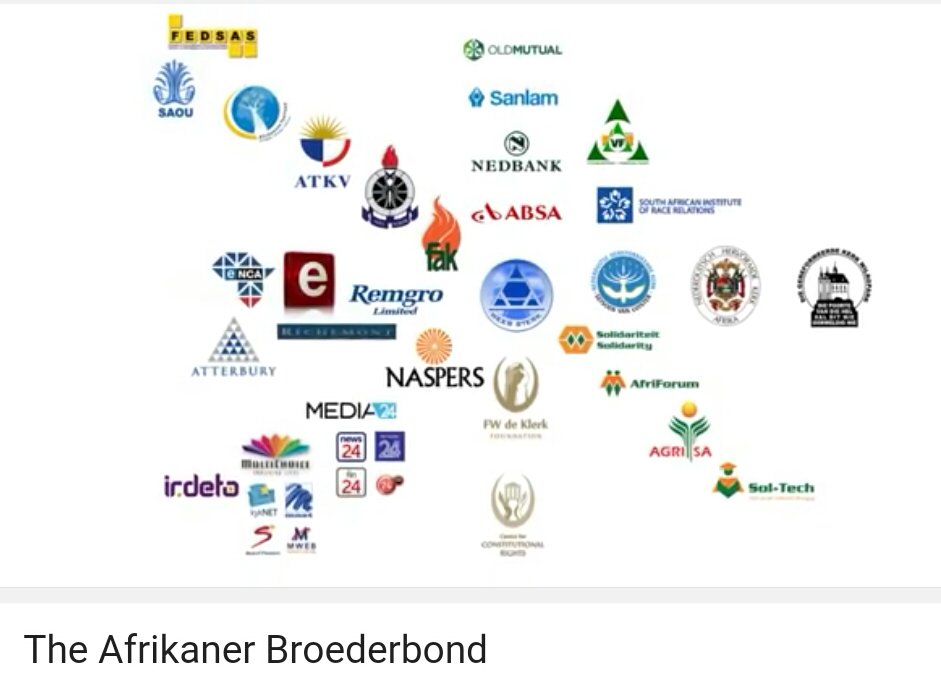
Everybody have choices today and even yesterday. But a men’s organisation do not have a mandate to negotiate such an important issue – what about us, the non-members, the people (Boere volk – there is no connection at all)? Do they really think they are a god’s organisation – perhaps for their own god? The Afrikanerbond members think they are part of the Boer people (volk) but they are not. They are today various fully multi-cultural organisations – while their website told they are only for the elite Afrikaners? Who are the people of any multi-cultural organisation? Only members (like a club).

*
Before 1994, the Broederbond were only an organisation open to MEN and were agents with their own hidden agenda – it was a secret organisation. As a men’s organisations, it is impossible to be for any “volk” (people). Even before 1900 membership was only for men and called themselves Afrikanerbond. Thereafter it was the Broederbond and again after 1994 Afrikanerbond.
*
They even paid the British money to fight the Boer people.
1900 Dertig sikkels silwer (30000 Britse pond) – ABO
Afrikaner stigting Solidariteit Julie 2024
Orania, selfbeskikking Afrikaner verklaring
Afrikaner multi-kultuur verklaring – Eloff-Buys
Veelrassige organisasies – ABN
*
The Broederbond aka Afrikanerbond is not for the Boer people. It was their members that started negotiations with communists after the killing of Dr Verwoerd. They and their liberal white elite friends of Dakar did not have any mandate to speak on behalf of our Boer people and give the country over to the chaos what we have today.
https://www.afrikanerbond.co.za/copy-of-copy-of-wie-is-ons
*
Who are the rulers of South Africa since Dakar?
George Soros financed the Idasa meetings in Dakar, outside the country, as well as Codesa “meetings and discussions” – the so-called “democratic” (read communist) country, parliament and constitution. Ford Foundation and others.Renwick and other donors in parliament and legislations, included the B-BBEE and Employ Equity legislations.BACKGROUND – RACISM, DISCRIMINATION, CRIME, CORRUPTION“RAMAPHOSA AND THE LIBERALS”
MORE INFORMATION TO READ AT:
2018 meeting – Ramaphosa attend.
He was also involved in racism and discrimination against the whites with B-BBEE legislations.
https://www.afrikanerbond.co.za/nasionale-raad
*
*
Verwoerd Assassinated – Commonwealth Premiers Meet (1966)
*
3 July 2012 by Max du Preez – Having lived through most of the apartheid era and the heyday of Afrikaner nationalism, I can confidently say there is nothing about our former ruling class that I would recommend as an example of how our new ruling class should behave.
No, there is one: the way the Afrikaner nationalists approached the upliftment and economic advancement of their own people.
During recent research into the Afrikaner Broederbond, the secret society of Afrikaner men that determined so much of South Africans’ lives until the late 1970s, it struck me that borrowing some of its methods could be much more effective than nationalisation, land grabs and threats if the ANC and the government were really serious about the “triple threat” of poverty, inequality and unemployment, the theme of last week’s ANC indaba.
The Afrikaner Broederbond was founded in 1918 with noble ideas.
It was a mere 16 years after the end of the South African War that devastated the Afrikaner community in the Free State and Transvaal.
The scorched-earth policies of the British Empire forced large numbers of Afrikaners to the cities where they were completely out of their depth.
They were badly educated and had few skills apart from being good farmers. There was, in the language of the time, an armblanke (poor-white) problem.
*
Professor Pieter de Lange, Afrikaner Broederbond-voorsitter na 1983, het bekendgemaak dat die Broederbond se hoofdoel gedurende die beginjare was “om die Afrikaner ‘n moderne stedelike wese te maak terwyl hy ‘n Afrikaner bly”.
Saam met die Nasionale Party (NP) en ander Afrikaner-instellings het hulle glo merkwaardige werk gedoen. Die program om Afrikaners te bemagtig het vroeg in die vorige eeu begin met die stigting, met min kapitaal, van Nasionale Pers (wat toe Die Burger en Huisgenoot gepubliseer het), die wynmakerskoöperasie KWV, Volkskas Bank en die versekeringsmaatskappye Santam en Sanlam. Landboukoöperasies is oor die hele land gestig om boere by te staan. Sanlam en die Broederbond het die Ekonomiese Volkskongres in 1938 georganiseer waar volkskapitalisme gebore is: ‘n konsep wat bepaal het dat vrye onderneming meer as ‘n manier is om individue te verryk, dit moes Afrikaners help om “ekonomiese diensbaarheid” te ontsnap.
Die Reddingsdaadbond is uit die kongres gebore. Die Afrikanernasie is anders as die Boerevolk. Die Boere volk is nie deel van die veelvolkige Afrikanernasie nie.
Dit was ‘n beweging om Afrikanergeld , wat bydraes van al die arm Boere volk ingesluit het, te mobiliseer en Afrikanerbesighede te vestig (amper ‘n nasionale stokvel). Die Boere volk het ook tot hierdie ‘Reddingsdaadbond’-fonds bygedra.
Daar is destyds gesê as elke Afrikanergesin net 25c bydra, sal magtige finansiële krag ontketen word.
’n Broederbond-dokument van 1969 het verklaar dat die Reddingsdaadbond “ ’n boodskap van krag gebring het aan ’n nasie wat amper moedeloos geraak het in sy stryd teen armoede”. Die Afrikaners was deel van die Britte se geveg teen die Boere republieke.
&
Professor Pieter de Lange, Afrikaner Broederbond chairman after 1983, says the Broederbond’s main aim during the early years was “to make the Afrikaner a modern urban being while remaining an Afrikaner”.
Together with the National Party (NP) and other Afrikaner institutions, it did a remarkable job. The programme to empower Afrikaners started early in the previous century with the establishment, with little capital, of Nasionale Pers (which then published Die Burger and Huisgenoot), the winemakers’ co-operative KWV, Volkskas Bank and the insurance companies Santam and Sanlam. Agricultural co-operatives were formed all over the country to assist farmers. Sanlam and the Broederbond organised the Economic People’s Congress in 1938 where volkskapitalisme was born: a concept that determined that free enterprise was more than a way to enrich individuals, it had to help Afrikaners escape “economic servitude”.
*
The Reddingsdaadbond was born from the congress. Afrikaners nation are different from the Boer people. The Boer people are not part of the multi-culture Afrikaner rainbow nation.
It was a movement to mobilise Afrikaner money and establish Afrikaner businesses (almost a national stokvel). Boer people also contributed to this ‘Reddingsdaadbond’ fund, not only Afrikaner people.
It was said at the time that if every Afrikaner family contributed only 25c, mighty financial power would be unleashed.
A Broederbond document of 1969 stated that the Reddingsdaadbond “brought a message of strength to a nation which had almost become disheartened in its struggle against poverty”.
“To a nation that regarded a position of economic subservience as almost natural, it presented the ideal of an Afrikanerdom which would not only be employee, but also employer, not only a foreigner in the economic life of his fatherland, but also the owner of material power, which rightfully belonged to him.” (Does the language sound familiar?)
The financial institution Federale Volksbeleggings (FVB) that invested Afrikaners’ savings also grew out of the Volkskongres.
By the end of World War II, FVB had substantial investments in fisheries, wool, steel, chemicals and agricultural implements.
From FVB came Federale Mynbou, the first Afrikaner participation in mining, which eventually morphed into General Mining. FVB gave the young entrepreneur Anton Rupert his first capital loan to start the Rembrandt group, which is today an internationalconglomerate. (all moneys belong to the Afrikaner or rather Boer peoples)
?
Hoeveel van hierdie myne en mynontwikkelings is en was deel van die meer as 20 Boere republieke?
HOW MANY OF THIS AREAS OF MINING CONTRACTS WERE PART OF THE BOER REPUBLICS ?
Historian Hermann Giliomee says the Afrikaner share in the private sector grew from 1 percent to 18 percent in mining between 1938 and 1975, 3 percent to 15 percent in manufacturing and 8 percent to 16 percent in trade. From there it grew exponentially.
The Broederbond and the NP practised their own form of cadre deployment and affirmative action with the placement of their own men in strategic positions and providing sheltered employment to lesser skilled Afrikaners with state corporations such as the Railways, Iscor and Evkom (now Eskom).
(not the white peoples – it was the elites of their own ranks).
Cadre deployment and affirmative action, yes, but with one big difference: in those days a heavy emphasis was placed on good education and training and workshops to increase skills.
The Helpmekaarfonds helped many thousands of Afrikaans students through university and teachers’ training colleges with grants and study loans at almost zero interest. (recently F Buys from Solidarity, mentioned the “Reddingsdaadbondfonds” and said they want to “repeat that they will do the same as in the past).
There is no need to even state that circumstances were vastly different then compared with today and that the narrow ethnic nationalism practised by the Broederbond and the NP would be undesirable in today’s democratic SA.
But surely there is a lesson in the commitment, hard work and clever strategising rather than just rhetoric and blaming the colonial heritage that brought such amazing results?
Surely there is something to be learnt from the dedication to the benefit of the many rather than the enrichment of the few?
Surely the example of placing an emphasis on education and training is worth emulating?
https://www.iol.co.za/mercury/anc-could-learn-from-afrikaners-1333312
*
*
All those businesses and extra smaller companies were created, with Reddingdsdaadbondfonds, with poor Afrikaners and OBVIOUS Boer people’s money. NOT only with money from the ‘afrikaners’. The Boer people are not part of the Afrikaner nation.
They have no right, but they give it all away for free when FW de Klerk gave the country over to communists, with B-BBEE part and parcel of their hidden agenda, to be destroyed by the communists and destroy us in the same time. They build their own elite empires for themselves, with our parents and great parents contributions.
There were 700000 mostly the Boer people contributed to the Reddindaadbond fonds to uplift themselves. What happened after 1994 to all those businesses that were created by our parents.
There were even an Industrial Development Corporation (Nywerheids ontwikkelings korporasie) created to uplift the 10 traditional Homelands and blacks – with various border industries. Millions of rands were spent in the old homelands and even other places.
After 1994 they kept all those areas, just for themselves. Landclaims after 1994, are also under CPA and Trust land legislations and only for those black and coloured peoples.
There are 8840 traditional leaders – Hansards December 2018. Previously those leaders and the British colonial empire called those areas Reserves and British Crownland (since 1850).
Traditional leaders South Africa: 8840
Segregation (aparte gebiede) was already created by blacks, coloureds and the british crown after 1830. Legislations by the British Empire were created in London, 1854 and 1894.
Jan Smuts – Churchill – Rhodes – apartheid – British rules
The Boer people prefer their own independence and own country, the more than 20 Boer repubics.
And even Ramaphosa said that on video (24:42) about the happyness of the “NP and Broederbond” to give the country over as one unit. WHILE the Boer republics were private land and have nothing to do with the ANC or anybody else.
Herstel van Boere republieke en Boere volk
*
Selfbeskikking en onafhanklikheid Die gebiede wat deur die 1994 Volkstaatraad ondersoek was, is en was meestal Boere republieke en was nog nooit Afrikaner republieke genoem nie. Hierdie gebiede behoort aan die Boere volk en nie aan enige ander volk of gemengde reënboognasie soos Afrikaners nie.
Boer self-determination and volkstaat
Keep in mind. It was the ANC that agreed during the 1994 that self-determination and volkstaat be investigated – not the NP or the Afrikanerbond Broederbond. The agreement was signed by Constand Viljoen with international representatives as witnesses. It is an international right that people (volk) have the right to do so. That was why the Volkstaat Council was an official body and organisation of SA Parliament.
Those areas that were investigated were all Boer republics.
It is not Afrikaner republics.
Selfbeskikking (publikasie 1995) (Griggs)
WHY MUST WE BE ATTACKED AND MURDERED ON A DAILY BASIS BY TERRORISTS AND COMMUNISTS? BLACK ECONOMIC EMPOWERMENT IS ONLY AGAINST THE WHITES OF SOUTH AFRICA. THIS IS VIOLATION OF ALL OUR HUMAN RIGHTS.
***.
*
Contact Admin:
Admin kan gekontak word by
volksvryheid9@gmail.com

 ONAFHANKLIK
If the new government is to adopt the old systems way of empowering their own ppl then sadly the whites,coloureds @ indians are going to suffer the old regime gave their kind a handsome pay-check at the expense of the non-white suffering with only a few Rands to live on so thats the type of horror that’ll be upon us..i call it living of other peoples “blood,sweet @ tears” and that is the same as murder to me,this life is temporary we all have expiery dates and oneday we’ll answer for what we’ve done to his creation..
LikeLiked by 1 person
[…] Afrikanerbond – Afrikaner-Broederbond in SA […]
LikeLike
[…] The Helpmekaarfonds helped many thousands of Afrikaans students through university and teachers’ training colleges with grants and study loans at almost zero interest. (recently F Buys from Solidarity, mentioned the “Reddingsdaadbondfonds” and said they want to “repeat that they will do the same as in the past). Afrikanerbond – Afrikaner-Broederbond in SA […]
LikeLike
Back in the day, my Grandpa and my wife’s Grandpa, both millers by trade, were put out of business in brutal ways. Guess who followed. I grew tired of clubs and manipulation, left church in 2007 and found peace.
LikeLiked by 1 person
[…] Afrikanerbond – Afrikaner-Broederbond in SA […]
LikeLike
[…] Afrikanerbond – Afrikaner-Broederbond in SA […]
LikeLike
[…] The Helpmekaarfonds helped many thousands of Afrikaans students through university and teachers’ training colleges with grants and study loans at almost zero interest. (recently F Buys from Solidarity, mentioned the “Reddingsdaad bondfonds” and said they want to “repeat that they will do the same as in the past).Afrikanerbond – Afrikaner-Broederbond in SA […]
LikeLike
[…] The Afrikanerbond members think they are part of the Afrikaner and Boer people (volk), but they are not. They are today a fully multi-cultural organisation – while their website told they are only for the Afrikaners? Before 1994, the Broederbond were only an organisation open to MEN and were agents with their own hidden agenda – it was a secret organisation. As a men’s organisations, it is impossible to be for any “volk” (people). Even before 1900 membership was only for men and called themselves Afrikanerbond. Afrikanerbond – Afrikaner-Broederbond in SA […]
LikeLike
[…] Before 1994, the Broederbond were only an organisation open to MEN and were agents with their own hidden agenda – it was a secret organisation. As a men’s organisations, it is impossible to be for any “volk” (people). Even before 1900 membership was only for men and called themselves Afrikanerbond. Afrikanerbond – Afrikaner-Broederbond in SA […]
LikeLike
[…] geskryf, veral sedert die dae van Rhodes (1880). Dakar 1986 – Notes of H GiliomeeAfrikanerbond – Afrikaner-Broederbond in SAAfrikanerbond – Johann Rupert – Remgro – RichemontRamaphosa: Afrikanerbond*The […]
LikeLike
[…] (1940)Afrikanerbond – Afrikaner-Broederbond in SASabido – Remgro – RupertRemgro – […]
LikeLike
[…] Oppenheimer and RamaphosaGeorge SorosRemgro – B-BSEB-B-BBEECyril Ramaphosa “Empire” se geldeenheidCyril Ramaphosa “Empire” (1)Soros and RamaphosaAfrikanerbond – Johann Rupert – Remgro – RichemontAfrikanerbond – Afrikaner-Broederbond in SA […]
LikeLike
[…] Afrikanerbond – Afrikaner-Broederbond in SAAfrikanerbond – Johann Rupert – Remgro – RichemontKodesa leuens – Lies of Codesa […]
LikeLike
[…] Afrikanerbond – Afrikaner-Broederbond in SA […]
LikeLike
[…] CodesaDakar-Kodesa 1982-1986-1994Codesa – Kodesa … failedDakar 1986-.. – Notes of H GiliomeeAfrikanerbond : Afrikaner-Broederbond in SAMandela (Mells Park […]
LikeLike
[…] Afrikanerbond – Afrikaner-Broederbond in SA […]
LikeLike
[…] Afrikanerbond – Afrikaner-Broederbond in SA […]
LikeLike
[…] Rights – Minerale regteAfrikanerbond – Afrikaner-Broederbond in SAStem uit die GrafSubmission by Solidarity 14 May 2003 in ParliamentVF+ en Afriforum – Cato […]
LikeLike
[…] Afrikanerbond : Afrikaner-Broederbond in SAMandela (Mells Park House) […]
LikeLike
[…] Afrikanerbond : Afrikaner-Broederbond in SA Mandela (Mells Park House) […]
LikeLike
[…] Afrikanerbond : Afrikaner-Broederbond in SA Mandela (Mells Park House) […]
LikeLike
[…] Afrikanerbond : Afrikaner-Broederbond in SA Mandela (Mells Park House) […]
LikeLike
[…] Lees meer oor die privaat klubs wat hul rol gespeel het in ons konserwatiewe blankes se ondergang. Hul werk meestal net vir bevoorregtes en klublede.Afrikanerbond – Afrikaner-Broederbond in SA […]
LikeLike
[…] Afrikanerbond : Afrikaner-Broederbond in SAMandela (Mells Park House) […]
LikeLike
[…] Nelson Mandela and Albertina Sisulu were among the most consistent proponents of a united, non-racial, non-sexist society in which all would have equal rights and opportunities. They both believed deeply that Afrikaners were an essential and integral part of the South African nation. They believed that South Africa belonged to all its people equally and that none should be discriminated against on the basis of language, faith, culture, creed or origin. That is the South Africa that all of us, together, have a responsibility to build. We owe it to the memory of Nelson Mandela and Albertina Sisulu to forge a new nation that is united in its diversity. More importantly, we owe it to our children to forge a nation in which all may have security, all may have shelter and comfort and where all may enjoy an improving quality of life. If we are to achieve this, we need to heed the injunction in our Constitution not only to recognise the injustices of our past but to also work together to redress them. This means that we must strive together to realise the demand of the Freedom Charter that the people shall share in the country’s wealth. It is this demand that stands at the centre of the economic policy of every administration since 1994, to lift the majority of South Africans out of poverty by building an inclusive economy that creates jobs. It informs our focus on transformation, changing patterns of ownership, management and control to benefit black and women South Africans. It informs our focus on education and skills development, on employment equity and preferential procurement. It lies behind our determination as this government to undertake an ambitious investment drive to stimulate growth in the productive sectors of our economy. Part of this investment drive are concrete steps to remove all the impediments to greater investment and faster growth. As the first quarter GDP figures indicate, there is a pressing need to push forward with greater urgency to resolve policy issues in key industries like mining and telecommunications, to promote industrialisation more intensively and to advance productive land reform. We are hard at work to deepen our efforts to stabilise state-owned enterprises and set them on a path of recovery, to reduce the cost of doing business and to maintain our investment in economic and social infrastructure.Hierdie is ‘n inisiatief waarvan die Afrikanerbond ‘n integrale deel van moet wees. [This is an effort of which the Afrikanerbond needs to be an integral part.] Die Afrikanerbond kan ‘n bydrae maak tot die groei en transformasie van die ekonomie en daardeur sy Credo verwesentlik. [It is by contributing to the growth and transformation of the economy that the Afrikanerbond can give full effect to its Credo.]One of the singular achievements of the Broederbond was the economic empowerment of the Afrikaner. While this contributed in no small measure to the highly unequal distribution of wealth, skills and opportunity in our society, the Broederbond was responsible for unleashing the economic potential of the Afrikaner people. Now, as we work to build an inclusive society, we look to the Afrikanerbond to play its part in unleashing the economic potential of all the people of this country. It should do so informed by a determination to correct the injustices of the past, but based also on an understanding that a stable, prosperous and free South Africa is dependent on a more equal distribution of economic and social resources. It should be based on an understanding that the future of the Afrikaner is inextricably linked to the prosperity and fulfilment of the people of South Africa as a whole. Hierdie is ‘n realiteit wat die Afrikanerbond lank reeds erken en ons vertrou dat dit sy programme en aksies in die toekoms sal rig. [This is a reality that the Afrikanerbond has long appreciated and which we hope will continue to inform its programme and activities.] Hierdie is ‘n vertrekpunt wat ons benadering tot onderwys moet toelig. [This is an understanding that should inform our approach to education.] As a democratic state, we inherited a severely unequal education system which directed the bulk of resource towards white institutions. As we know, this had a devastating effect on the social and economic capabilities of generations of black South Africans, a deficiency that continues to severely limit the development of our economy and the transformation of our society. It was therefore imperative that the democratic government take urgent and far-reaching measures to establish an education system that benefits all South Africans equally. We have made great progress, but we have much further to go. As we have undertaken this task, we have had to confront the many impediments to equal access to education, including issues of poverty, distance, social norms and language. We have had to confront the reality that many of the better resourced public schools and around a quarter of our universities were Afrikaans-medium institutions. This proved to be a barrier to access and, had steps not been taken to change language policies at many such institutions, would have undermined our commitment to equal access to educational opportunities. This process, as it has unfolded over the last 24 years, has caused anxiety and even dissent in some sections of the Afrikaans community. We know that this is a matter that concerns the Afrikanerbond. It is a concern that is to be found in many other areas where we have taken measures to end white privilege and correct past injustices, whether it be employment equity, black economic empowerment or preferential procurement. We have a responsibility, as a society, to address these concerns. If we do not engage on these matters and seek to find consensus, we undermine efforts to build a united society in which all feel at home. As South Africa was preparing for its first democratic election in 1994, former Constitutional Court judge Albie Sachs wrote a paper on ‘Affirmative Action and the New Constitution’.In the paper he said: “The question is not whether or not to have affirmative action. Have it we must, and in a deep and meaningful way. “If well handled, affirmative action will help bind the nation together and produce benefits for everyone. If badly managed, it will simply re-distribute resentment, damage the economy and destroy social peace. If not undertaken at all, the country will remain backward and divided at its heart.” As we grapple with the complexity and challenge of transformation we remain guided by this sentiment. We remain committed to affirmative action that is meaningful and improves the lives of all our people. We remain committed in its implementation to dialogue, consultation and inclusiveness. Hierdie is dieselfde benadering wat ons sal volg met die oplossing van die grond-vraagstuk. [This is the same approach we are taking to the resolution of the land question.] The ANC took a resolution at its 54th National Conference in December to accelerate the process of land reform. Among the measures that government should use where appropriate is the expropriation of land without compensation. This has generated significant debate and much interest in the question of land in South Africa. It provides us with an opportunity to move together with purpose and determination to address one of the most contentious issues in our country’s history. In approaching this issue, we are guided by the Freedom Charter, which said: ‘The land shall be shared among those who work it’. I want to emphasise this point, that the land shall be shared. The land should never have been and will not be reserved for one group of South Africans. Our aim must be to ensure that all those who work the land – and who want to work the land – should be equally able to have such land. By the same measure, all those who need land, whether to build a house or to run a business, should be equally able to have title to land in well-located parts of our towns and cities. By restricting the ownership and use of land to a small minority over many decades, the apartheid government made sure that the country would never realise the full potential of this valuable resource. It is our responsibility to unlock the economic value of the land. It is our collective responsibility to deal with and reduce poverty and inequality. We also need to acknowledge that the taking of land and removal of the majority of South Africans from their land was the source of the poverty and inequality we see. We do so by returning land that was forcibly taken from African, coloured and Indian South Africans. We do so by securing the rights of labour tenants to the land they have occupied for generations. We do so by providing land close to urban centres for housing for the poor. We do so by providing emerging farmers with finance, training and other support. We call on all South Africans – including the members of the Afrikanerbond – to see the acceleration of land reform not as a threat, but as an opportunity. It is an opportunity to build a more just, more equitable society that makes full and effective use of all the resources it has – its land, its mineral wealth, its oceans and, most importantly, its people. Already, we know of several established white farmers who have found ways of sharing the land with farmworkers, labour tenants and neighbouring communities. They have not waited for government to arrive or act. They have taken the initiative and – with differing degrees of success –have developed different models for local land reform and agricultural development. We commend their efforts and call on others to follow their lead.Let us remember that “The question is not whether or not to have land reform. Have it we must, and in a deep and meaningful way. “If well handled, land reform will help bind the nation together and produce benefits for everyone. If badly managed, it will simply re-distribute resentment, damage the economy and destroy social peace. If not undertaken at all, the country will remain divided at its heart.” Ladies and Gentlemen, As we mark the 100th anniversary of the Afrikanerbond, it is inevitable that we reflect on the place and role of the Afrikaner in our history and in our democracy. Afrikaners are by name and by definition Africans. They are as integral to the South African nation as any other community. Their language, their culture, their needs and their aspirations are no less important – and no more important – than those of their compatriots. As we reflect on the last 100 years, we must acknowledge that for millions of South Africans, the Broederbond was an instrument of misery and hardship. But as we look ahead to the next 100 years, we must be firm in our resolve that the Afrikanerbond be an instrument of unity, progress and equality. If there is anything that our history has taught us, it is that the advancement of some cannot be achieved or sustained without the advancement of all. Allow me to conclude by borrowing the words of Beyers Naudé, one of the finest South Africans ever to have been a member of the Broederbond. Speaking in the days following the death in detention of Steve Biko in 1977, Oom Bey reflected on Biko’s message to fellow South Africans. It is appropriate to recall these words, delivered over 40 years ago, because they capture in many ways the journey of the Broederbond into the Afrikanerbond, the journey of our country from apartheid to democracy.Oom Bey said:So, should you ask me what message Steve Biko’s life has for the Afrikaners that we should heed today, I would say it was this: break free from the prison of your subservience to an ideology that is leading our country towards disaster and that can destroy the Afrikaners as well. Break free from this ideological system that is enslaving and suffocating your whole life. Do not seek security in weapons, in an exclusive identity or in clinging to false loyalties. Step outside and meet with black people, as they offer themselves in all sincerity to you. Grab the hand of friendship that is still being extended, even at this late hour, to you as Afrikaners and as white rulers of this country, and say to them: let us plan and determine the future of this country together. Let us seek peace together in this torn, tragic, divided South Africa. As we honour those who have come before us, as we pay tribute to those that lost their lives in defence of our liberty, let us heed the words of Beyers Naudé. Laat ons saam die toekoms van hierdie land beplan en bepaal. Laat ons saam die vrede van hierdie verskeurde, tragiese, verdeelde Suid‐Afrika soek. Ons is almal Suid-Afrikaners, wat hierdie land saam moet bou. Baie dankie. Bron:https://www.iol.co.za/news/opinion/read-president-ramaphosas-full-speech-at-the-afrikanerbond-centenary-15375293WETGVEWING SEDERT 1994DISKRIMINASIE EN RASSISME TEENOOR BLANKES IN SUID-AFRIKAB-BBEE legislations are racism and discrimination against whites – swart bemagtiging is Wetgewings en dis rassisme en diskriminasie teenoor blankesB-BBEE – EE – racism and discriminationRacism and Discrimination South AfricaExpropriation RACISM OnteieningSwart bemagtiging Inhoud B-BBEE Index Afrikanerbond – Afrikaner-Broederbond in SA […]
LikeLike
[…] Afrikanerbond – Afrikaner-Broederbond in SA […]
LikeLike
[…] Affirmative Action – Dakar 1989Dakar 1986- Notes of H GiliomeeDakar-Kodesa 1982-1986-1994Afrikanerbond – Afrikaner-Broederbond in SA1900 Dertig sikkels silwer (30000 Britse pond) – […]
LikeLike
[…] en ander swartes wat swart bemagtiging ingestel het. Swart bemagtiging Inhoud B-BBEE IndexAfrikanerbond – Afrikaner-Broederbond in SAAfrikaners is ‘n gemengde nasie en hul lede is nie net blankes nie, hulle is ‘n […]
LikeLike
[…] aksie – Affirmative Action – Dakar 1989Afrikanerbond – Afrikaner-Broederbond in SA Die ANC kaders help China daarmee in Afrika. Afrika dink die mense is van goud gemaak. […]
LikeLike
[…] Afrikanerbond – Afrikaner-Broederbond in SA Afrikanerbond – Johann Rupert – Remgro – Richemont […]
LikeLike
[…] – Eloff-BuysAfrikaner – verklaring 2024AAI (Afrikaner-Afrika inisiatief)Afrikanerbond – Afrikaner-Broederbond in SA1900 Dertig sikkels silwer (30000 Britse pond) – […]
LikeLike
[…] Afrikanerbond – Afrikaner-Broederbond in SA […]
LikeLike
[…] Afrikanerbond – Afrikaner-Broederbond in SA […]
LikeLike
[…] Afrikanerbond – Afrikaner-Broederbond in SA […]
LikeLike
[…] Afrikanerbond – Afrikaner-Broederbond in SA […]
LikeLike
[…] en DinokengAAI (Afrikaner-Afrika inisiatief)Afrikanerbond – Afrikaner-Broederbond in SA‘Afrikaner’ verklaring 2024Afrikaner stigting Solidariteit Julie 2024Orania, selfbeskikking […]
LikeLike
[…] stigting Solidariteit Julie 2024Afrikaner multi-kultuur verklaring – Eloff-BuysAfrikanerbond – Afrikaner-Broederbond in SAWaar is al hierdie arm Boere volk vandag? Daar is letterlik honderde duisende van ons in arm kampe […]
LikeLike
[…] minderhede uit ander bevolkingsgroepe , gemeng , wat soms Afrikaans praat en deel hiervan is.Afrikanerbond – Afrikaner-Broederbond in SAAfrikaner multi-kultuur verklaring – Eloff-BuysAfrikaner stigting Solidariteit […]
LikeLike