*
It is also called a War of Freedom for the Boer people. That is Majuba Hill (27 February 1881) that was the first main battle fought between British and Boer forces during the First Anglo-Boer War (1880-81). It was a comprehensive victory for the Boer fighters, who routed a 400-strong British force occupying the summit of the hill. Colley, in charge of the British army, had long known that the Boers had an outpost on top of Majuba during the day.
*
One cannot understand how or why the British could be so naive as to expect the Boers people to lay down their arms and submit; the Boers having done their utmost to reach a peaceful settlement and re-instate their Republics and, when this failed, having resorted to the almost unbelievable – the taking up of arms against the mighty British empire and, having done so, then inflicting upon the mighty empire three serious wounds besides bottling up all his garrisons in the Transvaal so that they were now helpless to move out against the so-called ‘Rebels’. The Boers had nothing to lose but everything to gain. In poker parlance they held all the cards and yet the enemy was calling the bets. The freedom for the Boer people were priority number one. The British Empire and their allies travelled far distances to annexed their Boer Republics.
During this first war, there were native spies involved that informed the British about it. This knowledge might possibly have sown the seeds which blossomed into his final decision to occupy the mountain but his plans did not go as far as surprising the picquet when they arrived – in fact all his actions made quite certain that by 08:00 every Boer in the area knew of his occupation of the summit.
*
Die Brits koloniale anneksasies in suidelike Afrika het almal uitgeloop op bloedige gevegte met verskillende inwoners en burgers van hul onderskeie gebiede sodat alle minerale regte ingepalm kan word. Alvorens die Britte die twee onafhanklike Boere republieke geteiken en geannekseer het, is al die ander volke wat besettings gedoen het se gebiede eers afgeneem en geannekseer. Hierdie gebiede het later aparte Britse kroongebiede en reservate vir die onderskeie swart stamme geword. Toe al was daar aparte gebiede geskep deur swartes wat grond beset het – hulle het geen grondgebiede gekoop nie.
Sedert 1994 tot datum sit ons met dieselfde probleem, ons is steeds onder die Britse statebond vasgevang, met dieselfde tipe aanslae teen ons volk gemik om die Boere volk verder te vertrap en uit te wis.
OPLOSSING VIR DIE BOERE VOLK SE PROBLEME – EIE ONAFHANKLIKE GEBIEDE
HERSTEL VAN DIE BOERE REPUBLIEKE SOOS IN 1899, VOOR DIE UITBREEK VAN DIE ANGLO-BOERE OORLOG – GEEN LAND MOET INMENG SOOS WAT ENGELAND, AMERIKA EN ANDER LANDE DESTYDS HIER INGEMENG HET NE.
Die Boere van die ZAR (Transvaal) het te Majuba op 27 Februarie 1881 ‘n klinkende oorwinning oor die Britte in die laaste veldslag van die Eerste Vryheidsoorlog behaal.
Dit word in verskeie artikels en publikasies genoem dat die Boere wat by Majuba deelgeneem het, uit alle Republieke afkomstig was, en nie net die Boere van die ZAR nie. Daar was vinnig ‘n strategie uitgewerk deur die destydse kommando leiers en die wat hierdie Slag beheer het. Danksy die Boere se teenwoordigheid van oral was dit ‘n geslaagde operasie. Vrywilligers het ook hier deelgeneem aan hierdie laaste been vir die oorwinning.
Op 12 Februarie 1877 annekseer Groot-Brittanje die Zuid Afrikaansche Republiek tot ‘n kolonie van Brittanje.
Majuba
1881
Bronkhorstspruit
https://www.youtube.com/watch?v=1gEN5fiMzrY
*
Majuba 1881
Die heuwel van die duiwe.
Die beeldmateriaal is van 1968. Van ver af lyk die berg na ‘n kleine Tafelberg en Leeukop. ‘n Groen kafenis en oorwinning wat tot vrede gelei het.
https://www.youtube.com/watch?v=yCDJSVmxHkg
*
Soos geweervuur wat destyds afgevuur was op Majuba vir selfverdediging, so voel elke nasaat van die Boere uit die Boere republieke vandag. Die gloede van ‘n rassistiese en vernietigende rewolusionêre Suid-Afrika groei tot ‘n baie groot ramp sedert 1994 . Dieselfde pad as Zimbabwe word knaend ontken. Hongersnood staar elkeen in die gesig.
Vroue inspirasie – Women inspiration
Daar is sover (2022) meer as 39000 Boervroue en kinders vermoor in konsentrasiekampe en Anglo-Boere oorloë. Kampe wat in ons nageslag as doods en helkampe aangeteken word. Boervroue, kinders en ou mense, die slagoffers, wat wind, weer, geen of min mediese sorg en min voedselvoorrade in die gesig gestaar het.
British concentration camps – ABW (Rudie Rousseau)
ABW concentration camps – Rudie Rousseau ea
ONTHOU MAJUBA EN DIE OORWINNING
Moenie vir een oomblik dink die Engelse was alleen hierin waar hulle alles van ons volk afgeneem of andersinds probeer vernietig het om van ons ontslae te raak. Daar was nog geen Suid-Afrika op die stadium nie, dus kon dit ook nie enige verbintenisse gehad het met Suid-Afrikaanse oorlog termes nie. Daar was ook wel ander volke wat saam die Boere geveg het, waarvan die Kaapse Rebelle bekend is.
Selfs swart en ander volke, hier in die streke en elders van Afrika en ander kontinente is ingespan om die Engelse se vuilwerk te doen. Hulle is gebruik om blokhuise, spoorlyne en paaie te bou. Hulle het meestal in werkerskampe of vlugtelingskampe gebly en geleef. Waarom dit as vlugtelingskampe omskryf word, sal net die Engelse ryk kan verduidelik.
Amerika was self diep betrokke met die skenking (of verkoop) van meer as 250000 perde aan die Engelse. Troepe is uit Kanada en Australië gestuur om die Engelse te help daarmee – vandag spog al hierdie lande met museums oor die twee Anglo-Boere oorloë.
British horses during the Anglo-Boer wars
British in ZAR and Free state – ABWars
Wat het die Engelse nou regtig verwag van ons mense? Dat ons Boere maar net ‘n paar plaasjapies is wat hul gewere eenkant sou plaas sodat die meerderheid liberale en mynmagnate (buitelanders en al hul immigrant werkers) hul land kon oorneem.
Ons voorgeslagte het juis weggetrek onder die juk van die Engelse wat ons hier kom aanval het, veral nadat hul gesien het daar is heelwat goud en diamante (minerale) ontdek. Die Boere was nie tevrede daarmee om elke onwettige immigrante van oral, regoor ander kontinente te kom huisves nie, dit teengestaan.
*
Dit bly steeds ons as Boere volk se reg om dit alles, met rentes terug te kry. Vryheid en onafhanklikheid is van ons voorgeslagte vervreem en gesteel deur die Britse ryk en Victoria, saam al hul koloniale vegters wat ons menseregte geskend het. Dit moet herstel word.
*
Die jeug en middelklas wat ‘n identiteit probeer opspoor in 2022 tussen die gemors van radikale rewolusies en swart bemagtiging, waar daar liedjies deur politici gesing word om ons blanke volk uit te wis, gaan dit nie maklik opspoor nie. Hierdie identiteit, kultuur en tradisies, ons taal gaan moeilik opgespoor word in die skaduwees van ‘n vernietigende Suid-Afrika.
Dit is slegs met onafhanklikheid en selfbeskikking 100% moontlik en beslis nie in ‘n vals geskepte ‘reënboog nasie’ nie. Die Herstel van al die meer as 20 Boere republieke, dis gebiede wat aan die Boere volk se nasate behoort. Elke Boere republiek is deur ons Boere leiers onderhandel en aangekoop. As volk het ons ‘n reg tot ons eie gebiede, kultuurskatte, skole, finansies, geskiedenis en ekonomie.
*
Dis goed en wel dat elkeen van ons burgers, die regte geskiedenis ken van die twee onafhanklike Boere republieke. Geskiedenis en ekonomiese toestande kan nie van mekaar geskei word nie. Geskiedenisfeite oor die Anglo-Boere oorloë is baie belangrik en nie net dit wat vir ons kinders geleer word in die demokratiese kommunistiese skoolopleiding program nie. Daar moet gefokus word op eie ideale, trots en volksidentiteit. In Afrikaans.
*
Rampe en moordverhale na 1966
Duisende van ons volkslede is sedert 1994 vermoor. Het al voor dit begin.
‘n Groter ramp het na 1966 begin afspeel in Suid-Afrika, na Dr Verwoerd se moord. Hy was ‘n goeie staatsman wat die toekoms kon insien en wou elke volk laat onafhanklikheid verkry het, maar liberale blankes veral was daarteen gekant, soos duidelik uiteengesit in al die vergaderings wat liberale blankes met die kommuniste gehad het, meestal buite ons landsgrense. Wat sou hy gedoen het vir ons Boere volk, sou die Boere republieke aan ons terugbesorg word of nie – dit was ooreengekom in die 1902 Vredesverdrag wat verbreek is deur Brittanje. Sedert 1902 was dit duidelik, liberale en britte wou een ‘verenigde’ land gehad het en die rewolusies het begin gebeur om die hele land af te brand. Na 1994 het dit erger geword. Die verenigde land is rondom ons vandag en ons sit gekluister en vasgevang in huisarres en in tronke. Ons kon lankal ons eie vryheid gehad het.
Min het dieselfde liberale blankes besef, dat al hierdie Khoi san en swart gebiede (wat sedert die 1840’s aparte Britse Kroon en Reservate) slegs vir daardie gemeenskappe is (Shepstone beleid en Kaapse koloniale Grey wetgewing) – hulle bly steeds in hul eie reservate en kroongebiede. Dit het slegs naamsveranderinge ondergaan met die gebiede en wetgewings. Na 1994 word dit Trust en CPA gedoop. Geen Boere volk het seggenskap in die gebiede nie en nog minder kon ons die gebiede gesteel het. Britse kroongebiede (khoi san/bruin) of reservate (swart) het nog nooit aan enige van ons volkslede behoort nie.
Richtersveld – KHOISAN AND CPA
*
Die Boere van ouds, het nie juis ‘n weermag gehad nie soos wat ons in 1961 gehad het nie, maar wel ‘n kommando sisteem wat vir etlike jare gewerk het. ‘n Kommando wat ingestel was, juis om alles rondom die Boer en gemeenskappe te beskerm. Met die Anglo-Boere oorloë was dit nie anders nie. Elkeen moes meestal hul eie “vervoer” (perde) en selfs wapens voorsien.
Swart bemagtiging en regstellende aksie rassistiese en diskriminerende wetgewings. Dis liberaal verligte en kommunistiese oorloë teenoor ons blanke volk (die Boere en konsertiewe blankes). Dit is wetgewing wat geïmplementeer is, net op blankes en hul besighede van krag. Hoeveel besighede het sedert 1994 in die stof geduik omrede hierdie rassistiese wetgewings?
Die nagevolge na bykans 30 jaar is meer as wat elkeen van ons volkslede ooit sal besef. Dit gaan oor geen ekonomiese deelname, geen voedsel op die tafels en ‘n armoede wat hongerdood oor elke huishouding uitgespreek het die afgelope bykans 30 jaar (sedert 1994). Families kan nie eers meer na mekaar omsien nie en honderde duisende het landuit gevlug, weens misdaad, aanvalle, verkragtings, moorde, swart bemagtiging en regstellende aksie.
*
Majuba Hill in South Africa was the final battlefield of the First Anglo-Boer War. Sometimes known as the Transvaal War, the First Anglo-Boer War was a conflict that lasted approximately a year in which the Boers rejected British annexation of the Transvaal region of South Africa.
Majuba Hill
*
Of daar soveel gesneuwel het, sal niemand ooit weet nie, dalk is daar meer, net soos bevind word met die konsentrasiekampe word as 24000 voorgehou, maar duisende meer, tot hede sover 39000 plus.
AMAJUBA (MAJUBA)
The British losses on this fateful day were 92 killed, 134 wounded, of whom a few succumbed during the following few weeks, and 59 taken prisoner. The Boers lost 1 killed and five wounded.
One of the five subsequently died from his injuries. Many excuses have been put forward by the British for their defeat. One such was that the men were too tired after their strenuous climb but this was refuted by Hamilton who was present and our subsequent climb. Another is that they ran out of ammunition – since refuted by numerous persons who were present. Most ammunition pouches were at least half full at the end of the battle. That the Boer tactics using fire and movement took them unaware is certain. What the British assumed was idle fire at the grass-tops was in fact covering fire for the Boers who were crossing the terraces and climbing exposed portions of the slopes. That the British were inferior shots has often been proved and partly accounted for their defeat. Whatever is said there is no doubt in my mind that British courage failed at the crucial stage of the battle and that they turned and fled, otherwise why only one Boer killed?
*
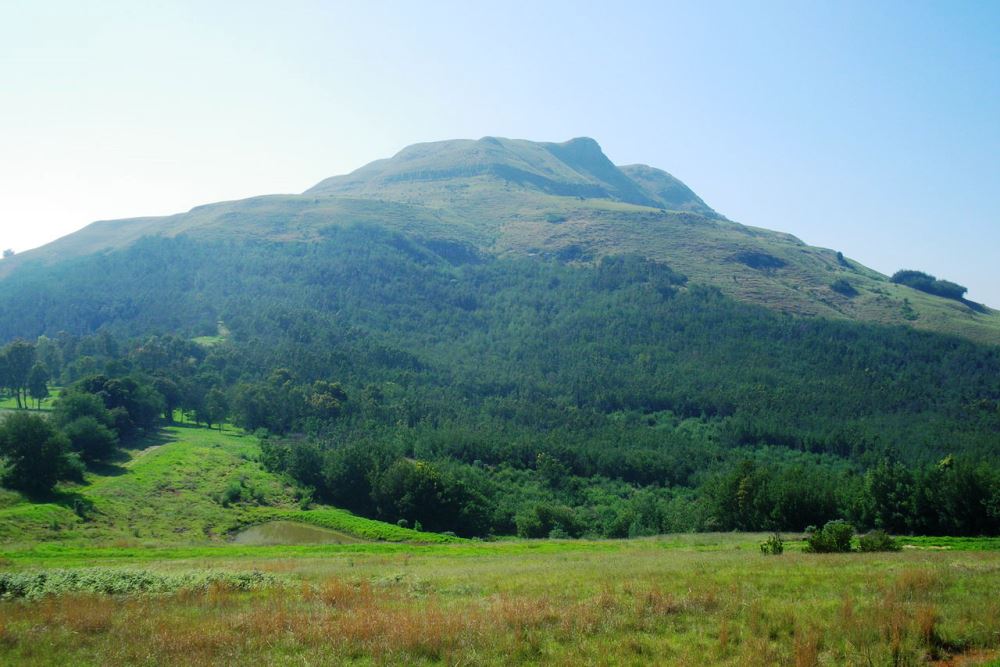
The top of Majuba is hollowed out like a saucer.
On the west towards the southernmost point is a large gully. A fold and rocky ridge rise out of the centre of the hollow. On the west is a prominent point known as MacDonald’s Koppie and at the north-western extremity of the hill, in fact a little beyond the top, is an isolated knoll which is now known as Gordons’ Knoll. On the north and east of this Knoll there are a series of terraces or large steps up which the Boers pressed their attack.
**
Colley decided against detailing one of his infantry battalions for the task. Instead he formed a composite force under his personal command, with Colonel Stewart, of the 3rd King’s Dragoon Guards, as his Chief-of-Staff. The force consisted of two companies 58th Regiment (170), two companies 3/60th Rifles (140), three companies 92nd (Gordon Highlanders) (180), and one company Royal Naval Brigade (64) – in all about 554 riflemen. How much better it would have been had he given the task to one of the infantry battalions and told the commanding officer to get on with the job. Both the 58th and the 3/60th were thirsting for revenge after their defeats, respectively, at Laingsnek and Schuinshoogte. The 92nd, freshly arrived from the Afghan Campaign and battle tried would obviously have been a good choice.
Colley’s men expected big things to happen and were excited. The Boers were certainly at their mercy, or at least so they thought, but they had badly under-estimated the quality of their opponents. It apparently never occurred to the British to remain quietly hidden and to surprise the Boer patrol that occupied the hilltop by day. Instead the troops exposed their occupation by walking on the skyline and even hurling insults and waving their fists and rifles at the Boer positions. Some shots were fired at a passing Boer patrol and this appeared to stir the Boer camp to great activity.
http://samilitaryhistory.org/vol052gr.html
https://www.angloboerwar.com/forum/6-places/28936-majuba
The vexed question of taxation led to a declaration of independence from British rule by Boer states on 16 December 1880.
Four days later at Bronkhorstspruit Commandant Frans Joubert intercepted and destroyed a British army column. Major-general Sir George Pomeroy-Colley (1835–1881), the British governor, was sent reinforcements and by 24 January 1881 the newly formed Natal Field Force numbered 65 officers and 1,397 men and was ready to move north from the town of Newcastle.
Boer military organization was based on the commando, a unit drawn from a given locality in which all males between sixteen and sixty years of age were obliged to serve, bringing their own horse and rations and often their own rifle. These ad-hoc formations elected their own officers and when given orders might cooperate or not, as they deemed prudent. All were skilled in their use of arms.
*
Pretoria Convention (August-October 1881)
Majuba Hill (27 February 1881) was the main battle fought between British and Boer forces during the First Anglo-Boer War (1880-81). It was a comprehensive victory for the Boers, who routed a 400-strong British force occupying the summit of the hill.
The discovery of gold in the Transvaal in 1886 led to a large influx of mainly British settlers. Concerned about losing control of their country, the Boers refused to grant these uitlanders (‘outlanders’) citizenship. This situation heightened tensions between Britain and Transvaal (and its Orange Free State ally).
https://nzhistory.govt.nz/media/photo/battle-majuba-hill
*
*
Saturday night, on 26 February the British Gen. Sir George Pomeroy Colley occupied the top of Majuba with some 400 men. In the early hours of Sunday 27th when the Burghers realised the British had occupied the mountain which dominated their positions blocking the Laing’s (Lang) Nek Pass and the road into the Transvaal they decided they would have to remove them. Taking advantage of the considerably amount of dead ground afforded by the mountain they advanced on the British position and shortly after 12h00 stormed the top of the mountain forcing the British off. The British suffered some 256 killed, including the British General, wounded and captured while the Burghers lost 5 men wounded, one fatal and one killed. This battle brought an end to the Transvaal War of Independence (1st Boer War) accessed from the N11 along the Kwaggasnek Road and is approximately 5km from the N11 south of Charlestown. Museum, Youth Lodge, picnic and caravan area and toilets available.
The Battle of Majuba
*
VOLKSMOORD WAT PLAASGEVIND HET WAT VOORTGAAN
Daar is sover meer as 39000 Boervroue en kinders vermoor in konsentrasiekampe. Kampe wat doods- en helkampe geword het vir die slagoffers, wat wind, weer, geen of min mediese sorg en min voedselvoorrade in die gesig moes staar. Hongerdood wat meeste se voorland.
Moenie vir een oomblik dink die Engelse was alleen hierin waar hulle alles van ons volk probeer vernietig het om van ons ontslae te raak. Dit was myns insiens ‘n groot skaalse wêreldoorlog wat in Afrika plaasgevind het, hier in die suidelike punt van Afrika. Daar was nog geen Suid-Afrika op die stadium nie, dus kon dit ook nie enige verbintenisse gehad het met Suid-Afrikaanse oorlog termes nie. Daar was ook wel ander volke wat saam die Boere geveg het, waarvan die Kaapse Rebelle bekend is.
Het hierdie spul gedink as hul ons voorouers sou breek en van elkeen ontslae geraak het, is die hele volk uitgeroei en ‘n land, ryk aan minerale is hulle sin. Ons voorgeslagte is nie sonder hande en voete gebore nie. Hulle het met die min wat hulle gehad het, opgestaan vir wat reg en verkeerd is nie, dat geregtigheid moet geskied. Na die tweede Anglo-Boere oorlog, is alle minerale ook in 1902 geannekseer – wetgewing is in London afgekondig. Waar is al hierdie rykdom van goud en diamante heen en aangewend vir watter doel?
Dit bly steeds ons as volk se reg om dit alles, met rentes terug te kry. Vryheid en onafhanklikheid is van ons voorgeslagte vervreem deur die Britse ryk en Victoria, saam al hul koloniale vegters wat ons menseregte geskend het.
Dit moet herstel word deur die Boere volk.
*
DIE AANSLAG TEEN DIE BOERE VOLK HET NOG NOOIT OPGEHOU NIE
Swart bemagtiging en regstellende aksie is liberaal verligte en kommunistiese oorloë teenoor ons blanke volk (die Boere en konsertiewe blankes). Dit is wetgewing wat geïmplementeer is, net op blankes en hul besighede van krag. Hoeveel besighede het sedert 1994 in die stof geduik omrede hierdie rassistiese wetgewings.
Die nagevolge na bykans 30 jaar is meer as wat elkeen van ons volkslede ooit sal besef. Dit gaan oor geen ekonomiese deelname, geen voedsel op die tafels en ‘n armoede wat hongerdood oor elke huishouding uitgespreek het die afgelope bykans 30 jaar (sedert 1994). Families kan nie eers meer na mekaar omsien nie en honderde duisende het landuit gevlug, weens misdaad, aanvalle, verkragtings, moorde, swart bemagtiging en regstellende aksie.
*
Britse besettings – Anglo-Boere oorloë
BOERE REPUBLIEKE was nog nooit Afrikaner republieke nie.
Rare footage! This montage is from the second Anglo-Boer War which was fought between the British Empire and the BOERS of two independent Boer republics, the South African Republic and the Orange Free State. It ended with the conversion of the Boer republics into British colonies.
*
*
Majuba Hill in South Africa was the final battlefield of the First Anglo-Boer War. Sometimes known as the Transvaal War, the First Anglo-Boer War was a conflict that lasted approximately a year in which the Boers rejected British annexation of the Transvaal region of South Africa. Majuba is in the province of KwaZulu-Natal, but was part of the Boer republic of Natalia.
Majuba Hill

*
SLAG V AN MAJUBA
ONTHOU MAJUBA – WAT HET DAAR GEBEUR
https://monument-sa.co.za/slag-van-majuba-bekende-woorde-geuiter/
*
AMAJUBA (MAJUBA) – THE FIRST ANGLO-BOER WAR
The British losses on this fateful day were 92 killed, 134 wounded, of whom a few succumbed during the following few weeks, and 59 taken prisoner. The Boers lost 1 killed and five wounded.
One of the five subsequently died from his injuries. Many excuses have been put forward by the British for their defeat. One such was that the men were too tired after their strenuous climb but this was refuted by Hamilton who was present and our subsequent climb. Another is that they ran out of ammunition – since refuted by numerous persons who were present. Most ammunition pouches were at least half full at the end of the battle. That the Boer tactics using fire and movement took them unaware is certain. What the British assumed was idle fire at the grass-tops was in fact covering fire for the Boers who were crossing the terraces and climbing exposed portions of the slopes. That the British were inferior shots has often been proved and partly accounted for their defeat. Whatever is said there is no doubt in my mind that British courage failed at the crucial stage of the battle and that they turned and fled, otherwise why only one Boer killed?
*
One cannot understand how the British could be so naive as to expect thc Boers to lay down their arms and submit; the Boers having done their utmost to reach a peaceful settlement and re-instate their Republic and, when this failed, having resorted to the almost unbelievable – the taking up of arms against the mighty Lion and, having done so, then inflicting upon the mighty Lion three serious wounds besides bottling up all his garrisons in the Transvaal so that they were now helpless to move out against the so-called ‘Rebels’. The Boers had nothing to lose but everything to gain. In poker parlance they held all the cards and yet the enemy was calling the bets.
READ MORE HERE:
http://samilitaryhistory.org/vol052gr.html
https://www.angloboerwar.com/forum/6-places/28936-majuba
They came from all over the world.
The vexed question of taxation led to a declaration of independence from British rule by Boer states on 16 December 1880. Four days later at Bronkhorstspruit Commandant Frans Joubert intercepted and destroyed a British army column. Major-general Sir George Pomeroy-Colley (1835–1881), the British governor, was sent reinforcements and by 24 January 1881 the newly formed Natal Field Force numbered 65 officers and 1,397 men and was ready to move north from the town of Newcastle.
Boer military organization was based on the commando, a unit drawn from a given locality in which all males between sixteen and sixty years of age were obliged to serve, bringing their own horse and rations and often their own rifle. These ad-hoc formations elected their own officers and when given orders might cooperate or not, as they deemed prudent. All were skilled in their use of arms.
*
Pretoria Convention took place during August-October 1881
The discovery of gold in the Transvaal in 1886 led to a large influx of mainly British settlers. Concerned about losing control of their country, the Boers refused to grant these uitlanders (‘outlanders’) citizenship. This situation heightened tensions between Britain and Transvaal (and its Orange Free State ally). The outlanders, referred to as Randlords, were mostly from other countries, outside the borders of the Boer Republics. The outlanders and immigrants wanted citizenship of the Boer Republics and voting rights. Those illegals, also import illegal immigrants from African and Asian countries, more than 460 000 workers, to work in the annexed mines since those times when Paul Kruger was the President of ZAR.
https://nzhistory.govt.nz/media/photo/battle-majuba-hill
*
It was the Saturday night, 26 February the British Gen Sir George Pomeroy Colley occupied the top of Majuba with some 400 men. In the early hours of Sunday 27th when the Burghers realised the British had occupied the mountain which dominated their positions blocking the Laing’s (Lang) Nek Pass and the road into the Transvaal they decided they would have to remove them. Taking advantage of the considerably amount of dead ground afforded by the mountain they advanced on the British position and shortly after 12:00 stormed the top of the mountain forcing the British off. The British suffered some 256 killed, including the British General, wounded and captured while the Burghers lost 5 men wounded, one fatal and one killed. This battle brought an end to the Transvaal War of Independence (1st Boer War) accessed from the N11 along the Kwaggasnek Road and is approximately 5km from the N11 south of Charlestown. Museum, Youth Lodge, picnic and caravan area and toilets available.
The Battle of Majuba
https://www.boererepublieke.co.za/die-slag-van-amajuba-27-februarie-1881/
*
DIE BERG VAN OORWINNING

BERG VAN VREDE
Die berg is ‘n bekende baken vir elke Boere volksgenoot. In die verlede is dit vasgevang en dit herrys daagliks uit die as van ons hartseer tog interessante verlede. Wees trots op die Boere volk en haar verlede wat diep ontvou is in ons nageslagte geheues.
Die Majuba berg weerspieël die Boere volk se oorwinning en die voetafdrukke van elke deelnemer, wat hier gemaak is. Daar is baie sulke berge en selfs groter, wat ons voorgeslagte getrotseer het.

https://grahamlesliemccallum.wordpress.com/2014/05/08/majuba-a-pictorial-history/
https://www.youtube.com/watch?app=desktop&v=zkkvcTflMiI
*
*
RELATED – VERWANTE ARTIKELS
Onafhanklikheid – Independence -British empire
Jan Smuts – Churchill – Rhodes – apartheid : British rules
Geskroeide aarde – Scorched earth (1)
Shepstone – Natal, roots of segregation
Hierdie Boere republiek het hul eie onderhandelings gehad met die Zoeloes en ‘n eie BOERE republiek uitgeroep.
Vryheid – Nieuwe Republiek (Boer-Zoeloe)
Regstellende aksie – Affirmative Action – Dakar 1989
Separate areas of British empire
(mostly theirs since 1840)
(since British empire annexed their land and areas, it was called Crown land or reserves)
Traditional land and leaders – landclaims
Gold and Diamonds – South Africa
*
Contact Admin:
Admin kan gekontak word by
volksvryheid9@gmail.com

 ONAFHANKLIK
[…] Majuba (SA) Amajuba […]
LikeLike
[…] Monument Pretoria – REG TOT VRYHEIDMajuba (SA) AmajubaChristiaan de Wet (Vrystaat)Christiaan de Wet 1854-1922Wie is die ABN – multi-kulturele […]
LikeLike
[…] *Verwante inligtingJan Smuts – Churchill – Rhodes – apartheid : British rulesShepstone and ABWAnglo Boere oorloë – ShepstoneGeskroeide aarde – Scorched earth (1)Twee Onafhanklike BOERE republiekeVryheid – Nieuwe Republiek (Boer-Zoeloe)Majuba (SA) Amajuba […]
LikeLike
[…] Majuba (SA) Amajuba […]
LikeLike
[…] Majuba (SA) Amajuba […]
LikeLike
[…] Majuba (SA) Amajuba […]
LikeLike
[…] Daar word geskryf, dat by die bekende Paardekraal klippe, was dit weer die geval, die wat kon, was daar teenwoordig. Hulle het hul waens op hierdie plek ingespan vir hul kwartaallikse ‘nagmaal’ of heilige nagmaal en weer, om Boere-onafhanklikheid op 16 Desember te herdenk en hul oorwinning oor die Britte in die Eerste Suid-Afrikaanse Vryheidsoorlog van 1880-1 te vier. Die oorlog wat by MAJUBA uitgebreek het, het al die Boere republieke se vegters deelgeneem.Invalsplanne op Boere republiekeMajuba (SA) Amajuba […]
LikeLike
[…] Majuba (SA) Amajuba […]
LikeLike