*
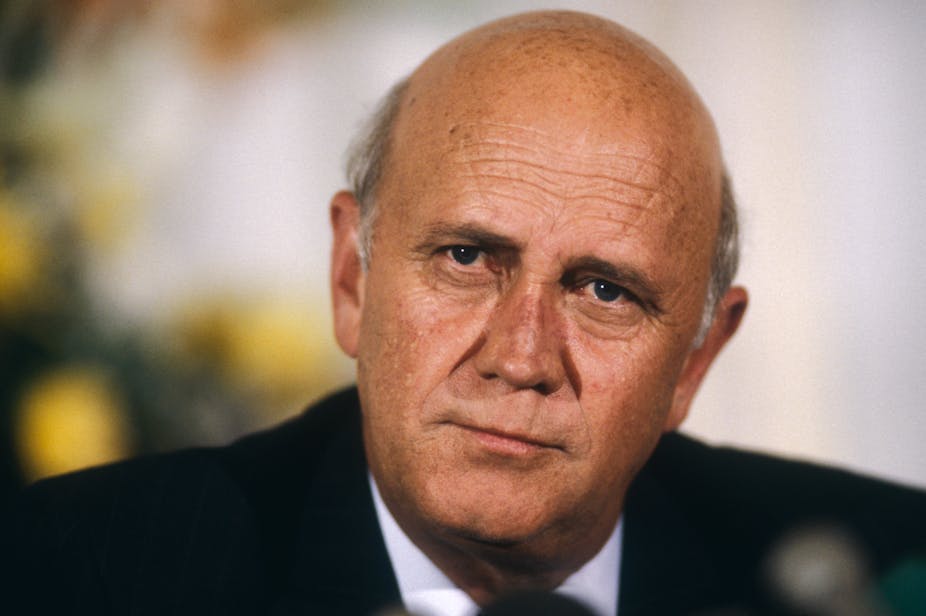
Hy het nie omgegee wie hy saam hom in die diep sloot intrek om nooit weer daaruit te kom nie. Geen multi-kultuur organisasies of sy sogenaamde demokrasie het na 1994 enige opbou in Suid-Afrika bewerkstellig nie. Inteendeel is die teenoorgestelde die waarheid. Suid-Afrika is een van lande met die hoogste misdaad, korrupsie op alle vlakke van regering, aanvalle en moorde. Daarvoor het hy en sy multi-kultuur organisasies of selfs demokrasie geen waarborge na 1994 gebring nie.
*
Slegs rewolusie en afbrand, vernietiging van alles waarmee die land gebou is. Hy was nie alleen nie, die liberaal verligte Afrikaners was saam hom en daar is heelwat multi-kulturele organisasies wat steeds hand op die blaas is met regering en ons almal die afgrond intrek. Sy ou toesprakie was niks anders as ‘n spul leuens en leë beloftes. Niemand het hom ‘n mandaat gegee wat hy aangevang het nie. Hy en sy organisasies dink hulle het al die wysheid in pag, maar hulle het niks.
Op 2 Februarie 1990 het De Klerk in die Parlement aangekondig dat Nelson Mandela ná 27 jaar uit die tronk vrygelaat word, die ontbanning van alle bevrydingsbewegings en die Kommunistiese Party en onderhandelinge vir ‘n oorgang, dis wat hy nou demokrasie noem. Die verwysing na 1985 hou verband met De Klerk se voorganger PW Botha se berugte Rubicon-toespraak wat na verwagting radikale beleidsverskuiwings sou maak, insluitend Mandela se vrylating, maar eerder Suid-Afrika in ‘n reeks noodtoestande ingeneem het namate hardlyers beweeg het om Botha se kabinet te oorheers. “Dit was my voorreg om in die Parlement op te staan om die aankondiging te maak wat Suid-Afrika vir altyd sou verander.”
*
FW de Klerk, the last apartheid president who went on to serve as a deputy president in the first democratic government, on Wednesday described inequality as democratic South Africa’s biggest failure, closely followed by failure to promote non-racialism. ‘It is a matter of the deepest regret that, in my opinion, South Africa can no longer be regarded as a non-racial society,’ he said, adding concern about ‘aggressive racial rhetoric’.
There is a certain incongruity in an apartheid president talking of equality and non-racialism. But in many ways, FW de Klerk does not see himself as the last of the apartheid presidents from 1989 to 1994, but as the politician, even statesman, who played a fundamental role in South Africa’s transition to constitutional democracy, regardless of what critics say.
On 2 February 1990 De Klerk announced in Parliament the release of Nelson Mandela from jail after 27 years, the unbanning of all liberation movements and the Communist Party and negotiations for a transition. The reference to 1985 relates to De Klerk’s predecessor PW Botha’s infamous Rubicon speech that had been expected to make radical policy shifts, including Mandela’s release, but instead took South Africa into a series of states of emergency as hardliners moved to dominate Botha’s Cabinet.
And with that statement, De Klerk claimed his place in South Africa’s history, on the right side of history as part of the democratic transformation. The inauguration of Mandela on 10 May 1994 was one of “the most fulfilling days in his life even though it meant the end of his presidency, was said. He believe he was handing power not to Nelson Mandela and the ANC, but to a new constitutional dispensation that would protect the reasonable rights of all South Africans.
But for many South Africans De Klerk remains inextricably tied to the apartheid regime and, in the years of negotiating the transition, the third force fomented political violence that saw train commuters thrown off moving carriages and killings not only in the volatile KwaZulu-Natal, but also killings like the June 1992 Boipatong massacre that saw De Klerk chased from the area and the ANC temporarily suspending participation in the negotiations.
Some of the unsettled and contested views on De Klerk emerged in 2015 when Cape Town renamed a major thoroughfare after him. Much of De Klerk’s just over the 30-minute address to the Cape Town Press Club was about that “historic achievement” of South Africa’s transition, although he acknowledged that it came on the back of a series of crises. He spoke about all the failures in South Africa.
*
Bykomende inligting
Submission by Solidarity 14 May 2003 in Parliament
AAI (Afrikaner-Afrika inisiatief)
Veelrassige organisasies – ABN
FW de Klerk in sy skik of nie?
Demokratiese rewolusie in SA na 1994
ANC, MK, Zuma and their struggle
Kodesa – liberale en kommunistiese grondwet skrywers

 ONAFHANKLIK
[…] READ ALSO FW en sy multi-kultuur […]
LikeLike
[…] the “socalled rainbow nation” FW en sy multi-kultuur […]
LikeLike
[…] FW en sy multi-kultuur […]
LikeLike
[…] FW en sy multi-kultuur […]
LikeLike
[…] the unbanning of all liberation movements and the Communist Party and negotiations for a transition.FW en sy multi-kultuurIndirek word daar meer steun aan swart bemagtiging gegee as wat ons weet. Die Blanke armoede […]
LikeLike
[…] FW en sy multi-kultuur […]
LikeLike
[…] FW en sy multi-kultuur […]
LikeLike
[…] FW en sy multi-kultuur […]
LikeLike
[…] FW en sy multi-kultuur […]
LikeLike
[…] FW en sy multi-kultuur […]
LikeLike
[…] FW en sy multi-kultuur […]
LikeLike