*
Who was the Black Pimpernel? 1964: ‘Black Pimpernel’ Convicted
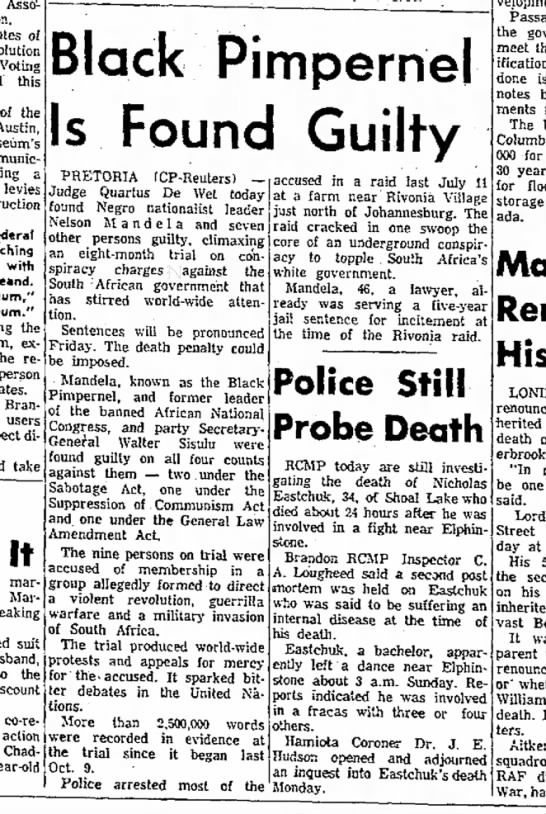
PRETORIA, South Africa — The African nationalist leader Nelson ‘‘the Black Pimpernel’’ Mandela and seven others were convicted today [June 11] by the Supreme Court of sabotage and plotting revolution. Sentences, which could be death. . A ninth defendant, Lionel Bernstein, one of two whites charged, was acquitted. Lionel “Rusty” Bernstein (20 March 1920 – 23 June 2002) was a Jewish South African anti-apartheid activist and political prisoner.

Go back into all history pages
*
LIONEL RUSTY BERNSTEIN – JEW WITH MANDELA
His political activism, abandoning privilege and dedicating his adult life to the struggle for liberation, democracy, human rights and peace, and for striving to build a better Africa and a better world through the anti-apartheid crusade.
Mr Lionel “Rusty” Bernstein was born on 3 March 1920 in the city of Durban of European Jewish immigrants. He was educated at Hilton College, and thereafter studied architecture at the University of Witwatersrand from 1937 to 1941. A committed anti-apartheid activist and leader of the Communist Party of South Africa, he gave up a comfortable and lucrative architectural practice and a convenient lifestyle to fight apartheid.
With the coming into power of the National Party and adoption of apartheid as state policy in 1948, Mr Bernstein’s resolve to fight for freedom and equality in South Africa intensified. By 1953, both he and Hilda were subjected to various bans and restrictions, including being barred from joining non-political bodies such as parent teacher associations.
In 1954, together with Mr Nelson Mandela, Mr Oliver Tambo and Mr Walter Sisulu, he played a major role in organising the Congress of the People, which subsequently adopted the Freedom Charter in Kliptown in 1955. He was also instrumental in the formation of the Congress of Democrats.
In 1956, together with 155 others (including Chief Albert Luthuli and Mr Mandela), Mr Bernstein was arrested and charged with treason during the 1956 Treason Trial. Together with his co-accused, he was acquitted after four years, but this lasted only for a while, as he and his wife were again arrested under the emergency regulations in 1960 after the Sharpeville Massacre.
On their release, they were banned and subjected to restrictions, including being forbidden to meet with other people and this was reinforced to house arrest in 1962. Despite the banning of the Communist Party in 1950, Mr Bernstein served it diligently together with the ANC as an underground operative after its reconstitution in 1953.
He contributed articles to a number of political journals and was responsible for much of the propaganda issued by the liberation movement. During this time, he also wrote extensively for many journals, including Liberation, Guardian, Sechaba, the African Communist and Fighting Talk and continued to write under pseudonyms even after being banned.
On 11 July 1963, Mr Bernstein was arrested with other leaders at Lilliesleaf Farm, in Rivonia, the headquarters of the high command of Umkhonto we Sizwe, the liberation army of the African National Congress (ANC), and then newly established with Mr Mandela as Commander-in-Chief.
This was after Mr Bernstein had served 90 days of detention. While most of his co-accused were sentenced to life imprisonment following the notorious Rivonia Treason Trial, he was released, rearrested and he eventually skipped the country together with his wife to England while he was still on bail.
Mr Bernstein worked as an architect in London for 17 years before retiring and staying in Oxfordshire. He continued to work for the anti-apartheid movement and wrote many articles during this period until his death. Until 1994, when the first free elections took place, he was still working towards the liberation of South Africa, never renouncing his principles or beliefs. He returned to the country in 1994 for four months for the first post-apartheid elections and worked in the ANC press office during this time, responsible for ensuring mass white participation in the first non-racial elections in South Africa.
Mr Bernstein was as independent-minded as he was intolerant of oppression, and in some instances opposed the most prominent of his colleagues, such as Mr Joe Slovo and Mr Mandela, on quite grave issues such as the armed struggle. During his term at Solomon Mahlangu Freedom College in Tanzania, he set up a political school and taught history to South African political exiles, encouraging critical thinking that occasionally challenged the ANC itself.
In 1995, he travelled to Italy to celebrate the 50th anniversary of the liberation of an area of Italy from Nazi occupation and represented the South African regiment that fought there.
In 1998, Rusty and Hilda Bernstein were awarded honorary degrees by the then University of Natal for their role in helping to bring democracy to South Africa. This followed the publication of Mr Bernstein’s acclaimed personal account of the unwritten history of South African politics between 1938 and 1964. He died in June 2002 at the age of 82.
https://www.thepresidency.gov.za/lionel-rusty-bernstein-1920
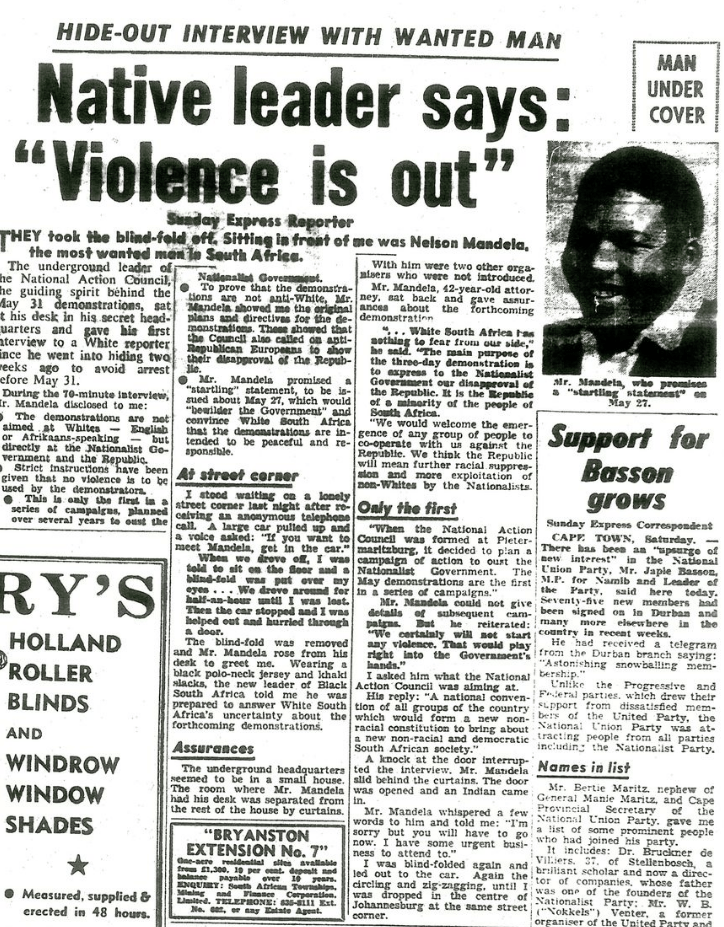
11 May / Mei 1961 Nuusberig / News
.
Fifty-one years after he conducted the last print interview with Nelson Mandela before his arrest, South African journalist Peter Hazelhurst has received the missing article.
On 14 May 1961 the Sunday Express journalist published an interview with South Africa’s most wanted man – Nelson Mandela who had been underground since early April 1961.
The article went missing during the journalist’s travels years later and with the assistance of the South African National Library the Nelson Mandela Centre of Memory has found the article and gave it to Mr Hazelhurst.
One day in May 1961 activist Ahmed Kathrada visited Mr Hazelhurst in the Johannesburg newsroom and asked whether he would like an appointment with the fugitive dubbed the Black Pimpernel. On the arranged day and time Mr Kathrada took him to a shop in central Johannesburg and he interviewed Mr Mandela in a back room for 70 minutes.
*
“Ruth [First] must have asked me to see you … because she was in touch with the media,” Mr Kathrada told Mr Hazelhurst when they met again in June 2012.
In May 1961 Mr Mandela, then aged 42, was the leader of the planned three-day strike against South Africa becoming a republic. He said in the interview that the strikes were not aimed at whites but directly at the National Party regime. He also spoke about his vision of “a national convention of all groups of the country which would form a new non-racial constitution to bring about a new non-racial and democratic South African society.”
Speaking this week Mr Hazelhurst said, “What I found amazing is that’s exactly what he said when he came out of prison.”
He went on to become a correspondent for the London Times covering the whole of Asia except Laos and North Korea. The day after the article appeared in the newspaper Mr Hazelhurst was questioned by the notorious Colonel At Spengler of the police’s Special Branch about the whereabouts of Mr Mandela but he had prepared for that. He had written in his story that he had been blind-folded in order to protect Mr Mandela and his comrades.
“They said, ‘who led you there?’” he recalled. “I said I was picked up on the street and I was blindfolded because I didn’t want to compromise that very brave lady in the shop … That’s why I went through that facade of using that in the lead,” Mr Hazelhurst said.
In fact for more than half a century he remembered the first paragraph of the article: “They took the blind-fold off. Sitting in front of me was Nelson Mandela, the most wanted man in South Africa.” The article ends with “I was blind-folded again and led out to the car. Again the circling and zig-zagging, until I was dropped in the centre of Johannesburg at the same street corner.”
To Mr Hazelhurst’s eternal dismay, the conservative Sunday Express editor Johnny Johnson changed his description of Mr Mandela from an “African leader” to “Native leader”.
Mr Mandela was arrested on 5 August 1962 soon after his return from a seven-month clandestine tour of Africa and London. He was charged with leaving the country illegally and inciting workers to strike. Mr Hazelhurst was subpoenaed as a witness against him because of the interview. In his cross-examination of the journalist Mr Mandela, an attorney managed to turn him into a witness for the defence. One of the questions he asked Mr Hazelhurst was whether he supported “one man one vote” to which he replied in the affirmative.
In the recess Mr Hazelhurst was recording women, including Winnie Mandela, singing outside the court. While the tape was running a Security Branch policemen and the assistant prosecutor threatened him to make him change his evidence. He refused and showed them the tape recorder and told them, “If you do anything I’ll play this to the judge.” They backed off.
Mr Mandela was sentenced to five years in prison. While he was serving his sentence, the raid on Liliesleaf Farm took place and he later joined his comrades on trial for sabotage. On 12 June 1964 at the end of what became known as the Rivonia Trial Mr Mandela and seven of his comrades were sentenced to life imprisonment.
..
LILLE — Two women and a man who occupied a chateau at Mont du Peruwelz, from which they could reach a house in Belgium just across the border by means of an underground tunnel and railway, were arrested by French officers this morning [June 11] as smugglers into France of millions of francs worth of tobacco, chocolate and other goods. The alleged leader of the accused smuggling ring was Raymond Monteyne, a Frenchman, but the two women gave their names as Carmen Olivares, Spanish singer, and Violette Piesproeck, Italian painter. To add insult to injury as far as customs officers were concerned the tunnel and railway track passed directly beneath a border customs house.
While in PRETORIA, South Africa — African nationalist leader Nelson ‘‘the Black Pimpernel’’ Mandela and seven others were convicted today [June 11] by the Supreme Court of sabotage and plotting revolution. Sentences, which could be death, will be handed down tomorrow. A ninth defendant, Lionel Bernstein, one of two whites charged, was acquitted.

 ONAFHANKLIK
[…] Black Pimpernel […]
LikeLike
[…] Misdadigers – Criminals (SA) UNITED NATIONS MEETING Ramaphosa : In Denial Black Pimpernel […]
LikeLike
[…] Black Pimpernel […]
LikeLike
[…] Black Pimpernel […]
LikeLike
[…] Black Pimpernel […]
LikeLike
[…] Black Pimpernel […]
LikeLike
[…] Black Pimpernel […]
LikeLike
[…] Black Pimpernel * […]
LikeLike
[…] MANDELA Black Pimpernel […]
LikeLike
[…] Mandela – black pimpernel Black Pimpernel […]
LikeLike
[…] *Who was / Wie wasBlack Pimpernel […]
LikeLike
[…] Black Pimpernel […]
LikeLike
[…] Black Pimpernel […]
LikeLike
[…] : revolutionMandela – terreur- terrorismMandela, Mbeki and the GuptasMandela and SorosBlack PimpernelFW de Klerk en Nelson Mandela (Nobel)“Mandela rules” (United nations)Goldman Sachs […]
LikeLike
[…] RR – Red revolutionTerrorisme – Sabotage to South Africa 13 July 2021 – RevolutionPreviouslyRed revolution at KoebergBlack Pimpernel […]
LikeLike
[…] Black Pimpernel […]
LikeLike
[…] Black Pimpernel […]
LikeLike
[…] Black Pimpernel […]
LikeLike
[…] Black Pimpernel […]
LikeLike
[…] Black Pimpernel […]
LikeLike
[…] *Who was / Wie wasBlack Pimpernel […]
LikeLike
[…] Black Pimpernel […]
LikeLike
[…] Black Pimpernel […]
LikeLike
[…] Black Pimpernel […]
LikeLike
[…] *Who was / Wie wasBlack Pimpernel […]
LikeLike
[…] Black Pimpernel […]
LikeLike
[…] Black Pimpernel […]
LikeLike