*
Is 2025 a repeat of what happened since 1652-until now? Brittain was not alone during the Anglo-Boer wars against a small little group of Boer people, fighters, women and children. Various countries assist the British empire to keep in charge of southern Africa, to keep the Cape sea route and also minerals in the Boer republics and other areas. The Boer republics (15), are not only TWO Boer republics, but more. Boer republics are not afrikaner republics and the Boer people are not with the multi-culture afrikaner nation and organisations. They ruled the Cape colony with Rhodes (Bond party – afrikaners) and their organisations still want ONE country today.
*
Some afrikaner organisations called the 1914 rebellion an ‘afrikaner’ revolution, but it was a Boer people rebellion, with Boer people leaders. Those leaders were not satisfied with the Union government (ruled from London), because of the 1902 Vereeniging Treaty. It was said and signed that the Boer republics will go back to the Boer people. All people, the Boer people as well, have an international right to rule themselves. They are not part of any other groups of people in South Africa.
The allies of the British empire, burnt down more than 30000 houses during the Anglo-BOER wars I and II and British Scorch policy and also raped the Boer women and youth (Havenga commission). The british concentration camps and graves are not only in the Free State and ZAR , but all the Boer republics. The Anglo-Boer wars took place over ALL the Boer republics, not only in the ZAR and Free state.
1900 Dertig sikkels silwer (30000 Britse pond) – ABO
Now all the multi-cultura Afrikaner organisations and political parties go to Trump and America.
Strange, but years back America, Canada, NZ and Australia was also allies with the British Empire, and they still is. Afrikaners those yours also was on the side of the British empire and their allies AGAINST THE BOER PEOPLE.
CORNE MULDER AND AFRIKANER ORGANISATIONS are multi-culture political party and their organisations are evidence of the same problem as 100 years back. THEY can not speak on behalf of the BOER peoples. Afrikaners are a multi-cultural rainbow nation.
THEIR organisations want ONE country only.
https://www.youtube.com/watch?v=XaBY9X1V9r4
Herstel Boere republieke Boere volk
*
read also –
AFRIKANER organisations have various discussions with the communists, since 1980’s.
AAI (Afrikaner-Afrika inisiatief)
*
MOELETSI MBEKI AND B-BBEE – AFRIKANERS STARTED THAT BEFORE 1989
https://www.youtube.com/watch?v=eNKg-W8RPHA
*
Brittanje was nie alleen in hierdie bloedige oorlog teen die handjievol Boere, vroue en kinders van die Boere republieke nie. Dit was nie ‘n Engelse oorlog teen Afrikaners of wat sommige mense noem dat dit Afrikaner Republieke is nie. Daar is geen sprake van dat dit Afrikaner republieke was nie, maar Boere republieke. Wat duidelik na vore kom, daar was nie ‘n ooreenkoms volgens opinies en webtuistes bereik nie. Nie alle Boere kommando lede het met hierdie Vredesverdrag saamgestem nie. Later het die 1914 Rebellie voortgespruit.
Die moontlikheid is nie uitgesluit dat daar ‘verskillende weergawes’ op die internet is rakende die 1902 Verdrag van Vereeniging, wat tussen die Boere en Britte gesluit is. Juis om die Boere volksgenote vandag op ‘n dwaalspoor te bring oor hierdie 1902 verdrag. Die verdrag is bekend dat dit deur Afrikaner en Sionis Jan Smuts opgestel is saam die Britte en haar bondgenote. Natuurlik sou hy hulle laat bevoordeel en nie die Boere nie. Afrikanerbond het ‘n groot rol gespeel om ons ondergang te bewerkstellig.
Dit word vermeld hoe Jan Smuts, wat ‘n Afrikaner en Sionis was op die stadium, betrokke was met die opstel van hierdie verdrag van Vereeniging en nie die Boere self nie. Dus, was sekere Boere leiers gedwing om dit te onderteken om die oorlog te stop, omdat dit die Afrikaner leiers behaag het om ‘n Unie van Suid-Afrika te word. Dus, was dit ‘n eensydige verdrag vanuit Afrikaner geledere om die ooreenkoms af te dwing in die guns van Brittanje en haar bondgenote.
Daar was hoegenaamd nie ooreenstemmigheid hieroor nie, nie alle Boere leiers het dit gesteun of onderteken nie. Die Rebellie het later gevolg in 1914, waarna Jan Smuts weer eens (namens Unie) opgetree het teen die Boere rebelle om hulle te vernietig.
Dit is eenvoudig klassiek – in sekere betrokke ‘kommentaar’ en volgens die ‘ooreenkoms’ word vermeld van die £3,000,000 wat aan Afrikaners uitbetaal sou word, terwyl dit nie Afrikaners was wat die skades gely het nie, maar die Boere in al die Boere republieke. Dit is ‘n vrot rot wat myle ver geruik kan word, waarin die Afrikaners en Sioniste ons Boere voorgeslagte gedompel het nie, maar dit het ons nageslagte mank gelaat. Veral om die minerale regte te bekom in 1902.
Terloops, hoekom sou die Boere leiers, ‘n ooreenkoms met enige Afrikaners en Sioniste gesluit het, as Afrikaners juis finansieel bygedra het tot die Britse oorlog om die Boere republieke te vernietig. Die Engelse se oorlog was teen die Boere, die Afrikaners het saam Brittanje geveg teen die Boere republieke, vir een ‘verenigde land’, en latere Unie van Suid-Afrika. Hulle doen dit vandag steeds in 2024 met hul gemengde kultuur lewenswyses, swart bemagtiging en regstellende aksie teenoor die Boere.
Hier volg ‘n paar aanhalings:
*
‘Grondwet“
In 1902 the Treaty of Vereeniging – signed by Boer and British leaders – ends the Anglo-Boer War, which began in 1899. This is followed in 1908 by a national convention that represents the exclusive interests of whites and which negotiates South Africa’s first constitution. This, the South Africa Act, is passed by the British House of Commons, despite petitions and protests from the African majority.
The Atlantic Charter, which Franklin D Roosevelt and Winston Churchill sign in 1941, lays the basis for a bill of rights in South Africa. In 1943 the ANC’s first attempt at such a document, African Claims, is modelled on this charter
*
1902 Verdrag – selfbestuur vir die Boere was heelwat bespreek na die verdrag .
*
Verdrag 1902
Melrose huis – Vrede van Vereeniging
*
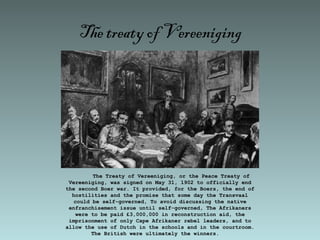
1902 – Treaty of Vereeniging ends the second Anglo-Boer War. The Transvaal and Orange Free State are made self-governing colonies of the British Empire.
After the First Anglo-Boer War the British government did not give up its ambition for unifying South Africa under Imperial British rule. The two Boer republics of the Orange Free State and the South African Republic or Transvaal still maintained their desire for independence. The Boer republics were a stumbling block for the British Empire.
NOT all Boers signed the Treaty. Eventually, these policies forced the Boers to seek certain terms like self-rule or self-government on more than one occasion.
On 31 May 1902, the Treaty of Vereeniging was signed and the Boers accepted British sovereignty but with limited self-government. The Boer republics were fully integrated into the Union of South Africa in 1910.
*
The two sides’ representatives met in the small Transvaal town of Vereeniging (pronounced in Afrikaans ‘fer-reen-igh-een’), although the treaty was signed in Pretoria, the capital of the Transvaal, on 31 May 1902. The treaty’s main points were that all Boer combatants would surrender, be temporarily disarmed and swear allegiance to the British crown. The war ended the Boers’ independence and the two republics became part of the British empire.
However, all Boers received an amnesty – their combatants returned home to their (often devastated) farms, although they were eligible for small reconstruction grants. They continued to use Afrikaans in schools, churches and courts, and while at first administered by British officials, were expected to regain self-government in a British South Africa, which was achieved within five years. While some British politicians had decried the Boers’ discrimination against the republics’ more numerous African population, the Boer delegates secured an undertaking not to discuss Black voting rights until the republics had regained self-government.
*
1906
The Transvaal Colony, former Zuid-Afrikaansche Republiek (ZAR) or Transvaal Republic, was granted self-government status by Britain, according to the terms of the Vereeniging Peace Treaty, signed between representatives of the two Boer Republics and Britain on 31 May 1902. The implementation of this term was precipitated by the replacement of the Conservative government in Britain by the Liberal administration in 1906. Transvaal was followed by the Orange River Colony in 1907. One of the clauses of the Vereeniging Peace Treaty (1902) gave the White people in the conquered Transvaal and the Orange Free State the right to decide whether or not to extend the parliamentary franchise to Black South African’s. The Boers decided not to, and Blacks were excluded from the vote.
*
1907
Die rol wat die Afrikanerbond en hul party speel in die Unie wordingsproses. Hulle wat die ‘Boere leiers’ ingedwing het in die uniewordingsproses. Hulle wou alles beheer en regeer saam Brittanje. Die Britse statebond inskrywing.
*
Self-government was restored in 1907, and in 1910 the colony became the Orange Free State Province within the Union of South Africa. The province remained unchanged when the Union of South Africa became the Republic of South Africa in 1961; but, after apartheid was abolished and the provincial governments were reorganized in 1993–94, the Orange Free State was renamed simply Free State.
https://www.britannica.com/place/Transvaal
https://sabctrc.saha.org.za/reports/volume3/chapter4/subsection1.htm
*
Eventually though, Boer forces surrendered in May 1902, and the subsequent Treaty of Vereeniging absorbed the Transvaal and the Orange Free State into the British Empire, with the promise of future self-government. The conflict was Britain’s economically most costly since the Napoleonic Wars and resulted in 150,000 military casualties (killed and wounded) on both sides, as well as the deaths of tens of thousands of civilians, largely as a result of British actions.
Afrikaners word op wikipedia genoem as die bevoordeeldes uit die Anglo-Boere oorlog, hulle het saam Brittanje teen die Boere geveg.
Afrikaners en Nederland het finansieel bygedra om teen die Boere te veg.
1900 Dertig sikkels silwer (30000 Britse pond) ABO
*
BYKOMENDE INLIGTING EN ARTIKELS
Boereheld Jopie Fourie en Smuts
Jan Smuts – VN – Darwin – Britse ryk
Anglo-Boere Oorlog: Konsentrasiekampe
*
*
Kontak Admin
volksvryheid9@gmail.com


[…] rulesBritish concentration camps – ABW (Rudie Rousseau)Emily Hobhouse en Lizzie van ZylVerdrag van Vereeniging 1902Melrose huis – Vrede van […]
LikeLike
[…] huis – Vrede van VereenigingVerdrag van Vereeniging 1902Invalsplanne op Boere republiekeOnregte en menseregte skendings teenoor Boere in […]
LikeLike
[…] is deur dieselfde regering die land ingebring na 1902. Boereheld Jopie Fourie en SmutsVerdrag van Vereeniging 1902Onregte en menseregte skendings teenoor Boere in SA*Apartheid – ‘n vloekwoord, maar dis […]
LikeLike
[…] na die 1902 Vredesverdrag wat deur Brittanje en haar bondgenote (Afrikaners ingesluit) verbreek is.Verdrag van Vereeniging 1902Onregte en menseregte skendings teenoor Boere in […]
LikeLike
[…] op Boere republiekeOnregte en menseregte skendings teenoor Boere in SA1914 Rebellie: Suid-AfrikaVerdrag van Vereeniging 19021900 Dertig sikkels silwer (30000 Britse pond) – […]
LikeLike
[…] Verdrag van Vereeniging 1902 […]
LikeLike
[…] Verdrag van Vereeniging 1902 […]
LikeLike
[…] Verdrag van Vereeniging 1902 […]
LikeLike
[…] Verdrag van Vereeniging 1902 […]
LikeLike
[…] Verdrag van Vereeniging 1902 […]
LikeLike
[…] Verdrag van Vereeniging 1902 […]
LikeLike
[…] Verdrag van Vereeniging 1902 […]
LikeLike
[…] Verdrag van Vereeniging 1902 […]
LikeLike
[…] Verdrag van Vereeniging 1902 […]
LikeLike
[…] International rights – Internasionale reg : Human Rights – MenseregteVerdrag van Vereeniging 1902 […]
LikeLike
[…] Verdrag van Vereeniging 1902 […]
LikeLike
[…] huis en voedsel was alles gesteel of verbrand. Boere en Russe – Anglo-Boere oorlog 1899-1902Verdrag van Vereeniging 1902 Dit wil dus ook voorkom dat die Unie van Suid-Afrika, wat uit London beheer is, vanaf 1909 tot […]
LikeLike
[…] Hierdie ooreenkoms was met Boere generaals en leiers aangegaan, nie met ander nie. Die Boere volk is hierna ingedwing in die Unie van Suid-Afrika. Daar was meer as twee Boere republieke, ZAR en Vrystaat, wat onderverdeel was in verskillende Boere republieke. Daar is altesaam 15 en nog meer. Boere vegters het vanuit al hierdie Boere republieke gekom en geveg teen Engeland en al haar bondgenote. Engeland was nie alleen nie en ook nie toe hulle konsentrasie helkampe geskep het vir vroue en kinders nie. Die verskroeide aarde beleid is in al hierdie Boere republieke uitgevoer, meer as 30000 plase is afgebrand, geplunder en beroof. Vroue en kinders is soos troppe vee aangejaag na konsentrasie helkampe. Die 1902 ooreenkoms is nie met ander volke gesluit nie. Die herstel van Boere republieke is hierin vervat. Net omdat Afrikaner leiers destyds ingestem het om deel van die Unie van SA te wees en ook vanuit London beheer te word, beteken nie die Boere volk het daarmee saamgestem nie.Verdrag van Vereeniging 1902 […]
LikeLike
[…] INLIGTING – RELATED INFORMATIONJan Smuts – VN – Darwin – Britse rykVerdrag van Vereeniging 1902Boere en Russe – Anglo-Boere oorlog 1899-1902CPA’s in SA & […]
LikeLike
[…] INLIGTING – RELATED INFORMATIONJan Smuts – VN – Darwin – Britse rykVerdrag van Vereeniging 1902Boere en Russe – Anglo-Boere oorlog 1899-1902CPA’s in SA & […]
LikeLike
[…] Verdrag van Vereeniging 1902 […]
LikeLike
[…] Verdrag van Vereeniging 1902 […]
LikeLike
[…] Verdrag van Vereeniging 1902 […]
LikeLike
[…] Verdrag van Vereeniging 1902 […]
LikeLike
[…] Afrikaner leiers, soos Jan Smuts was betrokke by die opstel van die Vredesverdrag, hoe gerieflik.Verdrag van Vereeniging 1902GRONDGEBIEDE – BOERE REPUBLIEKEDie Boere kommando’s en volk het hul grond wettig bekom, […]
LikeLike
[…] Verdrag van Vereeniging 1902 […]
LikeLike
[…] Verdrag van Vereeniging 1902 […]
LikeLike
[…] https://onafhanklik.com/2024/09/01/verdrag-van-vereeniging-1902/ […]
LikeLike
[…] Verdrag van Vereeniging 1902 […]
LikeLike
[…] republieke moes na 1902 plaasgevind het, maar dit het nie. Verwys na die Vredesverdrag. Verdrag van Vereeniging 1902Melrose huis – Vrede van […]
LikeLike
[…] Die Boere volk is ‘n aparte volk, Afrikaners is ‘n veelvolkige reenboognasie.Lees op oor die Boere rebellie van 1914, sowel ander inligting oor swart bemagtiging en regstellende aksie, wie dit in 1987 begin het. Afrikaners en hul organisasies. Heelwat Afrikaners was betrokke by die oorgawe van 1994 aan kommuniste. Swart bemagtiging onderrokkeDakar 1986 – Notes of H GiliomeeDakar-Kodesa 1982-1986-1994Regstellende aksie – Affirmative Action – Dakar 19891914 BOERE Rebellie: Suid-AfrikaAfrikaner leiers was selfs betrokke by die opstel van die 1902 Vredesverdrag – SmutsVerdrag van Vereeniging 1902 […]
LikeLike
[…] Verdrag van Vereeniging 1902 (onafhanklik.com) […]
LikeLike
[…] Verdrag van Vereeniging 1902 […]
LikeLike
[…] https://onafhanklik.com/2024/09/01/verdrag-van-vereeniging-1902/ […]
LikeLike
[…] Verdrag van Vereeniging 1902 […]
LikeLike