*
The A N C is a liberal MOVEMENT back-up by the liberal whites in SA, the West, Brics countries, the british empire, zionism, communism and perhaps all African countries. The ANC political party in SA parliament is not alone in South Africa, stand on various legs (PAC, SACP, Cosatu), financed by liberal organisations. They were created as a LIBERAL MOVEMENT in 1912.
*
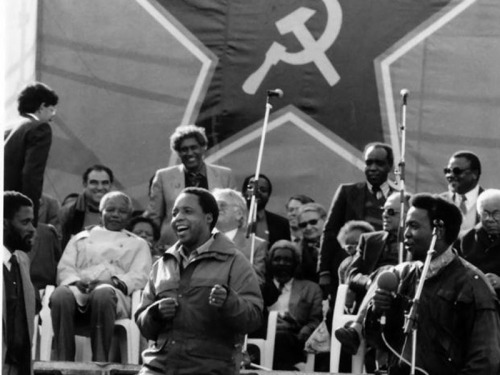
The SACP (communism party is one leg of the ANC) together with PAC and Cosatu (Congress of South African Trade Unions). They are not one ‘tribe’, but different tribes, that are part and parcel of the bigger machineries that control the protest actions, revolution, communism and zionism. They formed their own liberal networks, each in their own domain, ruled by their own leaderships. Most of the blacks came from the Lake areas in Africa but settled during British colonialism and some worked in the mines.
*
Their website states : Q It was formed in 1912 to unite the African people and spearhead the struggle for fundamental political, social and economic change. For ten decades the ANC has led the struggle against racism and oppression, organising mass resistance, mobilising the international community and taking up the armed struggle against apartheid. UQ …
READ THE ANC WEBSITE
https://www.anc1912.org.za/our-history//
Freedom charter 1955 and Constitution 1996:
Constitutional writers during Codesa. Most of them are sitting in Parliament in high positions.
Kodesa – liberaal kommunistiese grondwet skrywers
Idasa meetings, 1986 in Dakar, Africa, Brittain and elsewhere were followed by Codesa meetings. Both Idasa and Codesa were financed by OSF.SA and George Soros and other liberals.
B-BBEE and EE
CR chairperson of commission
Swart bemagtiging Inhoud B-BBEE Index
Black empowerment and affirmative action started outside the borders of South Africa before 1990. Ideology of discrimination and racism was not created by the ANC or SACP alone, but also by Afrikaner organisations, National Party, Democratic Party and mostly Afrikaner businesses. Sanlam and Metropolitan were given the green light before 1992 to put black affirmative action in their companies.
Dakar 1986 – Notes of H Giliomee
Regstellende aksie – Affirmative Action – Dakar 1989
Afrikanerbond – Afrikaner-Broederbond in SA
Afrikanerbond – Johann Rupert – Remgro – Richemont
*
APARTHEID BRITISH CONTROL AND COLONIALISM
By the way: Apartheid was created by themselves during the British colonialism 1806 to date and they are still living on those very same areas, the best in the country.
In 1854, the Zulu people occupied their own areas in the Natal area, under Lord Shepstone (he was also involved in the annexation of the Boer republics). The various Boer Republics were not part of the British colonial empire.
*
KILL THE BOER, KILL THE FARMER …
Die ANC , EFF en DA sing luidkeels VERMOOR DIE BOERE
Kill the Boer Kill the farmer in South Africa
Kill the Boer, kill the Farmer
Verskroeide aarde, Mfecane: Kill the Boer lied
VERNIETIGINGSPROSES – RUG TEEN DIE MUUR
Met meer troebel waters wat in die kommunistiese en rewolusionêre Suid-Afrikaanse waters ingevloei het, het dit na 1994 al slegter gegaan. Inderwaarheid het die ANC politieke party en alliansie, hul balspel, korrupsie en sindikate meer vergroot. Groot steun is verkry onder die massas. Dit sluit steun onder immigrante hierby in.
Die steun van die vorige regering, Afrikanerbond-Broederbond, Nasionale party ea, het geval nadat dit fisies gemanipuleer is van buite die landsgrense, onder Idasa, Kodesa kommunistiese vlae , oorhandig.
Dit is nie onmoontlik dat dit alles toeval en beplan is nie – die vals vlag van ‘n groeiende sneeubal van korrupsie, moord, verkragtings, sindikate en vernietiging.
Die Afrikaner organisasies, besighede, Broederbond-Afrikanerbond, die ou Nasionale Party, Demokratiese party, en liberaal verligte- denkende blankes het hulle agter die politieke blyspel van moord, korrupsie en oorname geskaar.
Dit het inderwaarheid Suid-Afrika na 30 jaar tot stilstand geruk en basies vernietig. Die massas het alles vir langer as 30 jaar gerugsteun en hul eie ondergang bewerkstellig met hul swart bemagtiging en regstellende aksie, protesaksies wat eenvoudig elke werksgeleentheid tot as verbrand wat later saam die brandende bande in rook opgaan het. Werklose jeugdiges sal nog agterkom wat doelgerigte geweld, armoede en honger is, die dag as daar geen kommunistiese of maatskaplike toelaes is nie. Belasting bydraes sal ook opdroog sodra nog besighede hul deure sluit.
*
GO back to 1962 – was he really the same person of 1961?
*
MANDELAThe SACP was somewhat more effusive, declaring in a December 5 statement: “At his arrest in August 1962, Nelson Mandela was not only a member of the then underground South African Communist Party, but was also a member of our Party’s Central Committee. To us as South African communists, Cde Mandela shall forever symbolise the monumental contribution of the SACP in our liberation struggle. The contribution of communists in the struggle to achieve the South African freedom has very few parallels in the history of our country. After his release from prison in 1990, Cde Madiba became a great and close friend of the communists till his last days.”
Mandela had denied membership in the SACP, first in his 1964 trial—for understandable reasons—and later after the end of the apartheid regime, when the SACP became a legal organization.
In the US, where the major networks and print media have pulled out all the stops to deify Mandela, painting him as some kind of South African Mother Teresa, committed to peace, love and reconciliation, the silence on this revelation is understandable. Any serious examination of Mandela’s actual politics would only cut across this propaganda effort, not to mention the attempts by President Barack Obama to wrap himself in Mandela’s mantle.
The sole exceptions have been right-wing commentators and websites, which have attempted to use Mandela’s connection to the SACP for their own reactionary purposes, and a cynical column buried in the New York TimesSunday Week in Review section by former Times editor Bill Keller, to which we will return.
In reality, an examination of the relation between Mandela’s ANC and the Stalinist SACP is indispensable to understanding not only South Africa’s history, but the fate of the struggle against apartheid and the fundamental political challenges facing the South African working class today.
Neither Mandela’s political legacy nor the political, social and economic panorama of present-day South Africa can be understood outside of the enormous damage that Stalinism inflicted upon the revolutionary struggles of the South African working class.
The answer to how Mandela could both lead the ANC and serve on the CP’s central committee is to be found in the counter revolutionary ideology of Stalinism. Under the pressure of the bureaucratic degeneration of the first successful workers’ revolution in the Soviet Union and, ultimately, the physical liquidation of virtually the entire cadre that had led it, the Communist International imposed upon the Communist Parties in the oppressed and colonial countries the “two-stage theory” of revolution.
This theory was an explicit repudiation of the perspective upon which the October 1917 revolution in Russia had been based. It held that in the oppressed and colonial countries, the working class could not emulate the seizure of power by the Russian workers in the October Revolution, but instead would be compelled to support a bourgeois democratic revolution, with the socialist revolution indefinitely postponed until after a period of capitalist development.
Stalinism virulently opposed the Theory of Permanent Revolution, elaborated by Trotsky in the aftermath of the 1905 revolution and adopted by Lenin in the preparation of the revolution of October 1917. This Marxist program insisted upon the political independence of the working class from the bourgeoisie in a struggle to win the leadership of the peasant masses on the basis of a socialist and internationalist program. It established that in the epoch of imperialism, the democratic and national tasks confronting the masses in oppressed countries like South Africa could be realized only through a socialist revolution, the establishment of a workers’ state and the spread of the revolution on an international scale.
In 1935, in a letter to supporters in South Africa, Trotsky spelled out the significance of this perspective for that country, insisting that, while the revolution must produce a “black republic,” that “the proletarian party can and must solve the national problems by its own methods.”
He advanced the perspective that “The Bolshevik-Leninists unmask before the native masses the inability of the [African National] Congress to achieve the realization of even its own demands, because of its superficial, conciliatory policy. In contradistinction to the Congress, the Bolshevik-Leninists develop a program of revolutionary class struggle.”
The South African Communist Party pursued just the opposite course, promoting the ANC as a revolutionary party and even drafting its program, the Freedom Charter of 1955, a reformist document that, in the name of “multi-racialism,” upheld bourgeois property relations and the fundamental institutions of the capitalist state.
Mandela and the ANC turned to the SACP because its program was indistinguishable from that of bourgeois nationalism and because it provided a useful instrument for subordinating the working class to the ANC’s program and currying favor with the Moscow Stalinist bureaucracy, which offered the movement limited support.
In the negotiations between the South African ruling class and the ANC that led to Mandela’s release from prison and the formal end of apartheid, the SACP adopted the most right-wing and conciliatory position. Its leader Joe Slovo pushed through the adoption of “sunset clauses” that guaranteed the apartheid regime’s National Party representation in the parliament—as well as a deputy presidency for the first five years—and barred nationalization of the mines, banks and corporations.
Nearly two decades later, the results of this policy, portrayed by the Stalinists as a “national democratic revolution,” are clear. South Africa today is the most socially unequal country in the world, with 60 percent of the national income going to the top 10 percent, while the bottom 50 percent subsists below the poverty line.
Programs such as Black Economic Empowerment have turned a layer of ex-ANC officials, union leaders and Stalinists as well as politically connected black businessmen, into multi-millionaires. The most representative of this layer is the former mineworkers union leader Cyril Ramaphosa, who has amassed a fortune of roughly half a billion dollars, including from contracting cheap labor for multinational mining companies.
The present South African government has been formally constituted nearly two decades as a “tripartite alliance” between the ANC, the COSATU union federation and the SACP. The latter two organizations function as a police force within the working class and a conduit for elements being groomed for positions within the government and corporate management.
This role was expressed most graphically in the SACP’s response to the Marikana massacre of 34 Lonmin platinum miners in August. Leading SACP figures denounced the striking miners as “counter revolutionaries” and declared their support for the police action.
“This was no massacre, this was a battle,” SACP official Dominic Tweedie was quoted as saying.
“The police used their weapons in exactly the way they were supposed to. That’s what they have them for. The people they shot didn’t look like workers to me. We should be happy. The police were admirable.”
These vicious attacks were a measure of the crisis gripping the ANC and its allies in the SACP and COSATU, under conditions in which the working class is coming into struggle not only against mining companies and other capitalist employers, but also against the ANC and the union apparatus that defends these interests.
South Africa’s President Jacob Zuma, who epitomizes the financial self-dealing of the ANC and has been implicated in scores of corruption scandals, came into office with the fervent support of the SACP, which attempted to cast him as a “man of the people.”
That the party continues to serve as a key base of support for the corrupt president was made clear in the aftermath of Tuesday’s mass memorial service for Mandela in Johannesburg, where significant sections of the crowd repeatedly booed Zuma.
The day after the incident, the SACP issued a statement that echoed the language of the Stalinist regimes of an earlier era, denouncing the booing as “counterrevolutionary” and calling on its members to “bring to the Party whatever information they might have about who was behind this despicable behavior” and “ensure that we get information of who the ring leaders behind this action were.”
The role of the SACP is clear. It stands as a defender of the bourgeois ANC regime and of capitalism against the opposition and struggles of the working class.
While the big business media has, for the most part, shown no inclination to probe this sordid relationship, Keller of the Times provided a cynical and reactionary analysis of the report of Mandela’s membership in the SACP—a report that never made it onto the “newspaper of record’s” news pages.
Keller, who points out that he reported for the Times from both “Gorbachev’s Russia and in transitional South Africa” is a thorough-going anti-communist and defender of US corporate interests. He nonetheless has praise for the role of the SACP.
He attributes Mandela’s alliance with the party to the ANC leader’s “pragmatism,” while crediting the SACP with fostering Mandela’s “multiracialism” and with opposing the “nationalizers and vengeance seekers” in forging the transition deal with the apartheid regime in 1992.
Keller adds, however, that the SACP-ANC alliance “helps explain why South Africa has not made greater progress toward improving the lives of its large underclass, rooting out corruption and unifying a fractious population.” His explanation is that the ANC failed to complete a transition from “liberation movement to political party, let alone government.” He added that it maintained the “culture” of liberation movements in tending “to be conspiratorial, to discourage dissent, to prize ends above means.”
A simpler explanation would be that the ANC government failed to fundamentally improve the conditions of the impoverished masses because it left the relations of capitalist exploitation and monopolization of wealth that existed under apartheid intact. It couldn’t “root out corruption,” because its entire relationship to the country’s capitalist rulers was corrupt, based on the enrichment on a narrow layer of politically connected blacks.
Moreover, one could equally apply the description Keller gives for liberation movements to the capitalist governments in the US, whose conspiracies to wage wars based on lies the former Times editor has repeatedly defended, and whose attitude toward dissent has been made clear in the persecution of Edward Snowden, Julian Assange and Bradley Manning.
Finally, Keller tosses out the observation that Stalinism performed the greatest service to Mandela and the ANC by “collapsing.” The end of the Soviet bloc, he asserts, meant South Africa’s apartheid rulers “could no longer pose as necessary allies on the right side of the Cold War. The game was up.”
This is a deliberate falsification of history. The negotiations with the ANC for a constitutional agreement that would preserve capitalist interests while formally ending apartheid began in earnest more than five years before the dissolution of the USSR. In 1985, Anglo-American mining magnate Gavin Relly led white South African business leaders to Lusaka, Zambia for meetings with Oliver Tambo and other ANC leaders.
These leaders of apartheid capitalism knew the “game was up” because they were confronting an unprecedented revolutionary upsurge in the black townships, which arose independently of the ANC. The regime was compelled to impose a nationwide state of emergency. The country’s capitalist ruling class was desperate for a deal that could quell this uprising and defend their wealth and property.
As with everything Keller writes, his analysis is tailored to the interests of the US government. It justifies Washington’s decades of support for apartheid on the grounds that South Africa’s rulers served as “necessary allies on the right side of the Cold War.”
Corporations like ExxonMobil, General Motors, IBM, Hewlett-Packard, Bank of America, General Electric, BP, Citigroup, Goodyear, United Technologies and Ford all had extensive operations in South Africa and reaped massive profits off of the exploitation of black workers under apartheid.
In 1985, the US was South Africa’s largest trading partner and its second-largest foreign investor, controlling roughly half of the South Africa’s oil industry, 75 percent of its computer industry, and 23 percent of its auto industry. These operations were driven not by Cold War politics, but by capitalist profit interests.
The death of Mandela and the subsequent media campaign of political myths and historical falsifications have only underscored the necessity of South African workers to draw the bitter lessons of the role of Stalinism and the ANC in aborting the revolutionary struggles that erupted under apartheid. A new revolutionary leadership must be built, founded on these lessons and based upon an internationalist and socialist perspective to carry through the fight for genuine democracy, equality and socialism. This means building a South African section of the International Committee of the Fourth International.
~
COMMUNISM IN SOUTH AFRICA
More than one political party is involved to implement communism 100% in South Africa – their goal is to attrack more and more in the communism field. Not all their political leaders are the same but there are differences.
Firstly, no one can continue to argue that the Tripartite Alliance is still a coherent political front bringing together a working class union movement (Cosatu), working class party (SACP) and a multi-class governing party (ANC).
Secondly, the SACP’s decision serves as an official recording of the radical changes the ANC’s identity has undergone in terms of how it defines its own interests or constituencies. It’s finally stating that its core interests and those of the ANC’s are in the process of parting ways. In socialist parlance, the ANC’s and SACP’s class interests have reached a crossroads.
In the 1960s the formation of Umkhonto we Sizwe, the armed wing formed by ANC and SACP members, was arguably the most concrete articulation of the ANC-SACP alliance.
In the decades that followed the SACP played a key role in facilitating the support of the Soviet Union and Eastern Bloc for the ANC and South African Congress of Trade Unions. The communists also shaped the ANC’s philosophy around national liberation as the “national democratic revolution” and view of apartheid as “colonialism of a special type”.
*
COMMUNISM IN AFRICA
Mandela en kommunisme – moorde in Afrika / SA
AFRICAN Socialism
Sosialisme in Afrika – koloniale onrus en protesaksies
by the Institute of Commonwealth Studies (London)
ANC ALLIANCE – SACP parties
~
DISASTER WITHIN SOUTH AFRICA
Farmer about “mandela” and agriculture – communism
Farmland in South Africa – Crime and murders
Black homelands became TRUSTLANDS after 1994 – they still exist
~
Meeste tuislande is na 1994 omgeskakel na iets anders steeds apart van mekaar, of Trustgebiede of geregistreerde CPA’s. Daar is 8840 tradisionele leiers wat ons belastings onderhou. Daar is steeds aparte gebiede. NIKS is gesteel of afgeneem nie, ook nie in 1910 nie.
*
Ingonyama Trust – only for Zulu people.
Zoeloes (Ingonyama Trust) > Ramaphosa
More background – what was there in 1910, or 1854 or 1994?
Trustgebiede>Tuislande>Reservate
Die kleed van die Britse ryk is nog netso in rooi gedrapeer oor Suid-Afrika as wat dit was in en gedurende die koloniale tydperk voor hulle onafhanklike gebiede geannekseer het as hulle sin. En nie net ons nie. Die Boere republieke was ingedwing in hierdie ryk in. Wat is in hul manifes vervat? And they are still involved here in South Africa, even on all other colonial states. Read the Charter of the Commonwealth.
Video
The Afrikaners even paid the British money to fight the Boer people. 30000 pound and even more than 50000 soldiers to fight against the Boer republics.
1900 Dertig sikkels silwer (30000 Britse pond) – ABO
Afrikaner stigting Solidariteit Julie 2024
Orania, selfbeskikking Afrikaner verklaring
Afrikaner multi-kultuur verklaring – Eloff-Buys
Veelrassige organisasies – ABN
*
Contact Admin:
Admin kan gekontak word by
volksvryheid9@gmail.com

 ONAFHANKLIK
[…] ANC and Communism in South Africa […]
LikeLike
[…] ANC and Communism in South Africa […]
LikeLike
[…] ANC and Communism in South Africa […]
LikeLike
[…] ANC and Communism in South Africa […]
LikeLike