*
During the second world war the future South African prime minister John Vorster was interned as a Nazi sympathiser. Three decades later he was being feted in Jerusalem. In the second part of his remarkable special report, Chris McGreal investigates the clandestine alliance between Israel and the apartheid regime, cemented with the ultimate gift of friendship – A-bomb technology … uranium. John Vorster was also part of the National Party and member of the Afrikaner Broederbond.
*
Israelis have always been horrified at the idea of parallels between their country, a democracy risen from the ashes of genocide, and the racist system that ruled the old South Africa. Yet even within Israel itself, accusations persist that the web of controls affecting every aspect of Palestinian life bears a disturbing resemblance to apartheid. After four years reporting from Jerusalem and more than a decade from Johannesburg before that, the Guardian’s award-winning Middle East correspondent Chris McGreal is exceptionally well placed to assess this explosive comparison. Here we publish the first part of his two-day special report.
Videos
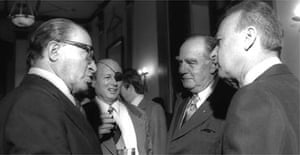
Footage of Prime Minister John Vorster, a Prime Minister for Apartheid-era South Africa, visiting the State of Israel where he met with Yitzhak Rabin, his Israeli counterpart and Shimon Peres, the Israeli Minister of Defence. It was the first visit to Israel by a South African premier for over 25 years. South Africa had been one of the first countries to recognise the creation of the Jewish state.
https://www.youtube.com/watch?v=qfcLU07MSQk
It was not only friendships – previous national government, the Afrikaners of South Africa and Israel.
War in the middle east started just after the Anglo-Boer WARS in 1902.
https://www.youtube.com/watch?v=E_KNrt6_9NY
Second part of Chris McGreal’s report
Israel
https://www.youtube.com/watch?v=Ptt6R3RPTNQ
*
Read the first part of Chris McGreal’s report
Quotes from the Guardian
https://www.theguardian.com/world/2006/feb/07/southafrica.israel
Several years ago in Johannesburg he met a Jewish woman whose mother and sister were murdered in Auschwitz. After their deaths, she was forced into a gas chamber, but by some miracle that bout of killing was called off. Vera Reitzer survived the extermination camp, married soon after the war and moved to South Africa.
Reitzer joined the apartheid Nationalist party (NP) in the early 1950s, at about the time that the new prime minister, DF Malan, was introducing legislation reminiscent of Hitler’s Nuremberg laws against Jews: the population registration act that classified South Africans according to race, legislation that forbade sex and marriage across the colour line and laws barring black people from many jobs.
Reitzer saw no contradiction in surviving the Holocaust only to sign up for a system that was disturbingly reminiscent in its underpinning philosophy, if not in the scale of its crimes, as the one she had outlived. She vigorously defended apartheid as a necessary bulwark against black domination and the communism that engulfed her native Yugoslavia. Reitzer let slip that she thought Africans inferior to other human beings and not entitled to be treated as equals. I asked if Hitler hadn’t said the same thing about her as a Jew. She called a halt to the conversation.
Reitzer was unusual among Jewish South Africans in her open enthusiasm for apartheid and for her membership of the NP. But she was an accepted member of the Jewish community in Johannesburg, working for the Holocaust survivors association, while Jews who fought the system were frequently ostracised by their own community.
Afrikaner anti-semitism
It was stated that apartheid sought to segregate every aspect of life from the workplace to the bedroom, even though whites in practice were dependent on black people as a workforce and servants. Segregation evolved into “separate development” and the bantustans – the five nominally “independent” homelands where millions of black people were dumped under the rule of despots beholden to Pretoria.
When the Nationalist party government first gained power in Pretoria in 1948, the Jews of South Africa – the bulk of them descendants of refugees from 19th-century pogroms in Lithuania and Latvia – had reason to be wary. A decade before Malan became the first apartheid-era prime minister, he was leading opposition to Jewish refugees from Nazi Germany entering South Africa. In promoting legislation to block immigration, Malan told parliament in 1937: “I have been reproached that I am now discriminating against the Jews as Jews. Now let me say frankly that I admit that it is so.”
South African anti-semitism had grown with the rise of Jews to prominence in the 1860s, during the Kimberly diamond rush. At the turn of the century, the Manchester Guardian’s correspondent, JA Hobson, reflected a view that the Boer war was being fought in the interests of a “small group of international financiers, chiefly German in origin and Jewish in race”. Fifty years later, Malan’s cabinet saw similar conspiracies. Hendrik Verwoerd, editor of the virulently anti-semitic newspaper, Die Transvaler, and future author of “grand apartheid”, accused Jews of controlling the economy. Before the second world war, the secret Afrikaner society, the Broederbond (Afrikaner men only) – which included Malan and Verwoerd as members – developed ties to the Nazis. Another Broederbond member and future prime minister, John Vorster, was interned in a prison camp by Jan Smuts’s government during the war for his Nazi sympathies and ties to the Grey Shirt fascist militia.
Don Krausz, chairman of Johannesburg’s Holocaust survivors association, arrived in South Africa a year after the war, having survived Hitler’s camps at Ravensbrück and Sachsenhausen when much of his extended family did not. “The Nationalists had a strongly anti-semitic platform before 1948. The Afrikaans press was viciously anti-Jewish, much like Der Stürmer in Germany under Hitler. . Every Jewish shop in that town was blown up by the Grey Shirts. In the communities that were predominantly Afrikaans, the Jews were absolutely victimised. Now the same crowd comes to power in 1948. The Jew was a very frightened person. There were cabinet ministers who openly supported the Nazis.”
Helen Suzman, a secular Jew, was for many years the only anti-apartheid voice in parliament. “They didn’t fear there would be a Holocaust but they did fear there might be Nuremberg-style laws, the kind that prevented people practising their professions. The incoming government had made it clear that race differentiation was going to be intensified, and the Jews didn’t know where they were going to fit into that,” she says.
“Israelis claim that they are the chosen people, the elect of God, and find a biblical justification for their racism and Zionist exclusivity,” says Ronnie Kasrils, South Africa’s intelligence minister and Jewish co-author of a petition that was circulated amongst South African Jewry protesting at the Israeli occupation of Palestinian territory.
For decades, the Zionist Federation and Jewish Board of Deputies in South Africa honoured men such as Percy Yutar, who prosecuted Nelson Mandela for sabotage and conspiracy against the state in 1963 and sent him to jail for life (in the event, he served 27 years). Yutar went on to become attorney general of the Orange Free State and then of the Transvaal. He was elected president of Johannesburg’s largest orthodox synagogue. Some Jewish leaders hailed him as a “credit to the community” and a symbol of the Jews’ contribution to South Africa.
“The image of the Jews was that they were following Helen Suzman,” says Alon Liel, a former Israeli ambassador to Pretoria. “I think the majority didn’t like what apartheid was doing to the blacks but enjoyed the fruits of the system and thought that maybe that’s the only way to run a country like South Africa.”
The Jewish establishment shied away from confrontation with the government. The declared policy of the Board of Deputies was “neutrality” so as not to “endanger” the Jewish population. Those Jews who saw silence as collaboration with racial oppression, and did something about it outside of the mainstream political system, were shunned.
Common aims
Israel was openly critical of apartheid through the 1950s and 60s as it built alliances with post-colonial African governments. But most African states broke ties after the 1973 Yom Kippur war and the government in Jerusalem began to take a more benign view of the isolated regime in Pretoria. The relationship changed so profoundly that, in 1976, Israel invited the South African prime minister, John Vorster – a former Nazi sympathiser and a commander of the fascist Ossewabrandwag that sided with Hitler – to make a state visit.
Leaving unmentioned Vorster’s wartime internment for supporting Germany, Israel’s prime minister, Yitzhak Rabin, hailed the South African premier as a force for freedom and made no mention of Vorster’s past as he toured the Jerusalem memorial to the six million Jews murdered by the Nazis. At a state banquet, Rabin toasted “the ideals shared by Israel and South Africa: the hopes for justice and peaceful coexistence”. Both countries, he said, faced “foreign-inspired instability and recklessness”.
Vorster, whose army was then overrunning Angola, told his hosts that South Africa and Israel were victims of the enemies of western civilisation. A few months later, the South African government’s yearbook characterised the two countries as confronting a single problem: “Israel and South Africa have one thing above all else in common: they are both situated in a predominantly hostile world inhabited by dark peoples.”
“We created the South African arms industry,” says Liel. “They assisted us to develop all kinds of technology because they had a lot of money. When we were developing things together we usually gave the know-how and they gave the money. After 1976, there was a love affair between the security establishments of the two countries and their armies.
Going nuclear
The biggest secret of all was the nuclear one. Israel provided expertise and technology that was central to South Africa’s development of its nuclear bombs. Israel was embarrassed enough about its close association with a political movement rooted in racial ideology to keep the military collaboration hidden.
So did many politicians. Israeli cities found twins in South Africa, and Israel was alone among western nations in allowing the black homeland of Bophuthatswana to open an “embassy”.
By the 1980s, Israel and South Africa echoed each other in justifying the domination of other peoples. Both said that their own peoples faced annihilation from external forces – in South Africa by black African governments and communism; in Israel, by Arab states and Islam. But each eventually faced popular uprisings – Soweto in 1976, the Palestinian intifada in 1987 – that were internal, spontaneous and radically altered the nature of the conflicts.
“There are things we South Africans recognise in the Palestinian struggle for national self-determination and human rights,” says Kasrils. “The repressed are demonised as terrorists to justify ever-greater violations of their rights. We have the absurdity that the victims are blamed for the violence meted out against them. Both apartheid and Israel are prime examples of terrorist states blaming the victims.”
There are important differences. Israel faced three wars of survival, and the armed struggle in South Africa never evolved to the murderous tactics or scale of killing adopted by Palestinian groups over recent years. But, from the 1980s, the overwhelming superiority of Israeli military power, the diminishing threat from its neighbours and the shift of the conflict to Palestinian streets eroded the sympathy that Israel once commanded abroad.
White South Africa and Israel painted themselves as enclaves of democratic civilisation on the front line in defending western values, yet both governments often demanded to be judged by the standards of the neighbours they claimed to be protecting the free world from.
Forgetting the past
Shimon Peres was defence minister at the time of Vorster’s visit to Jerusalem and twice served as prime minister during the 1980s when Israel drew closest to the apartheid government. He shies away from questions about the morality of ties to the white regime. “I never think back. Since I cannot change the past, why should I deal with it?” he says.
Pressed about whether he ever had doubts about backing a government that was the antithesis of what Israel said it stood for, Peres says his country was struggling for survival. “Every decision is not between two perfect situations. Every choice is between two imperfect alternatives. At that time the movement of black South Africa was with Arafat against us. Actually, we didn’t have much of a choice. But we never stopped denouncing apartheid. We never agreed with it.”
The deputy director general of Israel’s foreign ministry, Gideon Meir, says that while he had no detailed knowledge of Israel’s relationship with the apartheid government, it was driven by a sole consideration. “Our main problem is security. There is no other country in the world whose very existence is being threatened. This is since the inception of the state of Israel to this very day. Everything is an outcome of the geopolitics of Israel.”
When apartheid collapsed, the South African Jewish establishment that once honoured Percy Yutar – the prosecutor who jailed Mandela – now rushed to embrace Jews who were at the forefront of the anti-apartheid struggle, such as Joe Slovo, Ronnie Kasrils and Ruth First.
“I received these awards from international Zionist organisations claiming that it was my Judaic roots that had driven me,” says Suzman. “When I said I didn’t have a Jewish upbringing and that I went to a convent which didn’t influence me either, they said it was not actively but instinctively.”
During 2004, Ronnie Kasrils visited the Palestinian territories to assess the effect of Israel’s assault on the West Bank two years earlier in response to a wave of suicide bombings that killed hundreds of people. “This is much worse than apartheid,” he said. “The Israeli measures, the brutality, make apartheid look like a picnic. We never had jets attacking our townships. We never had sieges that lasted month after month. We never had tanks destroying houses. We had armoured vehicles and police using small arms to shoot people but not on this scale.”
Petition of conscience
More than 200 South African Jews signed a petition that Kasrils co-authored with another Jewish veteran of the anti-apartheid struggle, Max Ozinsky, denouncing Israel’s treatment of the Palestinians and drawing a parallel with apartheid. The document, called A Declaration of Conscience, prompted a furious debate within the community. Arthur Goldreich – one of Mandela’s early comrades-in-arms who also fought for Israel’s independence – was among those who signed but he attached an addendum recognising the impact of the suicide bombings on how Israelis view the Palestinians.
Kasrils acknowledges the effect of the bombers but says that Israel’s “apartheid strategy” was under way long before the suicide attacks began. He notes the resemblance of the occupied territories to South Africa’s patchwork of homelands – the bantustans – that were intended to divest the country of much of its black population while keeping the best of their land.
Colonialism crumbled in Africa and Israel grew strong, and the world became less accepting of the justifications in Pretoria and Jerusalem. South Africa’s white leadership eventually accepted another way. Israel now stands at a critical moment in its history.
With Ariel Sharon in a coma, it is unlikely that we will ever know how far he intended to carry his “unilateral disengagement” strategy after the withdrawal from Gaza and a part of the West Bank. Like FW de Klerk, who initiated the dismantling of apartheid, Sharon might have found he had set in motion forces he could not contain – forces that would have led to a deal acceptable to the Palestinians.
While Tony Blair was praising the Israeli prime minister for his political “courage” in leaving Gaza in August last year, Sharon was expropriating more land in the West Bank than Israel surrendered in Gaza, building thousands of new homes in Jewish settlements, and accelerating construction of the 400-plus miles of concrete and barbed wire barrier that few doubt is intended as a border.
Palestinians said that whatever emasculated “state” emerged – granted only “aspects of sovereignty” with limited control over its borders, finances and foreign policy – would be disturbingly reminiscent of South Africa’s defunct bantustans.
Take the roads. Israel is rapidly constructing a parallel network of roads in the West Bank for Palestinians who are barred from using many existing routes. B’Tselem, the Israeli human rights group, describes the system as bearing “clear similarities to the racist apartheid regime that existed in South Africa”.
So is it apartheid?
Stepping into modern Israel, anyone who experienced the old South Africa would see few immediately visible comparisons. There are no signs segregating Jews and non-Jews. Yet, as in white South Africa then and now, there is a world of discrimination and oppression that most Israelis choose not to see.
Israeli soldiers routinely humiliate and harass Palestinians at checkpoints and settlers paint hate-filled slogans on the walls of Arab houses in Hebron. The police stop citizens who appear to be Arabs on West Jerusalem streets to demand their identity cards as a matter of routine.
Some Jewish communities refuse to allow Arabs in their midst on the grounds of cultural differences. One Jewish settlement mayor tried to require Arabs who entered to wear a tag that identified them as Palestinians. In the 1990s, rightwingers menaced shopkeepers into sacking Arab workers. Those who complied were given signs declaring their shops Arab-free. Sometimes the hatred is explained away as religious discrimination, but the chants at the football matches go “Death to Arabs” not “Death to Muslims”.
The Israeli press largely ignores the routine of occupation despite the fearless reporting of some journalists on the disturbing number of children who die under Israeli guns (more than 650 since the second intifada broke out in September 2000, of which a quarter were younger than 12 years old); the abuse of Palestinians by settlers, and the humiliations meted out at the checkpoints.
The eight-metre-high wall driven through Jerusalem is almost invisible to residents of the Jewish west of the city. Because of the geography, most of the city’s Jews do not see the concrete mammoth dividing streets and families, and the demolished homes – just as most of South Africa’s whites steered clear of the townships and were blind to what was being done in their name.
Shortly after arriving in Jerusalem, I was invited for dinner at the home of a liberal Israeli family. The guests included an American magazine publisher, a prominent historian and political activists. The conversation turned to the Palestinians and degenerated into a discussion of how they do not “deserve” a state. The intifada and suicide bombings were seen to justify 37 years of occupation and offset whatever crimes Israel may have committed against the Arabs under its rule.
It was all very reminiscent of conversations in South Africa, and indeed the popular Israeli view of Palestinians is not so far from how many white South Africans thought about black people. Opinion polls show that large numbers of Israelis regard Arabs as “dirty”, “primitive”, as not valuing human life and as violent.
Sharon recruited into his government men who openly called for wholesale ethnic cleansing that would more than match apartheid’s forced removals. Among them was the tourism minister, Rehavam Ze’evi, who advocated the “transfer” of Arabs out of Israel and the occupied territories. Even the Israeli press called him a racist. Ze’evi was shot dead in 2001 by Palestinians who said his policies made him a legitimate target.
Colonial dispossession
Yossi Sarid, a leftwing Israeli MP, said of a cabinet minister who agitated for the forced removal of Arabs: “His remarks are reminiscent of other people and other lands which ultimately led to the annihilation of millions of Jews.” They are also reminiscent of comments by PW Botha, who went on to become South Africa’s president. Speaking to parliament in 1964 as minister for coloured affairs, he said: “I am one of those who believe that there is no permanent home for even a section of the Bantu in the white area of South Africa and the destiny of South Africa depends on this essential point. If the principle of permanent residence for the black man in the area of the white is accepted then it is the beginning of the end of civilisation as we know it in this country.”
But South African apartheid was more than just separation. “Apartheid was all about land,” says John Dugard, the South African lawyer and UN human rights monitor. “Apartheid was about keeping the best parts of the country for the whites and sending the blacks to the least habitable, least desirable parts of the country. And one sees that all the time here [in the occupied territories], particularly with the wall, now, which is really a land grab. One sees Palestinians dispossessed of their homes by bulldozers. One can draw certain parallels with respect to South Africa that, during the heyday of apartheid, population relocation did result in destruction of property, but not on the same scale as the devastation in Gaza in particular, [or in] the West Bank.”
Kasrils agrees. “Yes, there are enormous parallels with apartheid, but the problem with making comparisons is it actually distracts from the Palestinian context,” he says. “We have to look for another definition. What struck me is dispossession, colonial dispossession. Most colonial dispossession took place over centuries through settlers and forced removals. In South Africa, that was a 300-year process. Here, it’s taken place in 50 years; 1948, 1967 and the present in terms of the heightened nature of militarism in the West Bank and Gaza leading to the wall, which I don’t see as a wall of security but a wall of dispossession.”
Daniel Seidemann, the Israeli lawyer who is fighting Jerusalem’s residency and planning laws, says that he used to reject the apartheid parallel out of hand but finds it harder to do so nowadays. “My gut reaction: ‘Oh, no! Our side? My goodness, no!’ I think there’s a good deal to be said for that reaction to the extent that apartheid was rooted in a racial ideology which clearly fed social realities, fed the political system, fed the system of economic subjugation. As a Jew, to concede the predominance of a racial world view of subjugating Palestinians is difficult to accept,” he says. “But, unfortunately, the fact of the absence of a racial ideology is not sufficient because the realities that have emerged in some ways are clearly reminiscent of some of the important trappings of an apartheid regime.”
States of fear
In Israel, at least until the late 1970s, the threat from its Arab neighbours was all too real. But fear also played a role among white South Africans, who watched with growing horror, and then terror, the tide of empire receding and black rule sweeping Africa. The accounts of white women raped in newly independent Congo and, years later, the scenes of whites fleeing Angola, Mozambique and Rhodesia, were used by South Africa to terrify its white citizens into accepting increasingly oppressive measures against black people. Nevertheless, the fear among whites was real. They, like Israelis, saw themselves as in a struggle for their very existence.
For Seidemann, the crucial issue is not how the apartheid system worked but how it began to disintegrate. “It unravelled because it couldn’t be done. Apartheid drained so much energy from South African society that this was one of the compelling reasons beyond the economic sanctions and pressures that convinced De Klerk that this was not sustainable. This is what is coming to Israel.”
“When 2.5 million people live in a closed-off Gaza, it’s going to be a human catastrophe. Those people will become even bigger animals than they are today, with the aid of an insane fundamentalist Islam. The pressure at the border will be awful. It’s going to be a terrible war. So, if we want to remain alive, we will have to kill and kill and kill. All day, every day,” he told the Jerusalem Post……
There are more in common regarding the previous governments and Israel government puzzles – apartheid started with blacks themselves, the British supported their system of segregation and that started in Natal Province 1854.
Balfour verklaring – Jan Smuts
Jan Smuts – VN – Darwin – Britse ryk
Jan Smuts – Churchill – Rhodes – apartheid – British rules
*
Contact Admin:
Admin kan gekontak word by
volksvryheid9@gmail.com
*

 ONAFHANKLIK
[…] South Africa – National Party, AB-BB, Israel and apartheid […]
LikeLike
[…] South Africa – National Party, AB-BB, Israel and apartheid […]
LikeLike
[…] South Africa – National Party, AB-BB, Israel and apartheid […]
LikeLike