*
Daar is soveel klein legkaartstukkies wat die groter prentjie vorm en bydraende faktore wat vir soveel geweld en moorde in Afrika verantwoordelik is. Nie net in Libië nie. Dit was ook tydens hierdie vergaderings wat plaasgevind het, waar verskillende sake op die agenda bespreek was deur die SA leiers van 2011. Daar word verwys na die besluite van die VN se Veiligheidsraad (besluit 1973) van 17 Maart 2011.
*
Die magsbeheptheid op die Afrika-kontinent het meestal gekom van invloede van buite die grense om lande te vernietig, hul regerings se ekonomies te vernietig met finansiële ineenstorting.
Al die ‘mineraaluitbuiting’ en grondgrype in Afrika moet nooit eenkant gelaat word nie, want dit is van die grootste oorsake, nie net op Afrika-grond nie. Wie sit agter beide in elke land? EEN wêreld regering.
In SA is dit 100% die geval, waar grondgrype en mineraalkraggrype hand aan hand gaan, veral met onteiening sonder vergoeding. Vir wie werk ANC en kaders as daar soveel korrupsie is?
&
The obsession with power on the Africa continent came mostly from influences from outside the borders to destroy each country, their economic destruction and financial implosion.
All the ‘mineral exploitation’ and land grabs in Africa must never be left aside, because they are among the biggest causes, not only on African soil. Who is behind both of that in each country? To get ONE world order into place.
In SA this is 100% the case, where land grabs and mineral power grabs go hand in hand, especially with expropriation without compensation. Who are ANC and cadres working for when there is so much corruption?
*
L I B Y A
Resolution 1973 (2011)
Protection of civilians
No Fly Zone
Ban on flights
Asset freeze
Adopted by the Security Council at its 6498th meeting, on 17 March 2011
Click to access 20110927_110311-UNSCR-1973.pdf
*
*
*
*
2011
Daar word genoem dat die African National Congress (ANC), ‘n ‘kommunistiese’ bevrydingsbeweging gedurende die dae van apartheid was en befondsing en politieke steun van Kaddafi ontvang het. Verder sal baie van Zuma se ANC-kiesers nie gelukkig wees met die skouspel van NAVO-bomme wat klaarblyklik bedoel is om regimeverandering teweeg te bring nie. Daar is verseker ander lande wat die ANC finansieel en ook van wapens voorsien het, wat die land ingesmokkel is.
&
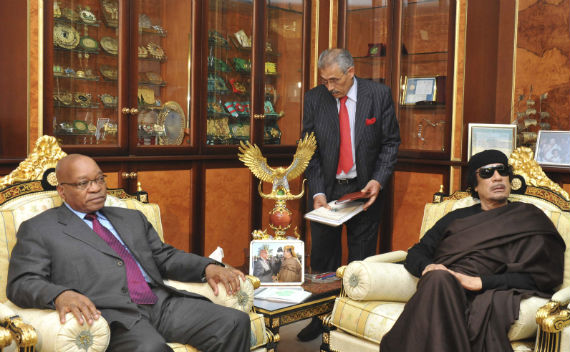
While he was president, Zuma, spoke at a high-level Africa Union panel on Libya in Pretoria during 2011, warned NATO against the “political assassination” of Muammar Qaddafi. Following the line of other African heads of state, Zuma said that UN Security Council Resolution (UNSCR) 1973 authorized military action only for the protection of the Libyan people and to facilitate humanitarian relief — not regime change. Zuma also called for a negotiated compromise between Qaddafi and the rebel Transitional National Council.
It was mentioned that the African National Congress (ANC), was a liberation movement during the days of apartheid and received funding and political support from Qaddafi. Further, many of Zuma’s ANC constituents will not be happy at the spectacle of NATO bombs apparently intended to bring about regime change.
The Libyan crisis has gone on longer than most observers expected when South Africa voted on March 17 for UNSCR 1973. Zuma must walk a fine line as he seeks the leadership of the African Union, preserves his liberation credentials — and yet also looks over his shoulder at the Democratic Alliance (DA), which did better than many expected among black voters in April’s local government elections, despite its image as a predominately white and middle class party.
https://www.cfr.org/blog/jacob-zumas-tightrope-walk-libya
*
Die magte is sterk aan die werk as daar rewolusie op die grond is. Dalk daarom wat daar al vir 60 jaar plus soveel radikale rewolusies veral in Suid-Afrika en selfs op ander kontinente plaasvind. Dit is nie net die radikale magte nie, maar elke immigrant word waarskynlik vergoed hiervoor (soros).
Die manier om geld te maak, volgens John D Rockefeller hom uitgespreek is om te koop wanneer bloed in die strate loop. ’n Makliker manier is wanneer ’n ander roofsugtige olieman – sê maar ’n Libiese diktator – dit vir jou gee, soos wyle Muammar Ghaddafi na bewering aan oudpresident Jacob Zuma gedoen het toe ware bloed in Ghaddafi se strate geloop het. Die geld, $30 miljoen in kontant, was blykbaar ‘n reëndagfonds om vir Gaddafi se verwagte regsprobleme te betaal; of dalk om ‘n erf in Nkandla te koop, ‘n nuwe begin, miskien, weg van ‘n land wat aan die brand is?
&
“The way to make money,” predatory oilman John D Rockefeller once said, “is to buy when blood is running in the streets.” An easier way is when another predatory oilman — say, a Libyan dictator — gives it to you, as the late Muammar Gaddafi allegedly did to former president Jacob Zuma when real blood was running in Gaddafi’s streets. The money, $30m in cash, was apparently a rainy-day fund to pay for Gaddafi’s expected legal troubles; or perhaps to buy a plot in Nkandla, a fresh start, maybe, away from a country on fire?
https://www.businesslive.co.za/fm/fm-fox/trending/2019-04-11-this-is-real-blood-money/
*
Wie skuil agter die geweldadige optredes en veral rewolusies in Afrika – gaan dit oor die inhoud van die grond en minerale om dit te beheer?
Daar is daarop gewys dat die Noord-Atlantiese Verdragsorganisasie (NAVO), wat aan die stuur van bomaanvalle in Libië staan, regimeverandering en politieke sluipmoorde in Libië nastreef, in plaas daarvan om by ‘n VN-resolusie te hou om burgerlikes te beskerm. Daar is gesê dat die Verenigde Nasies se resolusie 1973, wat slegs bedoel was om ‘n vliegverbodsone af te dwing en burgerlikes in die burgeroorlog te beskerm, misbruik word vir regimeverandering, politieke sluipmoorde en buitelandse militêre besetting.
Die mening was dat hierdie optrede die pogings van die Afrika-unie ondermyn het om oplossings te vind vir die probleme waarmee sy lidlande te kampe het. Dit staan ook in die gesig van alle pogings om die heiligheid van internasionale reg te bevorder,” het hy gesê en alle partye versoek om menseregte te respekteer en aan internasionale humanitêre reg te voldoen.
NAVO-leiers het herhaaldelik gevra dat Muammar Ghaddafi moet gaan en lugaanvalle het glo een van sy seuns doodgemaak, hoewel Westerse leiers die moontlikheid van ‘n landinval of besetting uitgesluit het. Zuma het Libië sedert Maart twee keer namens die Afrika-unie (AU) besoek om ’n oplossing vir die burgeroorlog te soek. Op sy laaste besoek het hy die AU-plan gelewer wat die omstrede regering van Libië aanvaar het, terwyl die rebelle die plan verwerp het.
&
During a meeting on Wednesday, June 15, 2011 in Pretoria, Zuma has spoken out against what he termed the “misuse of the good intentions in Resolution 1973”, which was put in place as a means of dealing with the Libyan conflict. Addressing Parliament on the Tuesday, Zuma said the events in Libya have “re-emphasised the urgency for the full operationalisation, without delay, of the African Peace and Security Architecture, and also the reform of the UN Security Council.”
It was pointed out that the North Atlantic Treaty Organisation (NATO), which is at the helm of bombings in Libya, was pursuing regime change and political assassinations in Libya, instead of sticking to a UN resolution to protect civilians.
He said the United Nations Resolution 1973, which was only meant to enforce a no-fly zone and protect civilians in the civil war, was being abused for regime change, political assassinations and foreign military occupation.
The opinion was that these actions undermined the efforts of the African Union in finding solutions to the problems facing its member states. It also flies in the face of all efforts to promote the sanctity of international law,” he said, urging all parties to respect human rights and comply with international humanitarian law.
NATO leaders have repeatedly called for Muammar Gaddafi to go and air strikes have reportedly killed one of his sons, although western leaders have ruled out the possibility of a land invasion or occupation.
Zuma has visited Libya twice since March on behalf of the African Union (AU), seeking a solution to the civil war. On his last visit, he delivered the AU plan which the embattled government of Libya accepted, while the rebels have rejected the plan.
https://www.sanews.gov.za/africa/zuma-weighs-nato-bombings-libya
*
JULY 2011 – ZUMA MEETING (LIBYA)
At the 5 July 2011 meeting, NATO Secretary General Anders Fogh Rasmussen spoke during a break from a meeting of the NATO-Russia Council in the Black Sea resort of Sochi, where Russian President Dmitry Medvedev also met South African President Jacob Zuma to discuss the situation of Libya.
Russia abstained from the U.N. Security Council resolution in March that authorised military intervention to protect civilians. It has criticised the NATO operation, but also joined Western nations in calling for Gaddafi to give up power.
It was stated by Medvedev they looked at Libya’s future practically identically, and everyone would like Libya to be a modern state, naturally, and a sovereign and democratic state.
Asked about the rebel declaration that Gaddafi is welcome to remain in Libya under international supervision if he gives up all power, Rasmussen made no direct statement about NATO’s position on the offer.
*
*
SACP and Ukraine – Russia
https://www.youtube.com/watch?v=6tEKLE77jfA
*
*
*
RELATED
Libya and war
Zuma – Gaddafi – SA Parliament
2013-14 Ukraine bloodiest days
Ukraine
Behind the Deep state Ukraine-USA (Alex Newman)
Sardinia island Nato
Contact Admin:
Admin kan gekontak word by
volksvryheid9@gmail.com
*


[…] The three Visegrad countries were duly invited to join Nato at the 1997 Madrid Summit, joining in 1999. Slovakia was forced to wait until 2004. The move was widely supported by the people of the countries which joined. Hungarians voted 85.3% in favour of Nato membership in a referendum, for example.The bedrock of the Nato-Russia relationship, the Nato-Russia Founding Act, was also signed at the 1997 Madrid Summit alongside the enlargement invitations. As the second formal agreement of the post-Cold War era between Russia and Nato, the act confirms that “Nato and Russia do not consider each other as adversaries”, and that Nato transformation is “a process that will continue”. It is, therefore, clear that Nato enlargement, was not considered a primary security concern for Russia.The Baltic States openly pursued Nato membership, following the signing of the Baltic Charter of Partnership with the US in 1998. Rather than oppose Baltic membership, Russia actually helped it to happen by resolving border disputes with Lithuania.https://theconversation.com/ukraine-the-history-behind-russias-claim-that-nato-promised-not-to-expand-to-the-east-177085**** *RELATEDNato …Zuma – Libya (Nato) […]
LikeLike
[…] Zuma – Libya (Nato) […]
LikeLike
[…] Zuma – Libya (Nato) […]
LikeLike
[…] Zuma – Libya (Nato) […]
LikeLike
[…] Zuma – Libya (Nato) […]
LikeLike