*
Die siektestoestand, rivierblindheid of onchocerciasis word 100% deur ‘n vlieg se byt wat oorsit en parasiete veroosaak wat wyd in Afrika, Yemen sowel as Suid-Amaerika voorkom. Dit tas die vel aan, maar veral oë, wat blindheid kan veroorsaak. Die vlieg kom nie normaal voor in Suid-Afrika nie, maar met toerisme is dit ‘n skrale moontikheid en veral migrasies uit daardie lande kan dit ook beïnvloed. Daar is selfs moontlikhede dat ander lande se burgers in hierdie lande gaan werk, wat dus meer permanent van aard is, wat die siekte of parasiete ook kan versprei.
*
Daar word gemeld dat toeriste wat die lande besoek het, het ook nagevolge ontwikkel van die parassiet of vlieg se byt .
Of daar ooit ‘n studie in ander lande gedoen is waar dit ook mag voorkom, is moeilik om te bepaal. Die feit dat daar soveel migrasies (immigrante) van mense plaasvind, dat niemand werklik aan die einde kan noem dat dit wel so versprei nie. Dit is beslis nie onmoontlik dat hierdie vlieg wat in riviere voorkom, ook na ander lande kan versprei nie. Dit het al in die geval van muskiete soos malaria voorgekom. Dit is ook soos ander plae, net ‘n plaag wat wel kan versprei of selfs in voedsel wat besmet is, kan versprei. Miljoene mense word hierdeur geraak en lewensgehaltes word verswak indien dit nie behandel word nie.
*
Die Mayokliniek
Infections due to Onchocerca spp. are found in tropical climates and are currently endemic in 37 countries, of which 30 are in sub-Saharan Africa. It is also called river blindness because the Blackflies that transmit infection breeds in rapidly flowing fresh water streams and rivers. Because the vectors – blackflies of the genus Simulium – are insects that breed as larvae in fast-flowing rivers and streams and bite humans near these sites, the disease is also known as “river blindness
This review features state-of-the-art data on the parasite, its endobacteria Wolbachia, the prevalence of the infection and its geographical distribution, its diagnostics, the interaction between the parasite and its host, and the pathology of Onchocerciasis. By development and optimization of the control measures, transmission by the vector has been interrupted in foci of countries in the Americas (Colombia, Ecuador, Mexico, and Guatemala)and inSudan, followed by Onchocerciasis eliminations. The current state and future perspectives for vector control and elimination strategy are described.
Onchocerciasis’ physical manifestations include troublesome itching, skin rash, visual impairment, and irreversible blindness; these manifestations result from dying and dead microfilariae inciting an immunologic and inflammatory response, ultimately resulting in tissue damage and scarring. The disease is second to trachoma as the leading cause of blindness due to infection in the developing world The endemic area starts from Senegal in the west to Ethiopia in the east and extends to the south of the equator from Angola in the west to Tanzania in the east. Pockets of Onchocerciasis exist in Sudan and Yemen. The disease was previously endemic in small foci in 6 Latin American countries (Brazil, Colombia, Ecuador, Guatemala, Mexico, and Venezuela)
Lees meer daaroor:
https://www.mayoclinic.org/drugs-supplements/ivermectin-oral-route/description/drg-20064397
*
Onchocerciasis (pronounced “on·ko·ser·kai·a·sis”), is a disease caused by a parasitic worm called Onchocerca volvulus. The parasite is transmitted through bites from Simulium blackflies, which are known to live and breed near fast-flowing streams and rivers. Those who are consistently bitten by infected flies may develop an itchy skin rash, sight-threatening eye disease and/or nodules beneath the skin. Treatment for the condition includes persistent administration of ivermectin and doxycycline until symptoms are no longer present.
The name “river blindness” — a common moniker for onchocerciasis — is a combination of the breeding place (typically a river or fast-flowing stream) of the flies that transmit the infection and a symptom of the disease (vision loss or blindness ). Incidents of river blindness tend to occur in tropical climates, with a majority of cases occurring in sub-Saharan African countries. A study released by The Global Burden of Disease in 2017 estimated that at least 20.9 million people are infected with onchocerciasis worldwide. It usually takes several fly bites to become infected with a river blindness parasite. Those affected typically work or live in remote areas near rivers where the Simulium blackflies breed.
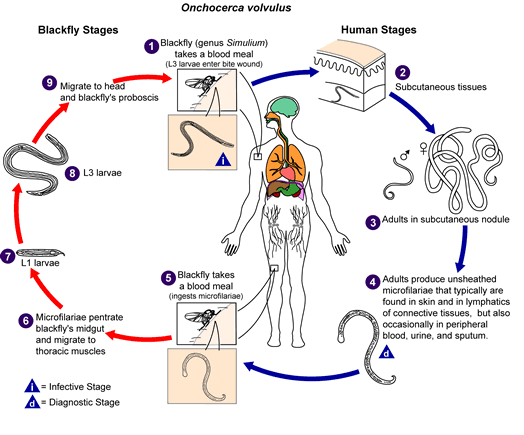
Onchocerciasis is transmitted when a female blackfly infected with the parasitic worm (Onchocerca volvulus) bites a human host. Baby worms (called larvae or microfilariae) are passed through the blackfly’s bite. Once transmitted, the larvae migrate to the skin and eyes, among other organs. The larvae use these locations to settle and mature into adult worms over 6 to 12 months. Adult worms may live for 10 to 15 years, producing millions of microfilariae during their lifetime. If an uninfected female blackfly bites a person who is infected with the parasite, the fly will become infected by ingesting the larvae in the infected person’s blood. The larvae will then grow and develop in the blackfly, which can then transmit the larvae to another human host.
River blindness symptoms affect the eyes and skin and fluctuate depending on where the parasites are in their life cycle. Symptoms commonly associated with the condition include:
- Changes in the skin, such as pigmentation and elasticity, that make the skin appear thin
- Severe itching of the skin and eyes
- Eye lesions
- Cataracts
- Nodules under the skin that form around adult worms
- Swollen femoral lymph nodes resulting in an enlarged groin
- Intense skin inflammation in response to the death of microfilariae
- Light sensitivity (photophobia)
- Vision loss or blindness
Tourists who have been bitten several times by an infected female blackfly but have not had prolonged exposure can develop what’s considered a “light infection.” This is typically more difficult to diagnose than cases identified in infected residents.
>
- Eye exam – Larvae that have migrated to the eyeballs can be detected through a slit-lamp eye exam. Larvae typically nest in the anterior (front) part of the eye, which results in the appearance of lesions. These lesions are visible and can be easily detected with an eye examination.
https://www.allaboutvision.com/conditions/infections-allergies/onchocerciasis/
https://www.allaboutvision.com/eye-care/eye-exam/what-to-expect/
There are various factors to blindness and vision.
https://aho.org/fact-sheets/blindness-and-vision-impairment-factsheet/
*
SUID-AFRIKA
Eintlik is Ivermektien reeds ‘n wettige middel, as daar na die persverklaring geluister word en dis veilig. Miljoene het in Afrika en ander lande oorleef met rivierblindheid en ook genees aan die einde van die dag. Sowel ander siektestoestande soos velprobleme en luise, ens. Rivierblindheid kom voor in verskeie Afrika lande sowel as Yemen en Suid-Amerika. Niemand weet ook nie of die vlieg wat rivierblindheid veroorsaak, nie reeds versprei het met migrasies uit hierdie lande nie. Die ander naam vir rivier blindheid is Onchocerciasis. Hierdie tipe van parasiet is al in die vorige eeu ondersoek en blindheid is heelwat voorkom, lewensgehaltes is verbeter en persone is genees.
https://aho.org/fact-sheets/blindness-and-vision-impairment-factsheet/
Lees meer oor die vlieg wat so wyd verspreid is oor verskillende lande: Dit is parasiete wat dit veroorsaak: Onchocerca volvulus,’n swart vlieg wat in riviere voorkom en ook uitgebroei het.
https://www.who.int/news-room/fact-sheets/detail/onchocerciasis
*
Meer inligting beskikbaar oor Ivermektien kan gelees word
Ivermektien – Ivermectin – Hannes Strydom
Ivermectin – India and Brittain
Quercetin – immune system
Zinc – Ivermectin – Doxycycline – virus
Ivermectin – Stromectol – Mectizan – Ivomec
Ivermectin – Covid-19 – Prof Thomas Borody
Ivermectin – Japan – Satoshi Ōmura
Ivermectin – Prof Paul Marik
COVID-19: The Ivermectin African Enigma
Ivermectin SA Doctors and Afriforum
Ivermectin – FDA approved
Ivermectin – Nigeria
Ivermectin – Carte blanche
IVermectin – IVermektien
FLCCC Alliance – Ivermectin …
Ivermectin – FLCCC
*
Contact Admin:
Admin kan gekontak word by
volksvryheid9@gmail.com
*

 ONAFHANKLIK