*
Die Britte het wetgewing in 1809 in plek gestel rakende die dra van pasboekies, veral onder slawe en werkers. Dit was nooit die sogenaamde ‘apartheidsregering’ van 1948-1994 wat dit ingestel het nie. Selfs die Boere en Boere republieke was nie hiervoor verantwoordelik nie. Daar was heelwat misdaad in die Kaapkolonie veral, en die owerhede destyds was meer as moeg vir misdaad wat deur die loslopers gepleeg is. Hierdie tipe van regulasies was reeds voor 1809 in werking, naamlik 27 Junie 1797, want dit het oor misdaadprobleme gegaan.

*
Later in 1910 is die Kaapkolonie en Natal, ingesluit in die Uniewording en regering wat ook uit Brittanje beheer is. Die dra van pasboeke is ook later in die ou reservate oftewel tuislande uitgevoer. Daarmee saam het die aandklokreël gegaan. Onlangs moes almal van ons ‘gehoor’ gee aan die beperkte beweging met die sogenaamde Covid siektestoestand. Heelwat persone dra hul eie identiteitskaart sowel as hul werkgewer(s) se identiteits en veiligheidskaarte om te toon as hul aan diens gaan of diens verlaat.
*
That is all what it is – an identity card as in 2024. This is or was not the same type of card from Home Affairs. Today all businesses require a safer system in place and have an identity card system into place, even for visitors. If you want to enter a mine or the parliament as visiter today, you need the necessary documents. If you travel overseas, you need a passport or visum. Some identification. If you do not have one and enter such a country, if they find you, you will be deported. The first internal passports in southern Africa were introduced on 27 June 1797 by the Earl Macartney in an attempt to exclude all natives from the Cape Colony.
Most of the people issued with identity cards today – to work – even if you want to pay a visit to parliament and municipalties they will give you a ID and visitors’ card.
*
The Cape Colony was merged with other states in the region to form the Union of South Africa in 1910, under Britain.
By this time, versions of pass laws existed elsewhere. A major boost for their utilization was the rise of the mining sector from the 1880’s: pass laws provided a convenient means of controlling workers’ mobility and enforcing contracts.
Outside the “homelands”, black South Africans (from the 1950s, including women) had to carry passbooks at all times in order to prove they were authorized to live or move in “White” South Africa. Pass laws, was an instrument of labour control, typically required proof of employment, and limited the amount of time in which employment could be sought.
The Pass Laws
Something to think about is why so many black South Africans actually supported the NP, something no one ever tells us either. The first pass laws in South Africa were introduced on 27 June 1797 by the Earl Macartney in an attempt to exclude all natives from the Cape Colony.
Introduced in South Africa in 1923, they were designed to regulate movement of black Africans in white urban areas. Outside designated “homelands”, black South Africans had to carry passbooks at all times, documentation proving they were authorised to live or move in “White” South Africa.
The laws also affected other non-white races. Indian people, for example, were barred from the Orange Free State. These discriminatory regulations fuelled a growing discontentment from the black population and the ANC began the Defiance Campaign to oppose the pass laws. The Natives (Abolition of Passes and Co-ordination of Documents) Act, 1952, commonly known as the Pass Laws Act, made it compulsory for all black South Africans over the age of 16 to carry a “pass book” at all times within white areas. The system of pass laws was not the work of the National Party, but something they inherited and could not merely overnight abolish and certainly not at the time, it would have led to a revolution that they would not have been able to contain. The system of pass laws was repealed by the National Party in South Africa in 1986.
*
The Natives (Urban Areas) Act of 1923 deemed urban areas in South Africa as “white” and required all black African men in cities and towns to carry around permits called “passes” at all times. Anyone found without a pass would be arrested immediately and sent to a rural area. It was replaced in 1945 by the Natives (Urban Areas) Consolidation Act, 1945 which imposed essentially the same restrictions. This Act outlined requirements for African peoples’ “qualification” to reside legally in white metropolitan areas. To do so, they had to have Section 10 rights, based on whether
- the person had been born there and resided there always since birth;
- the person had laboured continuously for ten years in any agreed area for any employer, or lived continuously in any such area for less than ten years;
- the person was the spouse, spinster or son under eighteen years of age of an African person, falling into the above two categories, usually lived with him and had originally entered the area legitimately; or
- the person had been granted a permit to remain by a labour bureau.
The ironically named Natives (Abolition of Passes and Co-ordination of Documents) Act of 1952, commonly known as the Pass Laws Act, made it compulsory for all black South Africans over the age of 16 to carry the “pass book” at all times within white areas. The law stipulated where, when, and for how long a person could remain.
The document was similar to an internal passport, containing details on the bearer such as their fingerprints, photograph, the name of his/her employer, his/her address, how long the bearer had been employed, as well as other identification information. Employers often entered a behavioural evaluation, on the conduct of the pass holder.
An employer was defined under the law and could be only a white person. The pass also documented permission requested and denied or granted to be in a certain region and the reason for seeking such permission. Under the terms of the law, any governmental employee could strike out such entries, basically canceling the permission to remain in the area.
A pass book without a valid entry then allowed officials to arrest and imprison the bearer of the pass. These passes often became the most despised symbols of apartheid. The resistance to the Pass Law led to many thousands of arrests and was the spark that ignited the Sharpeville Massacre on March 21, 1960, and led to the arrest of Robert Sobukwe that day. That was promulgated under the Union of South Africa (ruled from London).
Colloquially, passes were often called the dompas, literally meaning the “dumb pass.”
Other movement controls applied to other groups. Indian people, for example, were barred from the Orange Free State.
On July 23, 1986, as part of a process of removing some apartheid laws, the South African government lifted the requirement to carry passbooks, although the pass law system itself was not yet repealed. The system of pass laws was formally repealed on November 13, 1986.
*
*
Verwoerd was not HERE.
British Empire history: Slaves and “Hottentots” : AD 1806-1835
The British, took control in the Cape colony again in 1806 (2nd time), encounter a society in which the use of slaves has long been part of the established system and in which the local tribespeople (the Khoikhoi, known at the time by the Afrikaans word Hottentot) are employed in conditions little better than slavery. This clash of cultures comes at a time when British public opinion is enthusiastic in its support of the campaign against slavery. This campaign achieves its first great success just after the return of the British to the Cape. Parliament enacts in 1807 the abolition of the slave trade, making it illegal for British ships to carry slaves or for British colonies to import them.
*
An early statute of the British in the Cape colony becomes known as the Hottentot Code (officially the Caledon Code, 1809). Look at the real reasons why those code and legislation came into an Act by the British empire. They ruled the country after annexations, not the Boers or anybody else.
It requires written contracts to be registered for the employment of tribal servants and it provides safeguards against their ill treatment. But it also enshrines one familiar condition of serfdom; servants may only leave a farm if a pass is signed by their employer. And today we just wonder why the British people implemented this? Did they experience also same kind of problems?
*
Interesting, but the British missionaries, led by John Philip, are soon protesting at this restriction. From 1826 Philip campaigns vigorously back in Britain and in 1828 the house of commons passes a resolution for the emancipation of the Cape tribes. In the same year the governor of the Cape colony guarantees complete liberty of movement to ‘free persons of colour’.
From the point of view of the certain peoples, the Afrikaners in the Cape Colony, worse is to come. In 1833 the reformed parliament in London passes the Emancipation Act.
All slaves in British colonies are to be freed after a period of ‘apprenticeship’, which in the Cape colony ends in 1838. The Afrikaners in the Cape inevitably feel that alien ways are being imposed upon their long-established culture by a new colonial power, and their sense of isolation is increased by other changes.
In 1820 British families, numbering about 5000 people, are shipped to the Cape colony and are given 100-acre plots of land.
Under the new regime English becomes the language of the law courts. British teachers set up village schools where the lessons are in English. But above all it is British interference in the relationship between the races in southern Africa which gives the most profound offence to the traditionally-minded Boers – and prompts the Great Trek.
*
Again – apartheid WAS NOT created by the Boers in South Africa. The Boers worked all along with themselves in the Boer Republics – they were creating their own cities and towns to live in.
The Afrikaner people have been working most of the time with the British Empire since early days of British annexations, even during the time of Rhodes, the Union of South Africa, 1910 and later during the 1948 government. Even today, they and all their liberal multi-cultural organisations are together with the British empire and ANC.
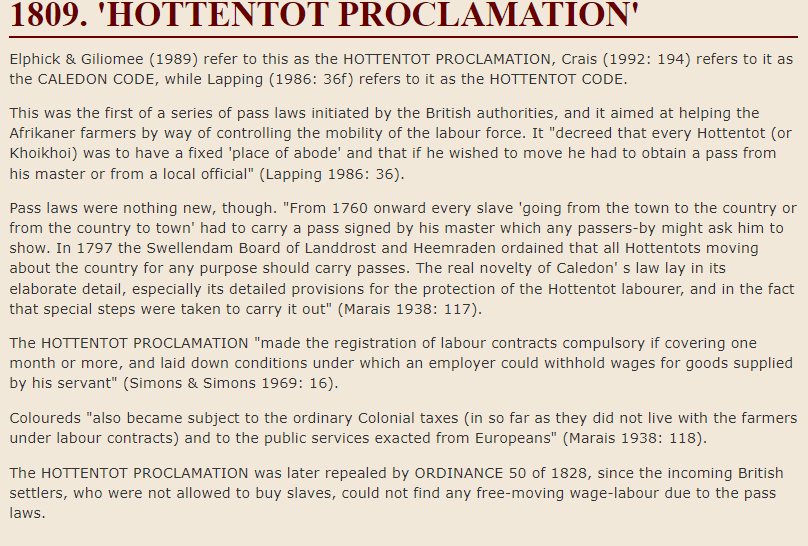
This was the first of a series of pass laws initiated by the British authorities, and it aimed at helping the Afrikaner farmers by way of controlling the mobility of the labour force. It “decreed that every Hottentot (or Khoikhoi) was to have a fixed ‘place of abode’ and that if he wished to move he had to obtain a pass from his master or from a local official”.
Pass laws were nothing new, though. “From 1760 onward every slave ‘going from the town to the country or from the country to town’ had to carry a pass signed by his master which any passers-by might ask him to show. In 1797 the Swellendam Board of Landdrost and Heemraden ordained that all Hottentots moving about the country for any purpose should carry passes. The real novelty of Caledon’ s law lay in its elaborate detail, especially its detailed provisions for the protection of the Hottentot labourer, and in the fact that special steps were taken to carry it out”
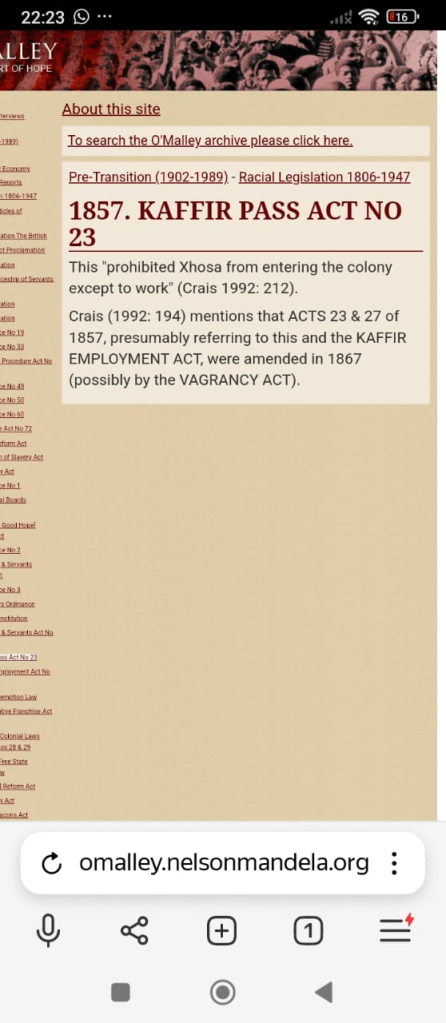
https://omalley.nelsonmandela.org/omalley/index.php/site/q/03lv01538/04lv01646/05lv01649.htm
*
The British, taking control in the Cape colony, encounter a society in which the use of slaves has long been part of the established system and in which the local tribespeople (the Khoikhoi, known at the time by the Afrikaans word Hottentot) are employed in conditions little better than slavery.
This clash of cultures comes at a time when British public opinion is enthusiastic in its support of the campaign against slavery. This campaign achieves its first great success just after the return of the British to the Cape. Parliament enacts in 1807 the abolition of the slave trade, making it illegal for British ships to carry slaves or for British colonies to import them.
An early statute of the British in the Cape colony becomes known as the Hottentot Code (officially the Caledon Code, 1809). It requires written contracts to be registered for the employment of tribal servants and it provides safeguards against their ill treatment. But it also enshrines one familiar condition of serfdom; servants may only leave a farm if a pass is signed by their employer. And today we just wonder why the British people implemented this? Did they experience also same kind of problems?
*
Op 1 November 1809 het die graaf van Caledon, die eerste burgerlike goewerneur van die Kaapkolonie sedert sy besetting deur Brittanje in 1806, een van koloniale Suid-Afrika se mees berugte stukke wetgewing aanvaar, naamlik die pasboek of ook bekend as die ‘Caledon-kode’.
https://journals.co.za/doi/pdf/10.10520/AJA02590190_651
https://www.africabib.org/rec.php?RID=296785326
*

Gedurig word vals beskuldigings voor ons Boere volkslede se deure geplaas, veral oor die maak van hierdie proklamasies, regulasies en wetgewings wat afgedwing is deur die Britse regering en hul leiers in veral die Kaapkolonie, wat later in die res van die land geskied het. Dit is ons, veral die Boere kinders en nageslagte van die Boere republieke, wat vandag onder hierdie vals vlag van Britse imperialisme die blaam kry vir iets wat nie deur ons of ons kinders gedoen is nie. En dit word steeds voortgesit deur veral swart en ander etniese groepe vandag.
Regdeur al hierdie tydperke was dit die regerings wat hierdie wetgewings uitgevaardig, uitvoer en gemanipuleer het. Daar moet onthou word, die Boere volkslede was net so geweldadig aangeval en verwoes onder die Britse heerskappy.
NIE DIE BOERE NIE.
QUOTE
1 November 1809:
Hottentot Proclamation aka “Hottentot Code / Caledon Proclamation / Caledon Code …
The 1st of the series of Cape colonial laws restricting the rights of the Khoikhoi [and presumably remnant `domesticated` / `civilized` Bushmen] in the Cape Colony is passed (1 November 1809), by the Earl of Caledon:
Du Pré Alexander, 2nd Earl of Caledon KP (14 December 1777–8 April 1839), styled The Honourable Du Pré Alexander (1790-1800) and Viscount Alexander (1800-1802)], 1st (post-1806) civilian British governor of Cape Colony and Irish peer …
The Proclamation ‘protects’ indigenous Khoikhoi by requiring written contracts to employ servants and providing safeguards against ill treatment but curtails their freedom by preventing them from moving away from their ‘original’ farms without a pass signed by employers.
This is later supported by a law passed (1812) mandating Khoikhoi children cared for by settlers for their 1st eight years to be apprenticed for a minimum of ten years.
Under heavy opposition by Christian missionaries, British government repeals the Hottentot Proclamation (1828) through Ordinance 50 stating Khoikhoi no longer have to carry a pass or be forced into labour contracts – repeal of code sets stage for abolition of slavery in all parts of the British Empire via the Emancipation Act (1833).
Note:
Caledon`s father James Alexander, 1st Earl of Caledon (1730-22 March 1802) is an `Irish nabob` …
His career, in India and in the East India Company’s civil service, is of particular significance in the context of his native Ireland … it being an unusual career for a contemporary or near-contemporary Irishman to pursue. It is also significant even in the wider context of the British in India …
Dr P.J. Marshall [Summary of the Caledon Papers at the Public Record Office of Northern Ireland] writes:
“[Among the great fortunes which were amassed in Bengal before the end of the 1760s] … were [those] made by Francis Sykes, Thomas Rumbold and James Alexander, who had all taken a rich harvest out of the early revenue administration, Sykes as Resident at Murshidabad, Rumbold at Patna, and Alexander at both …
… Alexander, one of the relatively few Irishmen in the Bengal civil service, believed that he was worth about £150,000 when he left Bengal in 1772. He acquired nearly 9,000 acres (36 km²) in Ulster, from which he hoped to derive an annual income of some £7,000, and became the 1st Lord Caledon …”
OOK op ander plekke word hierdie proklamasie aangehaal, nooit word daar berigte uit die Britse of statebondslande aangewys dat dit hulle is wat dit alles begin het nie.
Dus word ander etniese volke steeds sedert 1902 gebruik om die Boer te haat met hul “KILL THE BOER”, slagspreke en aanvalle teenoor Boere en hul gesinne.
https://www.wikiwand.com/en/Hottentot_Proclamation
*
*
Deur die Britte uitgevoer in suider Afrika.
NIE DEUR DIE BOERE NIE
https://omalley.nelsonmandela.org/index.php/site/q/03lv01538/04lv01646/05lv01649.htm
*
Contact Admin:
Admin kan gekontak word by
volksvryheid9@gmail.com


[…] Pass Laws – British colony 1797 […]
LikeLike
[…] Pass Laws – British colony 1797 * […]
LikeLike
[…] Pass Laws – British colony 1797 […]
LikeLike
[…] homelands) – Trustland -CPA – landclaimsShepstone : Natal, roots of segregationPass Laws : British colony 1797***SMUTSField Marshal Jan Christiaan Smuts OM, CH, ED, PC, KC, FRS was a prominent South African and […]
LikeLike
[…] Pass Laws – British colony 1797 […]
LikeLike
[…] Pass Laws : British colony 1797 […]
LikeLike
[…] Pass Laws – British colony 1797 […]
LikeLike
[…] Minerals – MineralePass Laws – British colony 1797 […]
LikeLike
[…] british-rule-colonial-rule/*Die Britte het hul eie ‘apartheids’wetgewings in plek gehad lank voor hul gebiede in suidelike Afrika beset het. Die pasboek kom uit hul geledere uit. Hulle het juis die swart hoofmanne gebruik omdat hulle nie met mekaar oor die weg kon kom nie. Later word die blaam van apartheid, gerieflik voor onskuldige blankes, die Boere volk, geplaas. Die britte het gebiede wat hul geannekseer en afgeneem het – die swartes was Reservate en Khoi san / Griekwa Britse kroongebiede genoem. Die Boere republieke is later geweldadig afgeneem met minerale regte as kolonies en moes inval by die 1910 planne van die liberaal verligte Afrikaners en Britte. Die pad van Rhodes loop regdeur van die Kaapse seeroete tot by die Suez kanaal in Egipte en Palestina. Uitbuiting om volke te verminder en selfs te vernietig op hul pad. Pass Laws – British colony 1797 […]
LikeLike
[…] Pass Laws – British colony 1797 […]
LikeLike
[…] Pass Laws – British colony 1797 […]
LikeLike
[…] Boere veral. Die Unie van SA het in 1910 daarmee voortgegaan – Afrikaners en Britte.Pass Laws – British colony 1797Apartheid – […]
LikeLike
[…] geword het. Selfs die pasboek is deur Engeland se groot menere uitgevaardig en toegepas. 1797Pass Laws – British colony 1797 Smuts het sy rol gespeel met die opstel van die VN se statute en grondwet (kastige menseregte), […]
LikeLike
[…] Pass Laws – British colony 1797 […]
LikeLike
[…] Pass Laws – British colony 1797Minerale en Apartheid tot datum -Brittanje […]
LikeLike
[…] Pass Laws – British colony 1797 […]
LikeLike
[…] Pass Laws – British colony 1797 […]
LikeLike
[…] Pass Laws – British colony 1797 […]
LikeLike
[…] Pass Laws British colony 1797 […]
LikeLike
[…] Pass Laws – British colony 1797 […]
LikeLike