*
Indien al die Tuislande, veral die TBVC lande, onafhanklikheid verkry het, was hul vandag welaf, meer opgevoed en onafhanklike lande om hulself te regeer. Die liberales en kommuniste, die wat agter die vernietiging sit, wou nie gehad het lande in Suid-Afrika moet vooruitgaan nie. Nissan is ‘n groot baken vandag, wat bereik was al vir langer as 60 jaar. Hier het alle kleure en rasse gewerk, nie net blankes nie. Nissan het gesorg vir baie geleerdheid en was vir baie ‘n heenkome vir voedsel en vooruitgang.

*
Een van die trotse groeipunte wat behoue gebly het en heelwat families van werk voorsien het. Dit gaan ver terug in ons mooi land se geskiedenis. Ongelukkig na 1994 het alles verval, is vernietig en die mooi saam het by die agterdeure uitgewaai. Dit is wat kommunisme, sionisme, swart bemagtiging en regstellende aksie doen. Ons kon al ‘n baie vooruitstrewende land gewees het, maar danksy die ANC-PAC-SAKP-DA-EFF en ander partye , word alles eenvoudig verswart met B-BBEE en EE, of vernietig en afgebrand.
Die groeipunt wat miljoene gevoed en geklee het vir meer as 60 jaar. Die spul wat alles net wil afbreek met swart bemagtiging en regstellende aksie. Julle is ‘n spul doringbosse wat net kan krap – julle is te lui om te werk en ‘n sent op die tafel te plaas vir voedsel en opvoeding.
Dit sluit die spul immigrante uit die noorde in, wat net eise stel. Hulle wil nie hul eie lande opbou nie, daarom is hulle hier om alles te plunder en af te brand.
*
South Africa – If you, like me, still remember where and when you saw your first Datsun Z – parking lot, Rand Easter Show, 1980 – it is because they were so rare. They were rare because it took 27 years before the Z was officially imported into South Africa. So, in the meantime and being a ‘Datsun-bedinges’ country, we made our own Z.
*
In the 1960s, the brothers Thys and Andries Bekker imported the first Datsun 1000 pick-up to South Africa. In 1965, the assembly of Datsun automobiles began at Motor Assemblies. The Datsun 1200 was the first Japanese passenger car to be imported in South Africa in 1966. Other sources cite the year 1959.
After the assembly plant Motor Assemblies, in which models of different brands were produced, was taken over by Toyota end of 1964, it came to the founding of the Rosslyn Motor Assemblers Ltd. and to the construction of an assembly plant mainly for Datsun models in Rosslyn.
Opened in 1966, the factory was initially a free assembly plant for the South African market, as the Bekker brothers awarded the Nissan concession to the mining company Messina Transvaal, which was interested in a greater diversification of the assembly. Other sources name the year 1965 as the opening year.
The company was renamed Datsun Nissan South Africa Ltd. in 1973 and, according to one source, focused on the sole production of Nissan products sold under the Datsun brand Ten years later (1983) the name of the company was changed to Nissan SA. The Rosslyn plant employs around 2,000 people.
In addition to Datsun models that were produced between 1967-1973, vehicles of the Alfa Romeo brand were also produced. From 1971 to 2008, the pick-up model Nissan 1400 was built exclusively in South Africa (initially as Datsun 1200, then as Datsun 120Y or 1400). Other models made only in South Africa were the Datsun 140Z (mid-1970s) and the Datsun 160Z (1978-1980).
In the years 1976 to 1978 (or 1976 and 1978) Nissan was with its brand Datsun the leading supplier in South Africa. Nissan had in 2014 in Sub-Saharan Africa (excluding South Africa) the second largest market share.
In total, around 275,000 copies of the Nissan 1400 were sold
https://en.wikipedia.org/wiki/Nissan_South_Africa
*
Diegene wat nie weet wat werk is nie, moet eerder teruggaan na hul eie lande toe, veral immigrante wat ronddrentel op soek na ‘n motorband wat hulle aan die brand kan steek. As burgers nie hul eie werksgeleenthede oppas sonder swart bemagtiging en regstellende aksie nie, ander gaan dit nie doen nie.
Nissan is al vir dekades, bykans ‘n eeu, groeipunte op verskillende vlakke in die besigheidsbedryf. Dit is ‘n trots wat eg Suid-Afrikaners opgebou het en die wat so op die plunder en afbrandwa spring, het geen idee hoe om te werk nie. Nissan is op die grense van Bophuthatswana en Suid-Afrika.
Bophuthatswana was een van die tuislande wat selfs oor ‘n eie geldstelsel beskik het. Goeie goue jare, – vra gerus aan die ou gardes wat hier gewerk het. Hulle het kos op hul tafels gehad en ‘n inkomste, selfs geleerdheid – want baie is opgelei in die motorbedryf. Maar die mense wil duidelik nie werk nie, daarom vernietig hulle eerder alles – hulle kan ure vir werk staar en kyk, sonder om ‘n vinger te verroer om hulself te help. Dit was NOOIT maklike jare nie, sommige broodwinners het 2-3 werke gehad om die pot aan die kook te hou en dan nog te studeer ook.
Stakers en ongeskiktes wat so afbrand, kommuniste, die wiel sal nog draai en daar sal eendag niks voedsel of geld wees nie. Protesters gaan nog baie harde klippe kou om hul honger te stil. Immigrante wat so saamdans en eise stel, gaan stel eise aan jul leiers in jul eie lande, of is julle bang daarvoor? Klippe kou is jul voorland. Niks broei voort uit ‘n brand nie, veral nie motorbande nie, dit produseer nie voedsel nie en nog minder bring dit inkomstes vir ‘n bord kos en klere. Die spul protesters en kommuniste het GEEN trots in wat hulle doen en hulle weet niks hoe om ‘n land met sukses te bestuur nie.
*
WAT ‘N TROTS VIR JOUSELF
BE PROUD OF YOURSELF AND YOUR STUNNING SKILLS
Owned by car enthusiast Freek de Kock, the museum has a collection of 118 Datsun and Nissan vehicles which includes a 240Z, a 1600 SSS, a 1971 first-generation Nissan Skyline GT-R coupe, together with five other GT-Rs including the R35; the 1970 Nissan President V8 limousine that was owned by the late Mozambican President, Samora Machel; a Pulsar; a 1200 GX; a Laurel; and many others.

Verseker sal die motorbedryf ook deur ‘n maalkolk gaan nes ander besighede en staatsentiteite. Swart bemagtiting en regstellende aksie verwoes alles. Die wat nog floreer, moet almal wat so staak en afbrand ook nog vernietig. Daar moet onthou word, die wat vernietig, is op ‘n missie om te vernietig, te plunder , want hulle wil nie werk nie. Sou hulle gewerk het, en dit het betrekking op elke beroep, sou hulle nooit by hulself aan enige staking deelgeneem het om werksgeleenthede te laat uitbrand nie.

Datsun has begun the fifth year of its operations in South Africa since re-entering the market in 2014. The company is strengthening its legacy built between the 1960s and the 1980s, when it had established itself one of the most loved car brands in South Africa. Given Datsun’s reputation for building strong and reliable cars, it’s no surprise that many of the vehicles from that era are still in use decades later. The Datsun Heritage Museum in Bothaville, Free State, serves testimony to the legacy of Datsun enthusiasm.

*
“Before the days of the internet, the cellular phone and even the colour TV, the Nissan 1400 was a trusted partner of South Africans. While fads like bell bottoms, Rubik cubes, Star Wars, Nintendo, dos computers and stone wash jeans came and went the Nissan 1400 bakkie remained ever present.

The longest era in South African motoring history has come to the end with the news that the iconic Nissan 1400 bakkie has reached the last of its production life. And what a good run it’s had, having seen generations of the Volksie Beetle, the original Mini, the Morris Minor, the Ford Anglia, the hugely popular Valiant, and a whole tribe of Ford, Chevrolet and other Yank-tanks come and go.
For close on 37 years the 1400 has been the baby workhorse and inexpensive plaything for thousands of South Africans. During its life span 275,000 of these tough half-tonners were sold fresh from the showroom floor and they just kept on going to be sold again and again to a succession of happy owners.
Not for nothing did it earn the nickname of “die kanniedood kruiwa”, which, roughly translated, means “the wheelbarrow you just can’t kill”.
“The Nissan 1400 bakkie has been the cornerstone on which Nissan’s commercial reputation was built in South Africa,” Chris Schell General Manager Light Commercial Vehicles at Nissan South Africa, told a large group of South African motoring journalists who had been invited to drink a toast to legendary bakkie.
The Nissan 1400 is truly an icon in South Africa’s motoring history and will be remembered for years to come as a true ‘Champion of Africa was said. The Nissan 1400 made its debut in South Africa in 1971. The original Datsun 1200 evolved into the Datsun 1400 in 1980 and became known as the Nissan 1400 in 1990. In both the Standard and Champ guises it has stood strong as one of the most affordable commercial vehicles on the South African market for the last decade. During this period if you wanted to buy any other rear-wheel-drive bakkie you’d have to spend at least an additional R40,000. The winner will walk away with number one of a special build-order of only 150 Heritage Edition 1400’s. The Heritage Edition “specials” will sell for R89,100. The numbered units will carry Heritage Edition decals, a certificate of authenticity, rubberized loadbox, nudge bar, tow bar, bucket seats, spot-lights and a tonneu cover.
*
At a glance history of the Nissan 1400
1971: The Datsun 1200 introduced in SA
1976: Renamed Datsun 120Y bakkie
1979: 40 000 unit sales recorded
1980: Datsun 120Y Improved to 1400cc and named Nissan 1400
1986: Sport and De-Luxe derivatives were introduced
1989: 100 000 sales recorded
1990: Introduction to the current Nissan 1400 Standard Bakkie
1993: Introduction of the Champ derivative
1995: 150 000 sales unit celebration
2004: 250 000 sales unit celebration
2008: 275 000 unit sales recorded
2008: Nissan 1400 farewell/Heritage Edition
https://www.bizcommunity.com/Article/196/454/26579.html
*
2015
In the 2014 Kinsey Report, the NP200 is singled out as the most affordable single cab pickup to own and maintain, beating its nearest rival, the Nissan NP300 Hardbody, in the bakkie-segment. The NP200 also beat all the entry-level vehicles in the passenger vehicle segment to be crowned the most affordable vehicle to maintain overall.

- NP200 is crowned as South Africa’s favourite half-ton bakkie
- 17 412 NP200 bakkies sold in 2014
- Market leadership follows glowing 2014 Kinsey Report and Ipsos Quality Award
Rosslyn, South Africa, 2 FEBRUARY 2015 – Nissan South Africa is celebrating the overwhelming success of its NP200 pickup after final national sales figures for 2014 reported that it had reached a full-year market share of 52.2% for the half ton pickup market.
https://www.datsun.co.za/Unique-all-in-one-finance.html
*
The original Z was launched 50 years ago in 1969 as the Datsun Fairlady Z in Japan and the 240Z in the States. Demand was huge and as far as we know the original 240 never made it to our shores. From around 1974 a few of 260Z and 280Z models were bought in as ‘grey’ imports, i.e. not officially. We had to wait until 1996 for the fourth generation 300ZX to be officially bought into the country.
But Datsun fundies wanted the Z, so Datsun South Africa made its own Z.
In 1976 Datsun modified the 140 GX coupe and called it the 140Z. Visually it had a different grille, spoilers front and back, mag wheels, black bumpers, its own exterior graphics and a 140Z badge on the back.
Under the hood, it was another matter. Datsun called on the legendary master tuner John Conchie at Alconi Developments in Johannesburg. He worked on the camshaft and added Dell’Orto carburettors and suddenly the little 1400 pushed out an astonishing 85kW and 130Nm. 0 – 100 took less than 10 seconds and had a top speed of 181kmh, easily breaking the benchmark 100mph (160kmh) of the time.
Datsun obviously had an eye on the racetrack when they launched the 140Z, and it paid off handsomely with many wins. The greatest win was the gruelling 1978 Wynn’s 1000km race at Kyalami, where they beat BMW 530 and 535, Fiat 131 Abarth, Ford Escort RS and Mazda RX TE. This was not only a testament of the Datsun’s speed but also its reliability.
Datsun Nissan followed up the success of the 140Z with the 160Z in 1978. It was based on the 160Y Coupe with the same engine used in the 160 SSS. It had a high-performance camshaft and two Hitachi side-draught carburettors. The engine had less power – 71kW vs 85kW – than the 140, but more torque. It had better brakes, springs and shocks than the predecessor.
Externally the 160Z had a similar colour scheme to the 280Z Special Edition Zap. The spoilers were different to those of the 140, and the 160 now came standard with the rear window louvre by Perana and special alloy wheels specifically designed by Tiger Wheels.
The Datsun Zs never had huge sales, as they were primarily made as brand builders and race winners. They were expensive for the average buyer but added a lot of lustre to the cars downstream.
The local Z-line was discontinued in 1980 and enthusiasts had to wait another 15 years before the mainstream Z was finally formally imported into South Africa.
https://en.wikipedia.org/wiki/Nissan_South_Africa#Automakers_SA
*
The 1980 Datsun 280ZX was powered by a 2.8-liter inline-6. Power was transferred to the rear wheels via a 5 speed manual gearbox.
Other special features include a golden Z hood badge, gold- or black-colored alloy wheels, commemorative wreath decals on the front fenders and hatch, headlight washers, a new style shift knob, tan or burgundy leather seats, a tinted T-bar roof, and a 40-watt, powerboosted four-speaker sound system.
1980:
Top song (Billboard): “Call Me” by BlondieBest picture: “Kramer vs Kramer”Most popular TV show: “Dallas”Other notable Nissan models of the year: Sunny (B310), Pulsar (N10) 1984 Nissan 300ZX Turbo 50th Anniversary Edition
The 1984 Nissan 300ZX Turbo 50th Anniversary Edition celebrated the five-decade anniversary of Nissan’s founding in December 1933. Only 5,148 of these cars were manufactured for the U.S. market; an additional 300 were built for Canada.
The 1984 300ZX Turbo came equipped with a 3.0-litre V-6. The transmission was either 5-speed manual or 4-speed automatic. Inside the cabin, drivers were treated to peak ’80s design and technologies considered advanced for the time, such as steering wheel audio controls, digital readouts and electronically controlled sport suspension.
The 300ZX 50th Anniversary Edition’s features included: “Nissan 50th Anniversary” commemorative badging, unique front fenders and rear fender flairs, and turbine-style alloy wheels with gold accents on the fins. In the cabin, unique touches included embroidered badging on the leather seats and floor mats, a futuristic digital instrument cluster with a dominant multi-LED sweeping tachometer, speed display and G-force indicator, and a Bodysonic Amplifier with adjustable intensity that added rumble to the front seats based on the sound profile of the music being played from the head unit.
The year 1984 marked not only a milestone for Nissan’s history as a automaker; it also marked the Z as the best-selling sports car in America.
*
The original Datsun Z debuted in 1969, it was a revelation for the automotive world.
https://thevillagenews.co.za/z-special-edition-anniversary-models-a-look-back/
An affordable, reliable sports car with style and comfort that could be used for daily driving was unheard of at the time. With a base price of US$3,626, the Z – known as the Datsun 240Z in North America – was a sports car that was accessible to anyone.
*
Datsun has begun the fifth year of its operations in South Africa since re-entering the market in 2014.
The company is strengthening its legacy built between the 1960s and the 1980s, when it had established itself one of the most loved car brands in South Africa.
Given Datsun’s reputation for building strong and reliable cars, it’s no surprise that many of the vehicles from that era are still in use decades later.
The Datsun Heritage Museum in Bothaville, Free State, serves testimony to the legacy of Datsun enthusiasm. Owned by car enthusiast Freek de Kock, the museum has a collection of 118 Datsun and Nissan vehicles including a 240Z; a 1600 SSS; a 1971 first generation Nissan Skyline GT-R coupe, together with five other GT-Rs including the R35; the 1970 Nissan President V8 limousine that was owned by the late Mozambican President, Samora Machel; a Pulsar; a 1200 GX; a Laurel; and many others.
Most of the cars are in working order. Those that aren’t are being lovingly restored in Freek’s workshop. de Kock has been in love with Datsun cars since he was a boy and started collecting them 11 years ago when his sons took over the family business. “With my sons running the business, it gave me time to focus on my hobbies,” said de Kock. “So, I started collecting cars. I realized that I would never sell the cars I was collecting, and that’s how the idea of a museum came about.”
Initially, de Kock thought it would be difficult to get his hands on the different Datsun models, but as people heard about the museum, he was offered several cars.
“My first car was the 300ZX, which I restored from start to finish,” said de Kock. “I’ve always loved Datsun cars because each one has a stand-out feature and also because both Nissan and Datsun have a well-known history of track performance.”
While the collection doesn’t operate as an official museum, it’s open by appointment to anyone who would like to view the vehicles. When asked why he is so dedicated to this project, Freek said:
“We need to preserve the Datsun heritage because, without heritage, there will never be much of a future.” Des Fenner, Datsun South Africa General Manager, said he and his team are proud of Datsun’s heritage as an iconic Japanese brand, and he is equally proud of South Africa’s heritage as a young democracy. ”
Heritage Day is about celebrating our diverse cultures, and Datsun will continue to support the inspiring people of our rainbow nation with cars they can rely on,” said Fenner.
“Since coming back to South Africa in 2014, we have established ourselves as a brand that people can trust. We look forward to playing a part in the ongoing development of our country.”
*
The Heritage Collection at Zama houses some of the rarest unicorns in Nissans history, from the earliest road cars and the craziest collection of race cars to an unbelievable number of GT-R’s! Watch Sam’s amazement as he tours around the museum checking out some of his favourites.
*
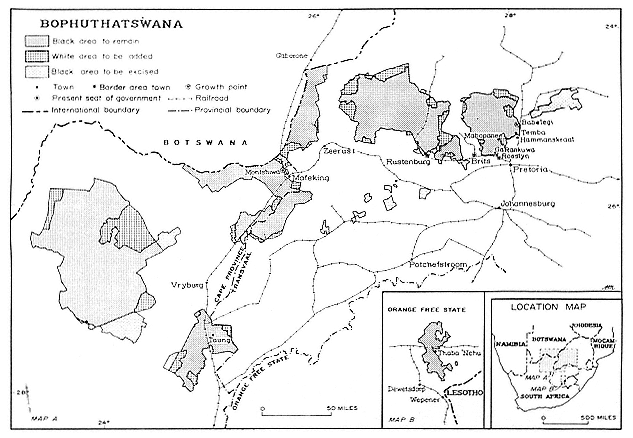
Bophuthatswana was ‘n tuisland, hulle het die grond voor 1830 beset. Dit was nie ‘n koninkryk nie, want daar was destyds slegs hoofmanne wat hul stamme beheer het. Heelwat van daardie Tswana stamme is deur Suid-Afrika en besighede opleiding gegee, veral op groeipunte soos Nissan omgewing sowel Hammanskraal.
Daar is verskeie reservate wat steeds hulle sin is en niemand het hul grond afgeneem of afgegooi van hul gebiede nie. Inteendeel, na 1994 het al die reservate CPA en Trustgebiede geword. En die gedeeltes het heelwat mineral en myne wat opgeskiet het.
Na 1961 het alle swartes in Suid-Afrika STEEDS stemreg gehad en het hul hul eie leiers gekies, met amptelike verkiesings. Reservate het Tuislande geword – hul eie keuses vir onafhanklikheid. . Niemand het ‘n geweer teen hul gehou of geforseer om onafhanklikheid te verkry nie. Suid-Afrika was behulpsaam met verkiesing en het ook opleiding verskaf in hul weermag en polisie dienste.
Ander voorbeelde
ORAL is besigheidsgeleenthede geskep wat triljoene beloop het, met die Suid-Afrikaners (meestal blankes), se belastings en staatskas. Vandag kan hul weinig of NIKS wys nie, want hulle het eerder afgebreek na 1994 as opgebou en gewerk vir ‘n toekoms vir hulself.
Ingonyama Trustgebied (en andere)
Zoeloes (Ingonyama Trust) > Ramaphosa
Trustgebiede>Tuislande>Reservate
South Africa: Traditional leaders
The real South Africa before 1994
*
Contact Admin:
Admin kan gekontak word by
volksvryheid9@gmail.com
*

 ONAFHANKLIK