*
Daar is heelwat diere species wat in Alaska en rondom op eilande voorkom. Hier is ‘n paar van die indrukwekkende species uit die koue Alaska.

Muskox at Alaska – interesting ….
*
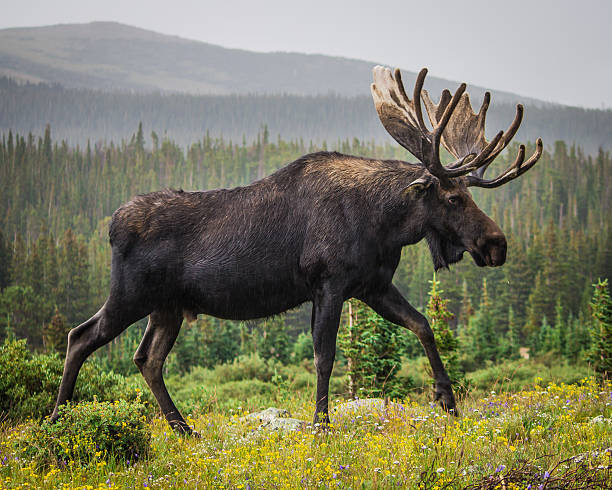
About 175,000 to 200,000 moose are widely distributed throughout Alaska. The following overview offers details according to various regions in the state. AI. Moose are widely distributed across the state, ranging from Southeast Alaska all the way to the Arctic Slope.
*
https://www.youtube.com/watch?v=dfD8lpYkQtc&t=17
Southeast Alaska mainland, Berners Bay, and Gustavus forelands (1C) :Berners Bay: In 1958, 15 calves from the Anchorage area were released in Berners Bay, and a supplemental release of six more calves occurred in 1960. The goal is to maintain a post-hunting survey count of 80 to 90 moose. The population estimate was 100 in 2005 and down to 75 in 2006, mortality due to harsh winter. Gustavus Forelands: Moose colonized the Gustavus area in the 1960s, probably by moving down the Chilkat Peninsula from the Haines area.
This has provided an opportunity to study moose and their impact on habitat as the population has grown. Managers and researchers continue to gather data associated with pregnancy, twinning, rump fat, and body condition – and habitat – to guide the management strategy. Population estimate was 329 (2006), and harvest averages about 42/year.
ELK

Elk in Alaska are limited to island habitats with temperate, maritime climates. They feed on a variety of plants at different times of the year. During the summer months, they favor grasses, forbs, willows, and other leafy greens while in the winter they munch on branches and twigs of trees and shrubs. The last native elk were found in interior Alaska during the “Ice Age” and died out many thousands of years ago. Modern elk populations were derived from Washington and Oregon elk being transplanted to islands in southeast Alaska and Kodiak.
https://alaskawildlife.org/project/elk/
PRAGTIGE FOTOGRAFIE – enjoy all the beautiful photos
https://www.alaskaphotographics.com/alaska-photo-articles/moose-photos/
Two subspecies of elk have been introduced to Alaska. Roosevelt elk (Cervus elaphus roosevelti) are larger, slightly darker in color, and have shorter, thicker antlers than the Rocky Mountain elk (Cervus elaphus nelsoni). In many European countries “elk” are actually what we know as moose (Alces alces).
https://www.adfg.alaska.gov/index.cfm?adfg=elk.main
BERE
• Bruinbere en Grizzlybere (Ursus arctos): Daar is ongeveer 30 000 in die staat. Bruinbere aan die kus word groter danksy ‘n dieet wat uit mariene voedsel en salm bestaan, terwyl grizzlybere in die binneland kleiner is. Die massiewe Kodiak-beer kom uitsluitlik op die Kodiak-argipel voor.
• Swartbere (Ursus americanus): Meer as 100 000 swartbere bewoon Alaska se digte woude en kusgebiede. Hulle het pelse in verskillende kleure (van swart tot kaneelkleurig of blond) en korter, geboë kloue.
• Ysbere (Ursus maritimus): Ongeveer 3 000 ysbere dwaal oor die see-ys in die uiterste noorde en weste rond, en kom laat in die somer aan land naby dorpies soos Kaktovik.
• Brown Bears & Grizzlies (Ursus arctos): Roughly 30,000 live in the state. Coastal brown bears grow larger due to a marine and salmon-rich diet, while interior grizzlies are smaller. The massive Kodiak bear lives exclusively on the Kodiak Archipelago.
• Black Bears (Ursus americanus): Over 100,000 black bears inhabit Alaska’s dense forests and coastal regions. They feature varying coat colors (from black to cinnamon or blonde) and shorter, curved claws.
• Polar Bears (Ursus maritimus): Around 3,000 polar bears roam the extreme northern and western sea ice, coming ashore near villages like Kaktovik in late summer.
Mothers teach their young cubs skills the cubs will need to survive their first winter, and the adult male bears patrol the beaches. The anticipation is palpable – you can sense that the bears know the freeze up is close.
enjoy this film
https://www.youtube.com/watch?v=dlqZXvEr-E8
*
There are the little ones as well
https://www.youtube.com/watch?v=oCh7rnVvif8
*
BRONNE EN INLIGTING
https://www.adfg.alaska.gov/index.cfm?adfg=moose.printerfriendly
*
Contact Admin:
Admin kan gekontak word by
volksvryheid9@gmail.com
*


