*
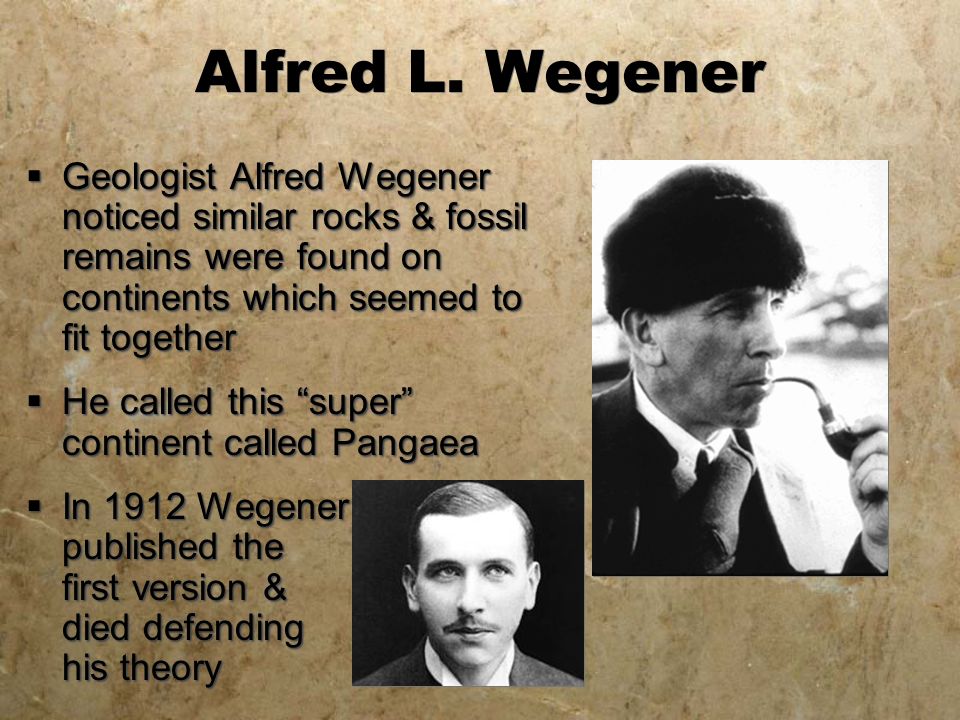
Alfred Wegener proposed the theory of continental drift – the idea that Earth’s continents move. Despite publishing a large body of compelling fossil and rock evidence for his theory between 1912 and 1929, it was rejected by most other scientists. It was only in the 1960s that continental drift finally became part of mainstream science. Read also more about Alexander du Toit of South Africa.
*
Alfred Wegener’s Scientific Legacy
Today, we recognize that continental drift theory is correct.
It was only in the 1960s, when the theory of plate tectonics was recognized as correct, that geologists finally accepted that Wegener’s continental drift theory and the concept of Pangaea were also correct. Wegener’s ideas are now standard concepts in geology, taught to everyone who studies the subject.
More about Afred Wegener
*
Wegener was on his fourth scientific expedition to the Arctic and he was director of the Danish-Greenland polar research camp. He was much better known around the world for his northern exploration than for his relatively obscure ideas about drifting continents. In fact, the New York Times covered his departure at the start of Wegener’s last trip and charitably did not mention his drift theory at all in their lengthy science article.
Wegener’s fourth mission to Greenland included testing a new seismic method to measure the thickness of the icecap that covered the island. He believed it was much thicker than the assumed 3,600 feet previously measured.
Sending sound waves into the ice and timing their returning echoes with seismic equipment would give him a better estimate of the icecap’s thickness. The expedition also involved preparations to establish a permanent station that would gather continuous meteorological data. But food shortages, extremely cold weather, and unpredictable blizzards put outlying camps at risk.
*
Alexander du Toit was a South African geologist who quickly accepted Wegener’s theory. Some consider Du Toit the greatest field geologist who ever lived. From 1903 to 1910, he travelled the whole of southern Africa on foot, ox cart, and bicycle with a mapping table slung over his shoulders. In 1923, he was awarded a Carnegie Institute grant to travel to South America to test his thesis that rock formations that ended on the edge of Africa picked up precisely the same in Brazil. They do, convincing him that continents had once been joined and have drifted apart. Alexander du Toit wrote Our Wandering Continents in 1937 and dedicated the book to Wegener’s memory.
Wegener’s Death and Drift’s Hiatus
*
Alfred Wegener’s Scientific Career
A first job and a world record
After completing his doctoral degree, Wegener started work in 1905 as a scientist at a meteorological station near the small German town of Beeskow.
There, working with his older brother Kurt, he carried out pioneering work using weather balloons to study air movements. If there had been a Guinness Book of World Records in 1906, the Wegener brothers would have won the record for the longest continuous balloon flight ever: 52.5 hours in April of that year.
Greenland
Wegener was delighted to be appointed as the official meteorologist for the Danmark scientific expedition to Greenland, the world’s largest island, which took place from 1906 to 1908. The expedition’s principle aim was to chart the coastline of Greenland’s unexplored northeast coast. During the expedition, Wegener made his mark by building Greenland’s first meteorological station and taking a large number of atmospheric readings using kites and balloons.
The expedition’s work in uncharted territory was dangerous – three expedition members died of starvation/exposure!
University Lecturer
Returning to Germany in 1908, Wegener became an associate professor in meteorology at the University of Marburg. There he quickly gained a reputation for giving lectures that made difficult topics easy for his students to understand.
In 1910 he published his first book: Thermodynamics of the Atmosphere. He also had the first inkling of the idea that would bring him both anguish and long-lasting fame: continental drift.
Continental Drift
Wegener looks at a map and sits up
Looking at a world map in 1910, Wegener noticed how the coastlines of eastern South America and western Africa seemed to fit together, rather like jigsaw pieces.
Publishing fossil and geological evidence
After further research, in 1911 Wegener learned that fossils of the same species were present in Brazil and western Africa. This evidence suggested to him that South America and Africa were in physical contact when the animals and plants that became fossils were alive.
He researched geological data and found evidence of similar rock formations on the two continents.
In 1912, age 32, Wegener gave talks at German universities and published two papers proposing that Earth’s continents moved. His work on continental drift was then interrupted by a second expedition to Greenland followed by the outbreak of World War 1 – Wegener was conscripted into the German Army.
Nevertheless, while recovering from a wound in 1915, he wrote and published his groundbreaking book: The Origin of Continents and Oceans, in which he discussed the movement of Earth’s continents.
He proposed that many millions of years ago Earth consisted of a single great continent surrounded by ocean. Very slowly the land masses of this huge continent moved apart to form the continents we see today. Unfortunately, nobody took much notice of his proposal!
Today we recognize that Wegener’s ancient continent truly existed. We call it by the name Wegener gave it – Pangaea.
More evidence and more book editions
In 1920, 1922, and 1929 Wegener published updated editions of The Origin of Continents and Oceans, adding more evidence each time for his idea that the continents move around the planet at very slow speeds. He also added further evidence he had gathered in Greenland that it had once been linked to North America.
He pointed out that he was not the first person to propose the movement of continents; others had also found evidence from fossils and rocks which strongly suggested continents now far apart were once joined; the American geologist Frank Bursley Taylor had published evidence in 1910 supporting the idea of continental drift.
Wegener’s work was independent of Taylors. In 1920s America, people referred to continental drift as the Taylor-Wegener theory.
Geologists Reject Wegener’s Ideas
Scientists who stray into another field can encounter difficulties, such as those encountered by physicist Luis Alvarez when he proposed a meteor impact had resulted in the extinction of the dinosaurs.
Wegener, an astronomer who had become a meteorologist, encountered vigorous resistance to his ideas from a large majority of geologists.
In compiling a huge volume of convincing evidence for Pangaea and continental drift he had made one or two small errors, and he also made one big error.
Although the rock and fossil evidence he reported should have been more than enough to convince skeptics that his theory was largely correct, Wegener tried to explain why continents move – and got this wrong!
Alfred Wegener
Polflucht
Polflucht is German for pole flight. Wegener proposed that there was a geological force which pushed the continents away from Earth’s poles towards the equator.
Geologists rightly told him this was untrue. Unfortunately they threw the baby out with the bathwater: they rejected Wegener’s truly compelling evidence for continental drift; and they also rejected work which today we recognize as a forerunner of the correct explanation of continental drift – plate tectonics, the idea that solid continents float on a fluid mantle.
The End
Wegener published what would be the final edition of his book The Origin of Continents and Oceans in 1929.
On an unknown day in mid-November 1930, Alfred Wegener died at the age of 50 on his fourth expedition to Greenland.
He had been trying to resupply a remote camp in very bad weather. Temperatures had dropped as low as a deadly -60 °C (-76 °F).
He supplied the camp successfully, but there was not enough food at the camp for him to stay there. He and a colleague, Rasmus Villumsen, took dog sleds to travel to another camp.
Wegener died on this journey, probably of a heart attack. Villumsen buried Wegener’s body in the snow and marked the grave with skis. Villumsen then resumed his journey, but did not complete it. His body was never found.
https://www.thoughtco.com/biography-of-alfred-wegener-1434996
>
In May 1931 Kurt Wegener discovered his brother’s grave. He and other expedition members built a pyramid-shaped mausoleum in the ice and snow, and Alfred Wegener’s body was laid to rest in it. The mausoleum has now, with the passing of time, been buried under Greenland’s ice and snow.
Alfred Wegener was survived by his wife, Else Köppen, whom he had married in 1913, and two daughters: Sophie Käte and Lotte.
Alfred Wegener
*
A brief introduction to Alfred Wegener’s theory of continental drift, which would lay the groundwork for the development of plate tectonic theory, which essentially explains the geology of the Earth.
*
WHERE THE FAULT LIES, Segment Two: From The San Andreas to The Calaveras Fault with Brian Hackney
*
National Geographic Naked Science Grand Canyon Full Movie
*
Alfred Wegener het die teorie van kontinentale drywing voorgestel – die idee dat die aarde se vastelande beweeg wat nie onwaarskynlik te wees nie. Ten spyte van die publikasie van ‘n groot hoeveelheid oortuigende fossiel- en rotsbewyse vir sy teorie tussen 1912 en 1929, is dit deur die meeste ander wetenskaplikes verwerp. Dit was eers in die 1960’s dat kontinentale drywing uiteindelik deel van hoofstroomwetenskap geword het.
Dit was eers in die 1960’s, toe die teorie van plaattektoniek as korrek erken is, dat geoloë uiteindelik aanvaar het dat Wegener se kontinentale drywingsteorie en die konsep van Pangea ook korrek was. Wegener se idees is nou standaardkonsepte in geologie, geleer aan almal wat die vak bestudeer.
Wegener was op sy vierde wetenskaplike ekspedisie na die Arktiese gebied en hy was direkteur van die Deens-Groenlandse poolnavorsingskamp. Hy was oor die hele wêreld baie beter bekend vir sy noordelike verkenning as vir sy betreklik obskure idees oor drywende kontinente. Trouens, die New York Times het sy vertrek aan die begin van Wegener se laaste reis gedek en het glad nie sy dryfteorie in hul lang wetenskapartikel genoem nie.
Wegener se vierde sending na Groenland het die toets van ‘n nuwe seismiese metode ingesluit om die dikte van die yskap wat die eiland bedek het, te meet. Hy het geglo dit was baie dikker as die veronderstelde 3 600 voet wat voorheen gemeet is.
Om klankgolwe in die ys in te stuur en hul terugkerende eggo’s met seismiese toerusting te bepaal, sou hom ‘n beter skatting gee van die yskap se dikte. Die ekspedisie het ook voorbereidings behels om ‘n permanente stasie te vestig wat deurlopende meteorologiese data sou versamel. Maar voedseltekorte, uiters koue weer en onvoorspelbare sneeustorms plaas afgeleë kampe in gevaar.
*
Alexander du Toit was ’n Suid-Afrikaanse geoloog wat Wegener se teorie vinnig aanvaar het. Sommige beskou Du Toit as die grootste veldgeoloog wat nog ooit geleef het. Van 1903 tot 1910 het hy die hele suidelike Afrika te voet, ossewa en fiets gereis met ‘n karteringtafel oor sy skouers.
In 1923 is ‘n Carnegie-instituut-toekenning aan hom toegeken om na Suid-Amerika te reis om sy tesis te toets dat rotsformasies wat op die rand van Afrika geëindig het, presies dieselfde in Brasilië opgetel het.
Hulle doen dit en oortuig hom dat vastelande eens saamgevoeg is en uitmekaar gedryf het. Alexander du Toit het Ons swerwende kontinente in 1937 geskryf en die boek aan Wegener se nagedagtenis opgedra.
*
Sydney Brenner rakende Alexander du Toit, die Kalahari asook sy vermoë om water te wys.
https://www.youtube.com/watch?v=74h0k3STpz8
Wegener was verheug om aangestel te word as die amptelike meteoroloog vir die Denemark
wetenskaplike ekspedisie na Groenland, die wêreld se grootste eiland, wat van 1906 tot 1908 plaasgevind het.
Die ekspedisie se hoofdoel was om die kuslyn van Groenland se onontginde noordooskus te karteer. Tydens die ekspedisie het Wegener sy merk gemaak deur Groenland se eerste meteorologiese stasie te bou en ‘n groot aantal atmosferiese lesings met vlieërs en ballonne te neem.
In 1910 het hy sy eerste boek gepubliseer: Thermodynamics of the Atmosphere. Hy het ook die eerste benul gehad van die idee wat hom beide angs en langdurige roem sou bring: kontinentale drywing.
Polflucht is Duits vir paalvlug. Wegener het voorgestel dat daar ‘n geologiese krag was wat die vastelande van die aarde se pole na die ewenaar weggestoot het. Geoloë het tereg vir hom gesê dit is onwaar. Ongelukkig het hulle die baba saam met die badwater uitgegooi: hulle het Wegener se werklik dwingende bewyse vir kontinentale drywing verwerp; en hulle het ook werk verwerp wat ons vandag erken as ‘n voorloper van die korrekte verklaring van kontinentale drywing – plaattektoniek, die idee dat vaste kontinente op ‘n vloeibare mantel dryf.
https://www.britannica.com/biography/Alexander-Du-Toit
PANGEA
https://www.floridamuseum.ufl.edu/wp-content/uploads/sites/16/2020/05/Florida-Museum-Pangea-Analyzing-Evidence-Worksheet.pdf
https://link.springer.com/book/10.1007/978-3-030-52711-2
Die wetenskaplike van Suid-Afrika
https://plants.jstor.org/stable/10.5555/al.ap.person.bm000070274
South African geologist and palaeobotanist. Alexander du Toit was one of South Africa’s most influential and versatile scientists. Highly esteemed by his contemporaries – the geologist R.A. Daly called him “the world’s greatest field geologist” – he added important knowledge to a variety of subjects (palaeobotany, petrology, hydrogeology, geomorphology, and economic geology), but is most famous as a champion of the theory of continental drift.
Du Toit was a descendent of Huguenot settlers who arrived in the Cape in 1687, and was born on the family estate near Cape Town. After graduating from South Africa College, he qualified in mining engineering at the Royal Technical College in Glasgow and studied geology at the Royal College of Science in London. He was appointed as a lecturer at both the Royal Technical College and the University of Glasgow but returned to South Africa in 1903 to work as an assistant geologist for the Geological Commission of the Cape of Good Hope.
For the next 17 years he mapped the geology of more than 100,000 square miles and drew many of the boundaries shown in the first maps published by the Geological Survey of South Africa. Travelling alone, on foot or by bicycle, with a plane table strapped to his back, he worked almost continuously in the field, mapping the Stormberg series in the east (between Herschel in the north and Cala in the south), the more arid northern country (Bechuanaland, Griqualand West and the districts of Prieska, Kenhardt, Britstown, Carnarvon and Victoria West), and Basutoland and the south and southeastern coasts. He also made the first systematic collections of fossil plants in South Africa, mainly in the Molteno Beds. His carefully detailed reports and maps have been the starting point for all later geological investigations of the region, and they supplied him with the geological evidence to support his theoretical work in the 1920s and 1930s.
Die Legkaart kontinente wys meer in die beeldmateriaal
(Pangea die superkontinent)
https://www.youtube.com/watch?v=_5q8hzF9VVE
*
SOUTH AFRICA
KERKENBERG (MOUNTAIN) KZN
Die berge – Retiefklip
*
Contact Admin:
Admin kan gekontak word by
volksvryheid9@gmail.com


[…] Continental drift – Gondwana – Alfred Wegener (Germany) […]
LikeLike
[…] AND LISTEN MORE ABOUT THE EARTH Continental drift – Gondwana – Alfred Wegener (Germany) KZN Die berge – […]
LikeLike
[…] Continental drift – Gondwana – Alfred Wegener (Germany) […]
LikeLike
[…] Continental drift – Gondwana – Alfred Wegener (Germany) […]
LikeLike
[…] gebiede, moontlik weens vrese van die Afrika wat sal opbreek. Africa topography – NasaContinental drift – Gondwana – Alfred Wegener (Germany)Afar – Africa depression – from spaceSomali Plate – Tectonic historyDaar […]
LikeLike
[…] *The Rovuma Basin, offshore Mozambique & Tanzania became a major global LNG exporting region in late 2022. With over 150 Tcf gas discovered, is further exploration of this basin warranted at this time? Is the crisis offshore East Africa actually that there is too much gas with insufficient infrastructure to get it to market?https://www.youtube.com/watch?v=waM5O27kDjshttps://www.sciencedirect.com/science/article/abs/pii/S1342937X13001676*Continental drift – Gondwana – Alfred Wegener (Germany)Somali Plate – Tectonic history […]
LikeLike