Jura is a canton in Switzerland – Very small country and with the approval also of the other cantons. The population is less than 100000. And they already signed other agreements with countries overseas as business partners. The canton of Jura was a sovereign state within the Holy Roman Empire for more than 800 years but after the Treaty of Westphalia in 1648 the Jura had close ties with the Swiss Confederation.

At the Congress of Vienna in 1815, the Jura region became part of the canton of Bern. This act caused dissention because the Jura was French-speaking and Roman Catholic, whereas the canton of Bern was mostly German-speaking and Protestant. After World War II, a separatist movement campaigned for a secession of Jura from the canton of Bern and a constitution was accepted in 1977. In 1978 the split was made official when the Swiss people voted in favour of the constitution, and in 1979 the Jura joined the Swiss Confederation as a full member. The canton celebrated its independence from the canton of Bern on 23 June 1979.
JURA MOUNTAIN
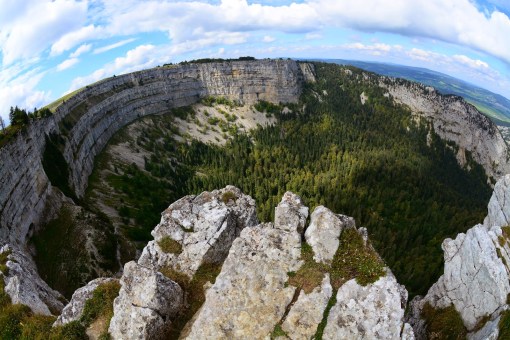
Creux du Van – a breath-taking, gigantic gorge gouged into the Jura landscape in the Val-de-Travers southwest of Neuchâtel – is probably the best-known, and most visited landmark in the entire length of the Jura. Lesser-well-known is its adjacent named peak – Le Soliat – which at 1465 metres comes in at number 53 on our list of highest named Jura peaks. Creux du Van isn’t really a peak, but is named as such in quite a number of references, so we’ve added its highest point (1457 metres) to our list – coming-in at number 57. We’d hiked up here – to the top of the Jura’s “Grand Canyon” – before (on a tough, post-winter, snowy ramble-scramble) in April 2009, but this was our first hike here since we’d started the Jura Mountain Rambling project. The last time it was just Lis and I, but this time we were accompanied by fellow hikers Denis, Gill and Kathy, who were visiting from Canada.
The breath-taking panorama of the magnificent one-kilometre-wide and
400 metre deep Creux du Van crescent.
It’s the biggest (and most spectacular) gorge in the entire Jura.
http://richardmclellan.blogspot.com/2014/09/
***
***
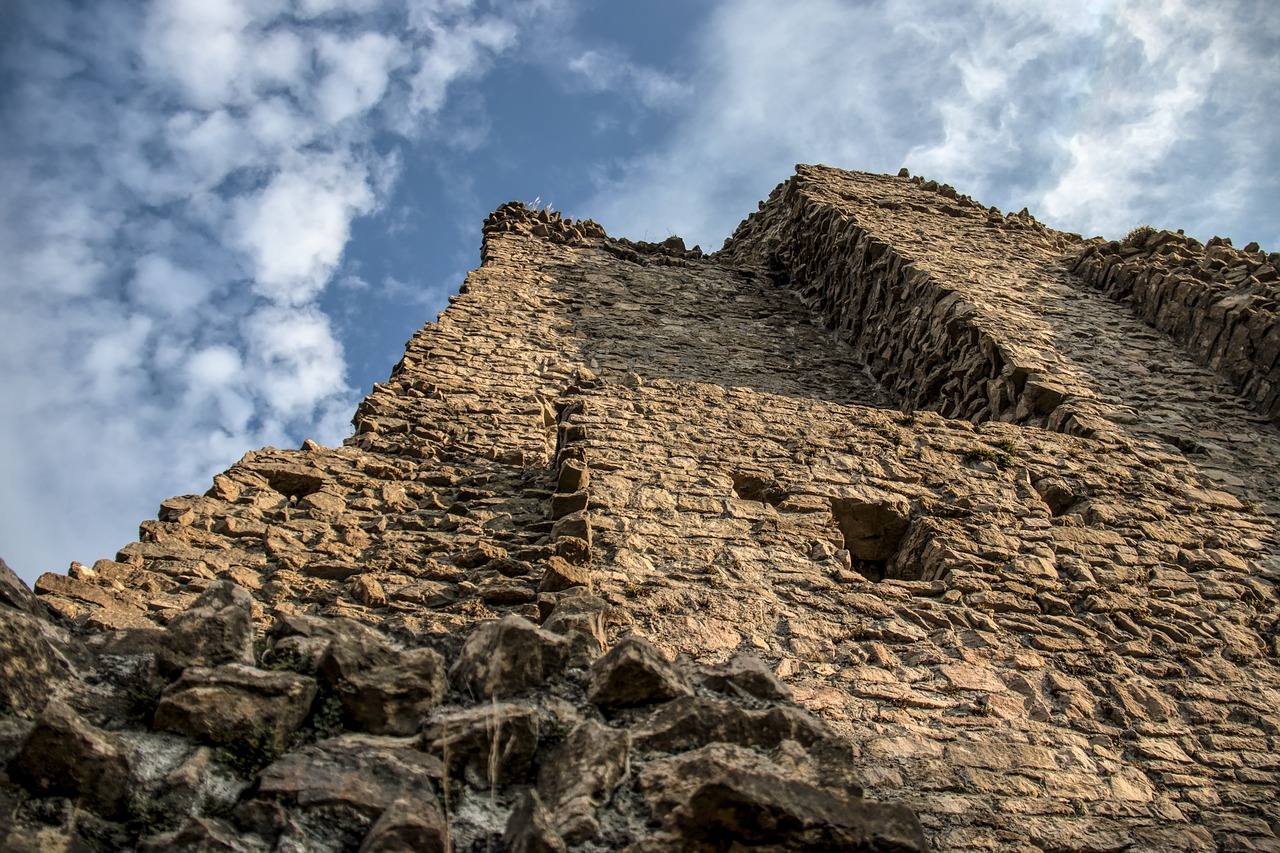
Castles of Switzerland – Schenkenberg Castle – Thalheim – Aargau
https://www.youtube.com/watch?v=5rbFbxwMyMI
***
HISTORY
The King of Burgundy donated much of the land that today makes up canton Jura to the Bishop of Basel in 999. The area was a sovereign state within the Holy Roman Empire for more than 800 years. After the Treaty of Westphalia in 1648 the Jura had close ties with the Swiss Confederation. At the Congress of Vienna (1815), the Jura region became part of the canton of Bern. This act caused dissention. The Jura was French-speaking and Roman Catholic, whereas the canton of Bern was mostly German-speaking and Protestant.
After World War II, a separatist movement campaigned for a secession of Jura from the canton of Bern. After a long and partly militant struggle, which included some arson attacks by a youth organisation Les Béliers, a constitution was accepted in 1977. In 1978 the split was made official when the Swiss people voted in favour, and in 1979 the Jura joined the Swiss Confederation as a full member. The canton celebrated its independence from the canton of Bern on 23 June 1979.
However, the southern part of the region, which is also predominantly French-speaking but has a Protestant majority, opted not to join the newly formed canton, instead remaining part of the canton of Bern. Although this decision may be considered strange linguistically, the choice may have been influenced by the fact that the canton of Bern is financially richer and is at the heart of federal power in Switzerland. The area is now known as Bernese Jura. The word Jura, therefore, may refer either to canton Jura, or to the combined territory of canton Jura and the Bernese Jura. Switzerland as a whole often presents the latter from a touristic standpoint with documentation easily available in French or German.
On creation, the canton adopted the title Republic and canton of the Jura. Other cantons in Switzerland using the title “Republic and Canton” are Ticino, the canton of Geneva, and the canton of Neuchâtel. In each case, the title refers to the autonomy of the canton and its nominal sovereignty within the Swiss Confederation.
Since 1994, the question of the Jura region has again been controversial. In 2004, a federal commission proposed that the French-speaking southern Jura be reunited with the canton of Jura, as the language question now seems to be more important than the denominational one. A possible solution would be to create two half-cantons, as reunification with the creation of only a single canton would mean a complete restructuring of the Jura’s current political system, with the cantonal capital being transferred from Delémont to Moutier.
On 18 June, 2017, the town of Moutier voted to quit Bern and join the canton of Jura. On 17 September, 2017, the nearby municipalities of Belprahon and Sorvilier conversely voted to remain in the canton of Bern. The vote in Moutier has since been declared invalid.

 ONAFHANKLIK