Harvard researchers see alien potential in mysterious object. Is the interstellar object known as “‘Oumuamua” a sign of extraterrestrial life? Avi Loeb, chair of Harvard’s Astronomy Department, isn’t surprised that his idea has drawn skepticism. All the same, he notes, progress begins with an open mind.
*
Surprisingly, our first interstellar guest appeared to be weird and unlike anything we have seen before. By the time we realized it, the guest was already out the door with its image fading into the dark street, so we did not have a chance to get a second look at its mysterious qualities. Below is a list of six peculiarities exhibited by ‘Oumuamua:
- Assuming that other planetary systems resemble the solar system, Pan-STARRS should not have discovered this or any other interstellar rock in the first place. In a paper published a decade ago, we predicted an abundance of interstellar asteroids that is smaller by many (two to eight) orders of magnitude than needed to explain the discovery of ‘Oumuamua, assuming it’s a member of a random population of objects. Put another way, ‘Oumuamua implies that the population of interstellar objects is far greater than expected. Each star in the Milky Way needs to eject 1015 such objects during its lifetime to account for a population as large as ‘Oumuamua implies. Thus, the nurseries of ‘Oumuamua-like objects must be different from what we know based on our own solar system.
- ‘Oumuamua originated from a very special frame of reference, the so-called local standard of rest (LSR), which is defined by averaging the random motions of all the stars in the vicinity of the sun. Only one star in 500 is moving as slowly as ‘Oumuamua in that frame. The LSR is the ideal frame for camouflage, namely for hiding the origins of an object and avoiding its association with any particular star. The relative motion between ‘Oumuamua and the sun reflects the motion of the sun relative to the LSR. ‘Oumuamua is like a buoy sitting at rest on the surface of the ocean, with the solar system running into it like a fast ship. Could there be an array of buoys that serves as a network of relay stations or road posts, defining the average galactic frame of reference in interstellar space?
- Most interstellar asteroids are expected to be ripped away from their parent star when they lie in the outskirts of their birth planetary system (such as our solar system’s Oort cloud, which extends to 100,000 times the Earth-sun separation), where they are most loosely bound to the star’s gravity. At these outskirts, they can be removed with a small velocity nudge of less than a kilometer per second, in which case they will maintain the speed of their host star relative to the LSR. If ‘Oumuamua came from a typical star, it must have been ejected with an unusually large velocity kick. To make things more unusual, its kick should have been equal and opposite to the velocity of its parent star relative to the LSR, which is about 20 kilometers per second for a typical star like the sun. The dynamical origin of ‘Oumuamua is extremely rare no matter how you look at it. This is surprising, since the first foreign guest to a dinner party should be statistically common (especially given the larger than usual population inferred in the first point above).
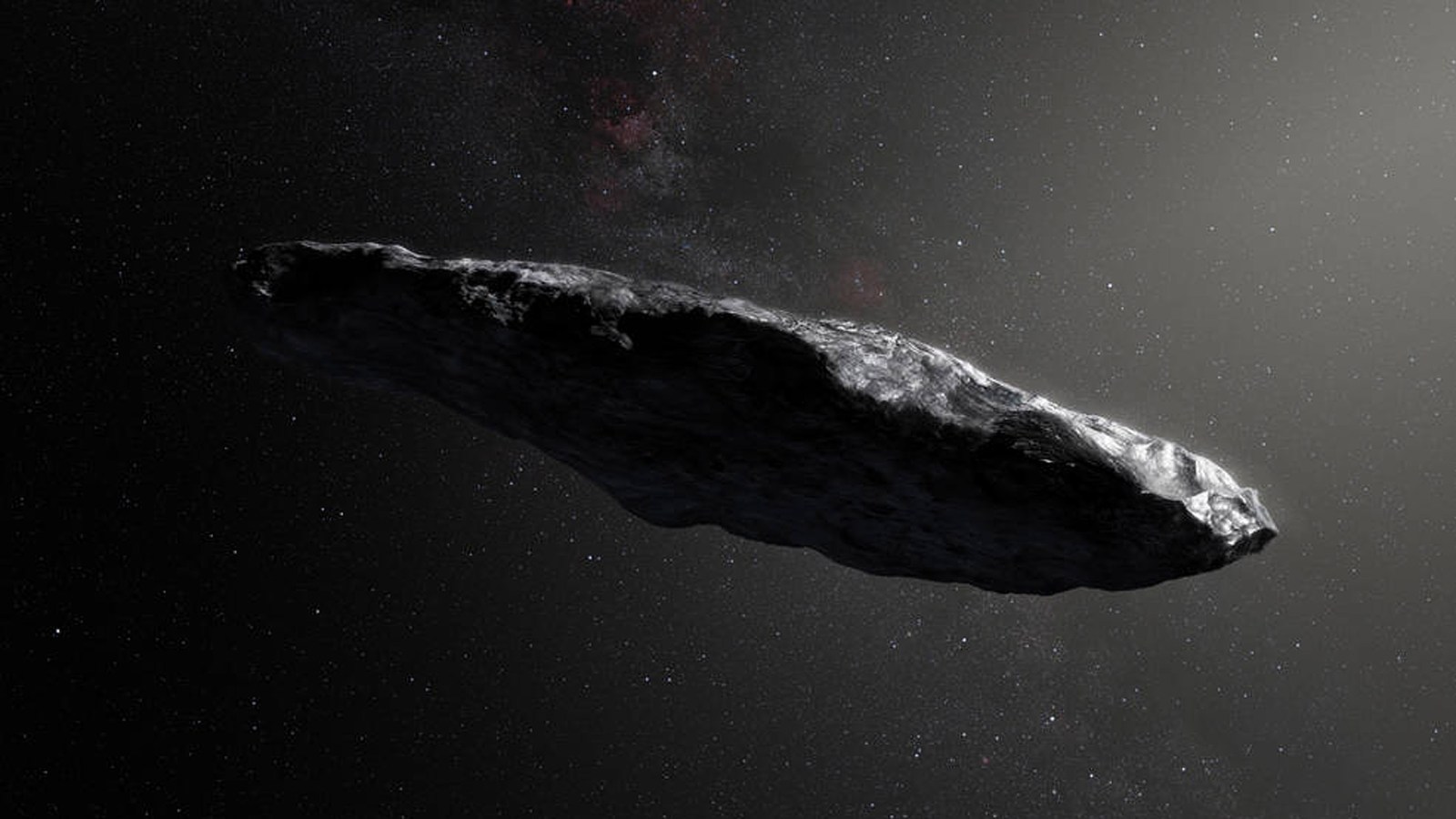
- We do not have a photo of ‘Oumuamua, but its brightness owing to reflected sunlight varied by a factor of 10 as it rotated periodically every eight hours. This implies that ‘Oumuamua has an extreme elongated shape with its length at least five to 10 times larger than its projected width. Moreover, an analysis of its tumbling motion concluded that it would be at the highest excitation state expected from its tumultuous journey, if it has a pancake-like geometry. The inferred shape is more extreme than for all asteroids previously seen in the solar system, which have an length-to-width ratio of at most three.
- The Spitzer Space Telescope did not detect any heat in the form of infrared radiation from ‘Oumuamua. Given the surface temperature dictated by ‘Oumuamua’s trajectory near the sun, this sets an upper limit on its size of hundreds of meters. Based on this size limit, ‘Oumuamua must be unusually shiny, with a reflectance that is at least 10 times higher than exhibited by solar system asteroids.
- The trajectory of ‘Oumuamua deviated from that expected based on the sun’s gravity alone. The deviation is small (a tenth of a percent) but highly statistically significant. Comets exhibit such a behavior when ices on their surface heat up from solar illumination and evaporate, generating thrust through the rocket effect. The extra push for ‘Oumuamua could have originated by cometary outgassing if at least a tenth of its mass evaporated. But such massive evaporation would have naturally led to the appearance of a cometary tail, and none was seen. The Spitzer telescope observations also place tight limits on any carbon-based molecules or dust around ‘Oumuamua and rule out the possibility that normal cometary outgassing is at play (unless it is composed of pure water). Moreover, cometary outgassing would have changed the rotation period of ‘Oumuamua, and no such change was observed. Altogether, ‘Oumuamua does not appear to be a typical comet nor a typical asteroid, even as it represents a population that is far more abundant than expected.
The extra push exhibited by ‘Oumuamua’s orbit could not have originated from a breakup into pieces because such an event would have provided a single, impulsive kick, unlike the continuous push that was observed. If cometary outgassing is ruled out and the inferred excess force is real, only one possibility remains: an extra push due to radiation pressure from the sun. In order for this push to be effective, ‘Oumuamua needs to be less than a millimeter thick but with a size of at least 20 meters (for a perfect reflector), resembling a lightsail of artificial origin. In this case ‘Oumuamua would resemble the solar sail demonstrated by the Japanese mission IKAROS or the lightsail contemplated for the Starshot initiative. An artificial origin offers the startling possibility that we discovered “a message in a bottle” following years of failed searches for radio signals from alien civilizations. Reassuringly, such a lightsail would survive collisions with interstellar atoms and dust as it travels throughout the galaxy.
On October 19, 2017, astronomers at the University of Hawaii spotted a strange object travelling through our solar system, which they later described as “a red and extremely elongated asteroid.” It was the first interstellar object to be detected within our solar system; the scientists named it ‘Oumuamua, the Hawaiian word for a scout or messenger. The following October, Avi Loeb, the chair of Harvard’s astronomy department, co-wrote a paper (with a Harvard postdoctoral fellow, Shmuel Bialy) that examined ‘Oumuamua’s “peculiar acceleration” and suggested that the object “may be a fully operational probe sent intentionally to Earth’s vicinity by an alien civilization.” Loeb has long been interested in the search for extraterrestrial life, and he recently made further headlines by suggesting that we might communicate with the civilization that sent the probe. “If these beings are peaceful, we could learn a lot from them,” he told Der Spiegel.
I recently spoke by phone with Loeb, who was frustrated that scientists saw ‘Oumuamua too late in its journey to photograph the object. “My motivation for writing the paper is to alert the community to pay a lot more attention to the next visitor,” he told me. During our conversation, which has been edited and condensed for clarity, we discussed why Loeb thinks we need to consider the possibility that ‘Oumuamua was sent by aliens, the dangers of unscientific speculation, and what belief in an advanced extraterrestrial civilization has in common with faith in God.
*
“This is how science works,” said Loeb. “We make a conjecture … and if someone else advances another explanation, we will compare notes and the next time we see an object of this type we will hopefully be able to tell the difference. That’s the process by which science makes progress.”
Loeb, also the Frank B. Baird Jr. Professor of Science, collaborated with postdoctoral fellow Shmuel Bialy on a paper suggesting that ‘Oumuamua may be a lightsail created by an alien civilization.
“When I first heard about ‘Oumuamua, this idea was in the back of my mind,” Loeb said. “So I approached Shmuel and said, ‘Let’s see whether sunlight can push this’ … because there was nothing else I could think of which could account for our observations, because this object is weird. So, my approach was to follow the maxim of Sherlock Homes — ‘When you have excluded the impossible, whatever remains, however improbable, must be the truth.’”
An alternative to traditional rocket propulsion, lightsails are propelled by radiation from the sun or from lasers. Calculations by Loeb and Bialy show that for solar radiation to push ‘Oumuamua, it must have an unusual geometry — tens of meters in size, but less than a millimeter thick.
In their paper, published this month in The Astrophysical Journal Letters, Loeb and Bialy advanced two possibilities for the object’s origins — that it is debris from a now-defunct craft tumbling through the galaxy, or that it was launched as a sort of reconnaissance probe from elsewhere in the galaxy.
While he acknowledged that other astronomers — including the researcher who discovered ‘Oumuamua — have dismissed those ideas, Loeb said such debates are an important part of the scientific process. And while alien life may once have been strictly science fiction, Loeb pointed to a growing body of evidence suggesting we’re not alone.
“We know a quarter of all the stars in the galaxy have planets in the habitable zone of their host star … so to me it’s not impossible that there may be life elsewhere,” he said.
First spotted just over a year ago by astronomers in Hawaii, ‘Oumuamua, whose name translates to “messenger from afar arriving first,” immediately captured scientists’ imaginations because it was the first known interstellar object to pass through the solar system. The mystery around the discovery quickly grew.
For starters, Loeb said, its reflection of sunlight suggested that its shape was much more elongated or flattened than any known asteroid or comet, and its motion indicated that it originated from the so-called “local standard of rest” obtained by averaging the random motions of all nearby stars. Fewer than one in 500 local stars moves as slowly in that frame, Loeb said.
What’s more, if ‘Oumuamua originated from a population of similar objects on random trajectories, its discovery would require the production of a thousand trillion such objects per star in the Milky Way — far more than the theoretical calculations Loeb and colleagues performed.
By far the most intriguing observation, Loeb said, suggested that ‘Oumuamua was not just accelerating, but deviating from its expected trajectory.
“The deviations aren’t large, only about one-tenth of a percent, but nevertheless that is significant,” Loeb said. “The question is what is making it deviate. We have seen deviations of this magnitude in comets when they experience outgassing as ice is warmed by the sun, but there is no cometary tail around ‘Oumuamua, and we don’t see its spin changing as we would with outgassing … so it occurred to me that this may be due to radiation pressure from the sun.”
The notion of using a solar sail to move across vast distances isn’t all that unusual, Loeb said.
In 2010, a Japanese spacecraft dubbed IKAROS demonstrated the first successful use of the technology. Loeb is the chair of the advisory board for the Breakthrough Starshot project, which aims to launch a solar-sail-driven probe to the nearest star system.
“It’s possible that, once a civilization reaches a certain maturity technologically, that this is a very common technological solution,” Loeb said. “A rocket is limited to a certain speed … because you are carrying the fuel with you. But if you are using light to push yourself, you’re not limited in the same way.”
Today, ‘Oumuamua is too far away to allow definitive answers on the questions raised by Loeb and other astronomers, and moving too fast to be chased down by probes launched from Earth. Loeb hopes that the next such opportunity will end with more answers.
“My hope is that the next time around, when there is an object like this, people will be intrigued, and … we will do everything we can to figure out what it is,” he continued. “It may well be that it’s a natural object, and if it is, I would argue that it has so many peculiar features that we should understand where it comes from, and we will learn something new from it. But until then, all possibilities should be on the table.”
Harvard researchers see alien potential in mysterious object
***
A Harvard astronomer is standing by his claim that a mysterious interstellar object may have come from aliens.
“For me, the question of whether we are alone is the most fundamental in science,” said Avi Loeb, chair of the Astronomy Department at Harvard University.
He’s made headlines around the world because of his take on the first known interstellar object to visit our solar system.
The faint little light speeding past the sun was discovered in Hawaii in 2017 and named “Oumuamua,” the Hawaiian word meaning “a messenger from afar arriving first.”
According to NASA, the reddish, cigar-shaped object spins on its axis about every seven hours. Oumuamua is also highly elongated and looks unlike any asteroid or comet observed in our solar system.
It’s been classified as an interstellar asteroid, but Loeb suggests it’s artificial.
In a paper published last fall, he and another researcher write Oumuamua may be a light sail from advanced alien equipment, or even a probe sent to Earth intentionally.
Loeb said he followed the logic of Detective Sherlock Holmes.
“If you exclude all other possibilities, whatever remains, however improbable, must be the truth,” he said.
He said it’s not speculation, but science based on Oumuamua’s unusual trajectory and unexplained boost of speed.
“The only force that I could think of is the pressure of light pushing it just like a light sail,” he said.
Loeb said if it’s thin like a pancake, Oumuamua could be a light, or solar, sail, propelled by solar radiation the way wind pushes a boat. The technology is being designed and tested by NASA and other groups, including Breakthrough Starshot, which Loeb is a part of.
“It’s quite possible that another civilization that had much more time for its technological development already matured this technology, and as a result, they’re using it,” he said.
No surprise, the theory has been met with skepticism.
One astrophysicist tweeted that the authors “insult honest scientific inquiry to even suggest it.”
“I do not believe it is a likely scenario,” said Julie Ziffer, who heads the Physics Department at the University of Southern Maine.
Like many, she believes Oumuamua is of natural origin.
“I think it was ejected from some other system and probably is a fragment of some sort of rocky body,” Ziffer said.
Ziffer cited three reasons she doesn’t believe Oumuamua is from aliens. First, there was no radio signal detected. Second, the fact that it’s tumbling instead of under control. And third, Ziffer said, it would have been sent millions of years ago, making perfect navigation to Earth unlikely.
“When you are the head of a department at Harvard, you have more freedom to go out on a limb than other people in the field, and I think it’s important to keep the conversation open as to what any of the possibilities are,” Ziffer said.
Loeb agrees that tenure at a prominent university allows him the freedom to talk topics that are taboo. He’s not only standing by his claims, but sharing them while he has the spotlight.
“Science is not about preserving your image,” he said. “It’s about pursuing the truth.”
The truth about Oumuamua remains a mystery, since it’s left our solar system, never to return.
With technology constantly evolving, Loeb hopes we’ll learn much more the next time we have an interstellar visitor.
“Having this uncertainty is not a fault. It’s actually what makes the scientific process exciting,” he said. “If we knew everything in advance, we would be bored.”
VIDEO
***
A new interview with Dr. Abraham “Avi” Loeb from Harvard and update on the subject of Oumuamua. We detailed point for point his findings that Oumuamua is an extremely strange object, regardless of its origins, and that it may be consistent with a light sail of some type. This is part one of a two part interview with Dr. Loeb.

 ONAFHANKLIK
[…] Mysterious Interstellar Object Oumuamua With Harvard’s Dr. Avi Loeb […]
LikeLike