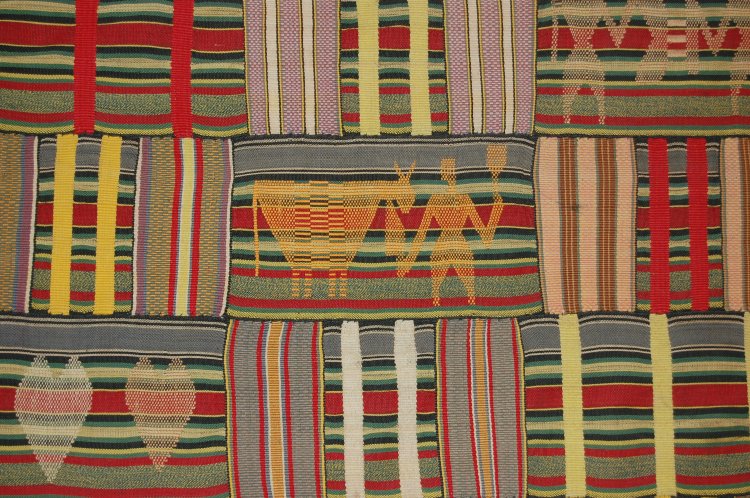
Beautiful and creative – Kente cloth is also worn by the Ewe people, who were under the rule of the Asante kingdom in the late 18th century. It is believed that the Ewe, who had a previous tradition of horizontal loom weaving, adopted the style of kente cloth production from the Asante—with some important differences. Historians maintain that kente cloth grew out of various weaving traditions that existed in West Africa prior to the formation of the Asante Kingdom. These techniques were appropriated through vast trade networks, as were materials such as French and Italian silk, which became increasingly desired in the 18th century and were combined with cotton and wool to make kente.
*
Not so easy – but well done and excellent work – overnight excursion from Kumasi and took a Tro Tro to Bonwire not too far from the city center to visit a Kente Weaving Worksop, producing these traditional fabrics with are so important to the Ashanti History. The patterns and colors have all different meanings
*
Kente is woven on a horizontal strip loom, which produces a narrow band of cloth about four inches wide. Several of these strips are carefully arranged and hand-sewn together to create a cloth of the desired size. Most kente weavers are men. Weaving involves the crossing of a row of parallel threads called the warp (threads running vertically) with another row called the weft (threads running horizontally). A horizontal loom, constructed with wood, consists of a set of two, four or six heddles (loops for holding thread), which are used for separating and guiding the warp threads. These are attached to treadles (foot pedals) with pulleys that have spools of thread inserted in them. The pulleys can be used to move the warp threads apart. As the weaver divides the warp threads, he uses a shuttle (a small wooden device carrying a bobbin, or small spool of thread) to insert the weft threads between them. These various parts of the loom, like the motifs in the cloth, all have symbolic significance and are accorded a great deal of respect.
Patterns each have a name, as does each cloth in its entirety. Names are sometimes given by weavers who obtain them through dreams or during contemplative moments when they are said to be in communion with the spiritual world. Alternatively, chiefs and elders may ascribe names to cloths that they specially commission. Names can be inspired by historical events, proverbs, philosophical concepts, oral literature, moral values, human and animal behavior, individual achievements, or even individuals in pop culture. In the past, when purchasing a cloth, the aesthetic and social appeal of the cloth’s was as important as—or sometimes even more important than—its visual pattern or color.
INTRODUCTION TO KENTE WEAVING IN GHANA
*
Facts and Statistics
Location: Western Africa, bordering the Gulf of Guinea, between Cote d’Ivoire and Togo
Capital: Accra
Climate: tropical along coast, becoming cooler inland at higher elevations; tropical in Amazonian jungle lowlands
Population: 30+ million (2019 est.)
Ethnic Make-up: Akan 45.3%, Mole-Dagbon 15.2%, Ewe 11.7%, Ga-Dangme 7.3%, Guan 4%, Gurma 3.6%, Grusi 2.6%, Mande-Busanga 1%, other tribes 1.4%, other 7.8% (2000 census)
Religions: Christian 68.8% (Pentecostal/Charismatic 24.1%, Protestant 18.6%, Catholic 15.1%, other 11%), Muslim 15.9%, traditional 8.5%, other 0.7%, none 6.1% (2000 census)
Government: constitutional democracy
Language in Ghana
Different sources give different figures for the number of languages of Ghana. This is because of different classifications of varieties as either languages or dialects.
As with many ex-colonies in Africa, the official language of Ghana is the colonial language, English. Nine languages have the status of government-sponsored languages: Akan, Dagaare/Wale, Dagbane, Dangme, Ewe, Ga, Gonja, Kasem, Nzema. However, two dialects of Akan, Twi and Fante, although not government-sponsored, are also widely-spoken in Ghana.
Hausa is widely used as a lingua franca by Muslims in Ghana.
Society and Culture
The People
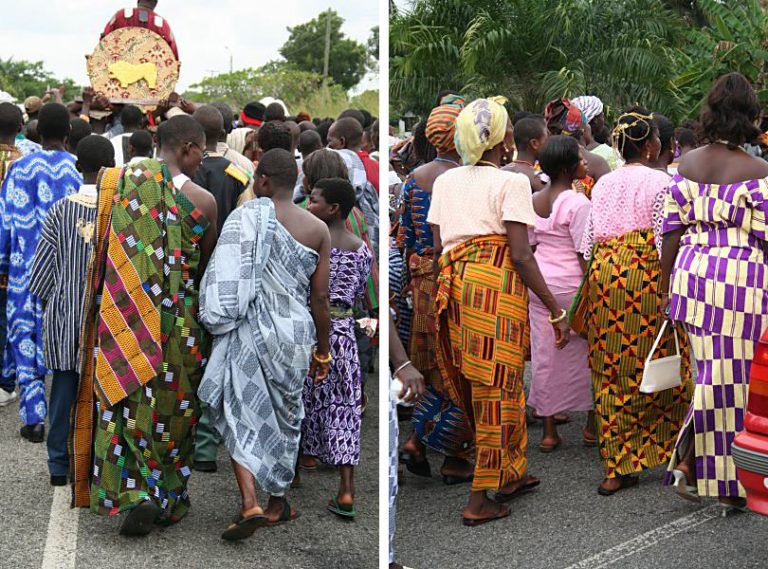
There are over 100 ethnic groups living in Ghana. The largest are Akan, Moshi-Dagbani, Ewe, and Ga. The Ashanti tribe of the Akan are the largest tribe and one of the few societies in West Africa where lineage is traced through the mother and maternal ancestors. Once famous for the luxury and wealth of their rulers, they are now more well known for their craft-work such as hand-carved stools, fertility dolls, and ‘kente’ cloth. Kente cloth is made cotton and is woven in bright, narrow strips with complex patterns.
The Family
Family is a very strong bond in Ghana and is the primary source of identity, loyalty and responsibility. Family obligations take precedence over pretty much everything else in life. Individuals achieve recognition and social standing through their extended family.
An interesting cultural variation among the Akan, or Ashanti and Fanti people, is that affiliation within the clan is through women. Mothers have a higher status as in their point of view people get their blood from mothers.
It is important for Ghanaians to maintain dignity, honour, and a good reputation. The entire family shares any loss of honour, which makes the culture a collective one. In order to protect this sense of face there is a need to maintain a sense of harmony; people will act with decorum at all times to ensure they do not cause anyone embarrassment.
*
Highlights from our Ghana, Togo & Benin Repatriation & Investment Tour Nov 17 – Dec 1, 2017. Brothers and Sisters from the African Diaspora return to their roots to experience the ultimate journey of a lifetime. The journey to the motherland introduces you to a vibrant Africa with a mix of roots, culture, paradise, night life, shopping, networking, business and investment opportunities. Let’s start working more towards empowering and being a part of the growth of Africa.
Hierarchy
Ghanaian society is hierarchical. People are respected because of their age, experience, wealth and/or position. Older people are viewed as wise and are granted respect. In a group one can always see preferential treatment for the eldest member present. With respect comes responsibility and people expect the most senior person to make decisions that are in the best interest of the group.
https://www.commisceo-global.com/resources/country-guides/ghana-guide
** ** ** **

 ONAFHANKLIK
[…] * Ghana – weaving traditions – West Africa […]
LikeLike