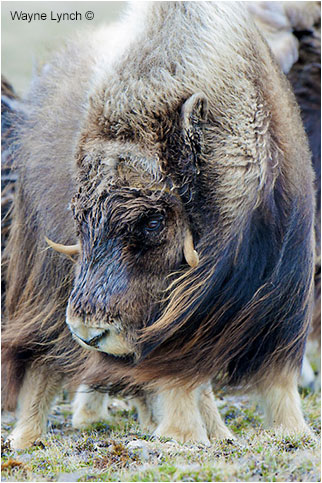
As sommige diere baie dik jasse dra, moet mens weet dit kan baie koud raak in hul omgewing. Hulle vertoon sterk en groot. Die baie lang hare verraai dit ook en is om die groot diere teen die koue te beskerm. Dit vertoon uitstekend en is pragdiere wat net op sekere plekke voorkom. Ons as mens het dit ook nodig om te oorleef en is aanpasbaar. Ons het voorheen ons eie land regeer en kan dit weer doen – waarom weifel ons? Daar is gebiede vir jare uitgewys waar ons in die meerderheid is. A habitat is a place where living things live and how they survive in that area. Animals have basic needs for air, water, food, shelter, and space. Plants, animals, and even humans choose habitats for many different reasons, depending on their needs. The muskoxen, like no other animal, symbolizes the tenacity of arctic life.
foto: Dr Wayne Lynch (Canada) – canadiannaturephotographer.com
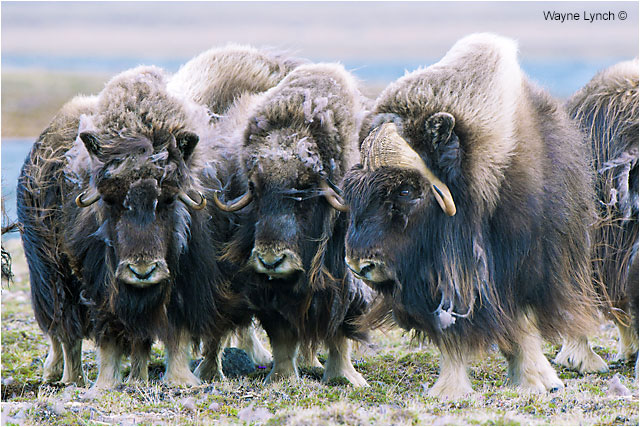
Baie mooi foto’s en beskrywing oor pragdier – lyk nes ‘n oerdier in die ys.
Today roughly 160,000 of these magnificent creatures, about 85 per cent of the total world population, eke out an existence in the northern hinterlands of Canada. For muskoxen, surviving the climatic extremes of the Arctic has always been a challenge. The oldest fossils of the modern day muskox are from Germany and are estimated to be somewhere around a million years old. Muskoxen spread from Asia into North America across the Bering Land Bridge between 250,000 and 150,000 years ago. From the beginning, they inhabited lands with long, cold winters and for that they are admirably adapted
Bio: Dr. Lynch is a popular guest lecturer and an award-winning science writer. His books cover a wide range of subjects, including: the biology and behaviour of owls, penguins and northern bears; arctic, boreal and grassland ecology; and the lives of prairie birds and mountain wildlife. He is a fellow of the internationally recognized Explorers Club – a select group of scientists, eminent explorers and distinguished persons, noteworthy for their contributions to world knowledge and exploration. He is also an elected Fellow of the prestigious Arctic Institute of North America.
https://www.canadiannaturephotographer.com/waynelynch4.html
***
Join me as I collect Muskox qiviut. What is Muskox Qiviut? Why, watch video and be amazed.
***
ZOO IN GERMANY
Musk ox calf rubbing its side on a stone at the Zoo Berlin, the oldest zoo in Germany.
***
In een geval toon die video hoe Ma en Baba Bison wat probeer om oor die vol rivier te swem, wat vir die ma dalk nie moeilik is nie, maar ‘n pasgebore baba het nie daardie krag nie. Tydens die sterk stroom word hul paaie egter geskei. Baba word meegesleur wat nie kon nie swem teen die sterk stroom nie, helaas was die ma seker ook maar teleurgesteld in die moeder instinkte wat nie mooi saamgewerk het nie. Baba het saam die stroom geswem en is later uitgewas op ‘n eensame eilandjie. Moeg, uitgeput en honger op die eiland, vol klippe, moes die baba die volgende dag ‘n honger wolf trotseer. Eende maak erg lawaai en toe kom die redding. Ongelooflik.
In nog ‘n ander video slaap die Bisons en die honger coyote treiter die jonges wat ook geslaap het. Waarskynik gedink hulle is dood. In ander video is dit weer die “Musk oxen”, pragtige diere en foto’s.
***
Die honger wolf en redding vir Baba Bison
***
The musk ox has a characteristic defiance behavior, in which the herd bunch together, often forming an impenetrable line or circle, with the calves inside and the adults’ sharp horns facing outwards

 ONAFHANKLIK
Extrait du documentaire : DES GRIZZLYS ET DES LOUPS. A priori inoffensifs pour les bisons, les coyotes savent toutefois entraîner les petits dans un jeu des plus dangereux. DES GRIZZLYS ET DES LOUPS est un documentaire diffusé sur la chaîne Nat Geo Wild. Plus d’informations, de photos et de vidéos sur natgeotv.com